Concrete Strength Degradation Factors Identified
3 Out of 17 Residential Buildings Rated 'Safety Evaluation D Grade'
It has been confirmed that uncertified recycled aggregate was used as raw material for ready-mixed concrete in the apartments of Geomdan New Town, Incheon, where a parking lot collapse accident occurred last April, resulting in three out of 17 residential buildings receiving a ‘Safety Evaluation Grade D’.
Recycled aggregate is produced by crushing and processing waste concrete to extract the aggregate contained within, which is then reused as construction aggregate. Due to its lower concrete strength, it is mainly used as subbase material in road construction.
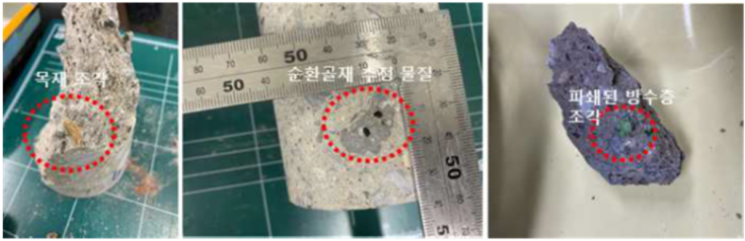 Suspicion of unauthorized recycled aggregate use found during concrete test specimen inspection at Geomdan apartments.
 [Photo by Heo Jong-sik, Office of the Democratic Party of Korea]
According to the ‘Incheon Geomdan AA13-1BL, 2BL Detailed Safety Inspection Report’ submitted by the Korea Land and Housing Corporation (LH) to Heo Jong-sik (Incheon Dong-gu Michuhol-gap), a member of the National Assembly Land, Infrastructure and Transport Committee from the Democratic Party of Korea, analysis of the surface of the ‘concrete specimen’ used to evaluate concrete compressive strength revealed that recycled aggregate and some weathered rock were used in the aggregate raw materials for the ready-mixed concrete.
A concrete specimen is a sample made from the same materials used at the time of pouring concrete for compressive strength testing. It serves as a crucial clue in determining the cause of construction site accidents, similar to a car’s ‘black box’.
In the coarse aggregate used as raw material for the ready-mixed concrete, many particles of blasted rock with poor particle shape were used, and fine aggregate included wood fragments, waterproofing layer pieces, and red brick particles. Holes and gaps with diameters of 20mm or more were visible to the naked eye in the concrete.
The detailed safety inspection report for the apartment indicated variations in the compressive strength of concrete in the interior walls, exterior walls, and slabs, with poor concrete compaction and the use of recycled aggregate identified as factors.
It is estimated that recycled aggregate was concentrated in the residential buildings of Block 1. According to the structural stability evaluation results, three buildings?101, 102, and 103?out of seven residential buildings in Block 1 received a Grade D rating.
Since the Act on the Promotion of Recycling of Construction Waste specifies the construction uses where recycled aggregate can be used, the use of uncertified recycled aggregate in the LH Geomdan apartments is expected to escalate into a legal violation controversy.
Assemblyman Heo Jong-sik stated, “Until now, the LH Geomdan apartments have only been focused on the ‘instant demolition apartment’ controversy due to missing rebar, but this concrete specimen analysis officially confirmed that substandard aggregate was used. GS Construction, LH, and the supervising engineers must take joint responsibility for aggregate management, supply, and all government-supplied materials.”
© The Asia Business Daily(www.asiae.co.kr). All rights reserved.

















