Price of Fresh Cream Rises Following White Milk and Processed Milk
Global Sugar Prices Hit Record High Due to Adverse Weather
Increased Burden on Confectionery, Bakery, and Coffee Industries
As the long holidays such as Chuseok and Hangeul Day come to an end, price increases related to food and beverages are intensifying. With the rise in raw milk prices, the prices of dairy products including white milk are soaring one after another, and the global sugarcane harvest decline is making a sharp increase in sugar prices inevitable. This has greatly increased the likelihood of 'Milkflation (milk + inflation)' and 'Sugarflation (sugar + inflation)' occurring simultaneously, where prices of related products such as confectionery, bakery, ice cream, and coffee, which use these raw materials, also rise accordingly.
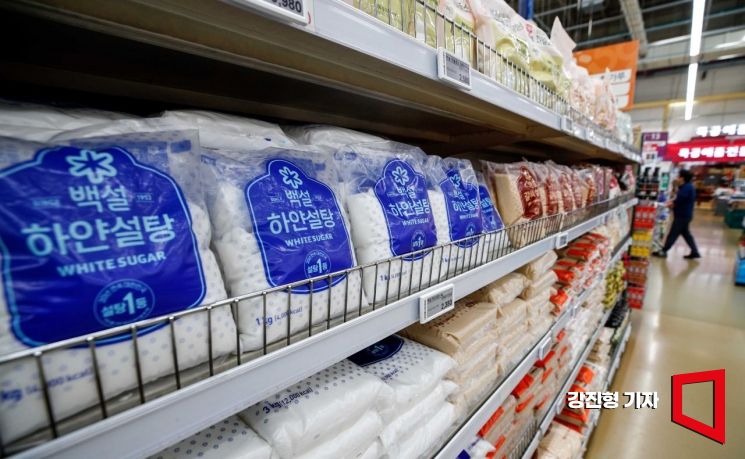 Last month, the price inflation rates of sugar and salt simultaneously reached their highest levels in a year, and on the 11th, sugar was displayed at Yangjae Hanaro Mart in Seoul. Photo by Jinhyung Kang aymsdream@
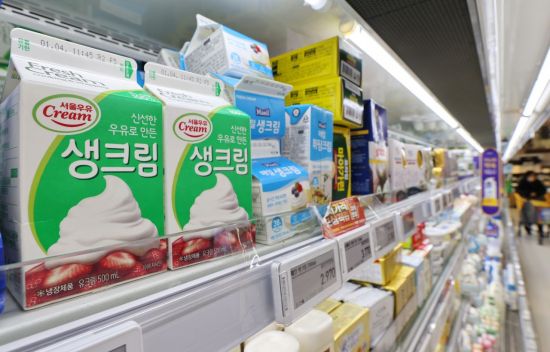
According to the industry on the 11th, Maeil Dairies has decided to raise the shipment prices of fresh cream products by 5 to 9% this month. This decision follows a sequential price increase of about 4 to 9% for white milk, processed milk, fermented milk, and cheese across distribution channels starting from the 1st of this month. Since the 6th, large supermarkets and discount stores have adjusted fresh cream prices, and the increased prices will also be applied to business-to-business (B2B) transactions.
Other companies such as Seoul Milk Cooperative and Namyang Dairy Products, which have already raised prices for white milk and dairy products, are also considering increasing fresh cream prices. Fresh cream is widely used in B2B sectors that produce cakes, bread, coffee, and snacks, so the rise in raw material costs for confectionery, bakery, and coffee-related industries is likely to be reflected in the prices sold to consumers. An industry insider said, "Not only raw materials but also labor costs, energy fees, and logistics costs have generally increased, making it difficult to bear a chain of cost increases."
The continuously rising global sugar prices are also a burden for these industries. According to the United Nations Food and Agriculture Organization (FAO), the global sugar price index last month was 162.7, up 9.8% from the previous month. The price index is based on the average price from 2014 to 2016 set at 100 for comparison. The global sugar price index recorded 157.2 in May this year and showed a downward trend until July, but rose consecutively in August and September, reaching the highest level in about 13 years since November 2010. This is due to drought caused by El Ni?o, which reduced sugarcane production in major sugar-producing countries such as Thailand and India. The FAO forecasts that the upward trend in sugar prices will continue for the next 9 to 12 months.
An industry official explained, "Sugar prices are set based on the price of raw sugarcane traded on the international market," adding, "For B2B, international prices are usually reflected domestically with a lag of 3 to 4 months." Considering this, sugarflation, where prices of snacks, bread, beverages, and other products using sugar as a raw material are sequentially raised, is expected soon. Additionally, starting today, OB Beer has raised the factory shipment prices of major beer products such as Cass and Hanmac by 6.9%, excluding the Cass 500ml can product, marking the beginning of price increases in the alcoholic beverage industry.
As food and beverage prices continue to rise, demand for cost-effective (price-performance) products is increasing. At some convenience stores, sales of private brand (PB) white milk products increased by about 40% compared to the same period last month from the 1st to the 9th of this month. Convenience store PB white milk products are priced in the mid-2,000 KRW range for 900ml to 1L, about 20% cheaper than name brand (NB) products priced around 3,000 KRW. Furthermore, according to customs export-import trade statistics, imported sterilized milk, known as UHT milk, totaled 25,389 tons from January to August this year, a 16.2% increase compared to 21,850 tons during the same period last year. In terms of import value, it was 21.135 million USD, up 32.6% from 15.9437 million USD in the previous year. The price of sterilized milk is about half that of domestically produced milk.
© The Asia Business Daily(www.asiae.co.kr). All rights reserved.


















