All High School Grades Use 5-Level GPA System
Absolute and Relative Scores Both Recorded
Stricter Qualification Criteria for CSAT Question Committee Members
The government will abolish the existing elective subjects and introduce an integrated subject system starting from the 2028 College Scholastic Ability Test (CSAT). The aim is to standardize evaluation criteria among students to eliminate unfairness. Along with this, the current high school grading system of 9 levels will be reorganized into 5 levels starting from 2025.
On the afternoon of the 10th, Deputy Prime Minister and Minister of Education Lee Ju-ho announced the "2028 College Entrance Examination System Reform Draft" at the Government Seoul Office. This targets the 2028 CSAT, which will be taken by current middle school second-year students. The Ministry of Education reported this plan to the National Education Commission and requested feedback on the same day.
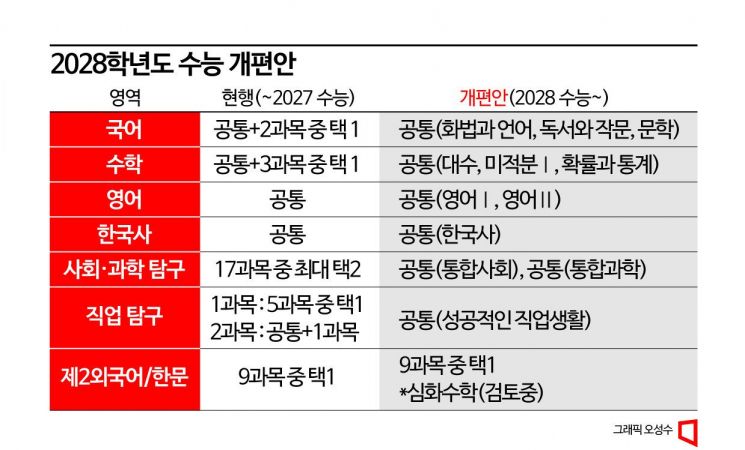
The biggest change is the reorganization of subjects currently evaluated as electives?such as Korean, Mathematics, Social Studies/Science, Vocational Education, and Second Foreign Language/Chinese Characters?into common subjects. According to the reform plan, these will be integrated into Common Korean (Speech and Language, Reading and Writing, Literature), Common Mathematics (Algebra, Calculus I, Probability and Statistics), Integrated Social Studies, Integrated Science, and Successful Vocational Life. Among these, for Mathematics, "Calculus II + Geometry" will be excluded from the common subjects, and the introduction of an "Advanced Mathematics" elective is under consideration.
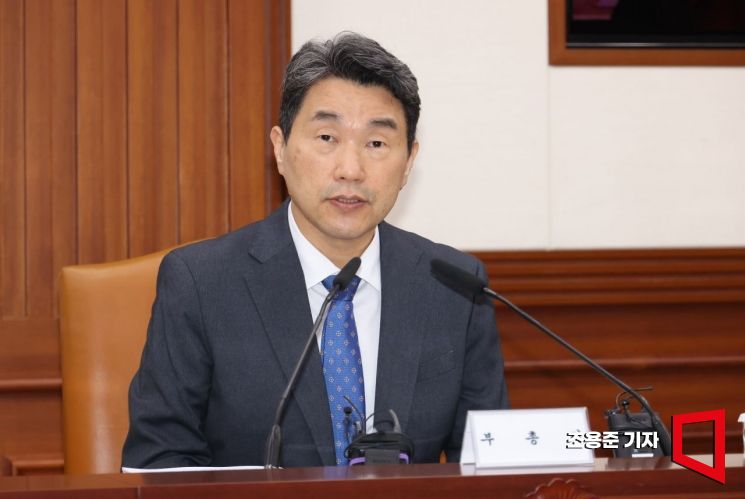 Lee Ju-ho, Deputy Prime Minister for Social Affairs and Minister of Education, is delivering opening remarks at the Social Relations Ministers' Meeting held on the 26th at the Government Seoul Office in Jongno-gu, Seoul. Photo by Jo Yong-jun jun21@
The Ministry of Education explained that under the previous elective subject system, rather than choosing various subjects suited to their aptitudes, students tended to concentrate on specific subjects advantageous for securing standard scores in the CSAT. Especially since the high school credit system to be applied from 2025 is based on subject segmentation and integration, the reform plan reflects the intention to align with this system. The Ministry stated, "We will evaluate all students based on the same content and criteria to assign scores fairly and simply," adding, "Questions will be based mainly on subjects generally offered in the curriculum and covering major content areas by field, maintaining the same learning volume as the current CSAT."
The Ministry of Education will also reform the grading system alongside the high school credit system starting in 2025. The current 9-level system will be changed to a 5-level system to ease competition. The Ministry added that major countries worldwide, including the United States, Japan, France, Australia, and Hong Kong, mostly implement a 5-level grading system such as 'A to E.'
However, to prevent confusion in evaluation methods by grade, absolute evaluation (A to E) will be applied to all grades 1, 2, and 3, while relative evaluation (levels 1 to 5) will be concurrently recorded. The Ministry explained, "This is to alleviate the excessive competition concerns among parents and students," and "the 5-level relative evaluation recorded alongside absolute evaluation serves as a supplementary measure to help absolute evaluation settle in the field." On the other hand, the CSAT will maintain the existing 9-level system to ensure institutional stability.
Additionally, to eradicate interest cartels, standards will be strengthened throughout all stages of CSAT question management. First, qualification criteria for CSAT question writers and reviewers will be tightened to exclude those engaged in profit-driven private education activities. Also, committee members will be randomly selected to prevent school ties, regionalism, and personal connections, and their tax information will be verified. After question setting, profit-driven private education activities based on CSAT and mock exam participation records for five years will be prohibited.
To facilitate field application, plans to strengthen teachers' evaluation capabilities were also presented. This includes revising guidelines to reinforce essay and descriptive evaluations and establishing a basis for this. Furthermore, training to enhance evaluation skills will be conducted for teachers through about 3,000 core and leading teachers.
© The Asia Business Daily(www.asiae.co.kr). All rights reserved.
![User Who Sold Erroneously Deposited Bitcoins to Repay Debt and Fund Entertainment... What Did the Supreme Court Decide in 2021? [Legal Issue Check]](https://cwcontent.asiae.co.kr/asiaresize/183/2026020910431234020_1770601391.png)

















