Israel-Hamas Conflict Escalates
WTI Rises Over 4% in One Day
'Oil Producer' Iran Suspected Behind Hamas
US Warns Oil Supply Cut if Iran Sanctioned
Concerns Over Oil Price Surpassing $100
The market has been hit by fears of a Middle East-originated oil shock following the armed conflict between Israel and the Palestinian militant group Hamas. Last week, the price of West Texas Intermediate (WTI) crude oil fell by more than 7%, but it surged over 4% in just one day, raising the possibility of a return to the '100 dollars per barrel' era that emerged right after last year's Ukraine war. Israel, which compared this incident to the 'Holocaust' during World War II and warned of terrible retaliation, may attack Iran, which is mentioned as the mastermind behind the attack, or if the United States sanctions Iran, concerns are spreading that the uncertainty of international oil prices will increase further.
International oil prices surge over 4% in one day... Middle East tensions escalate
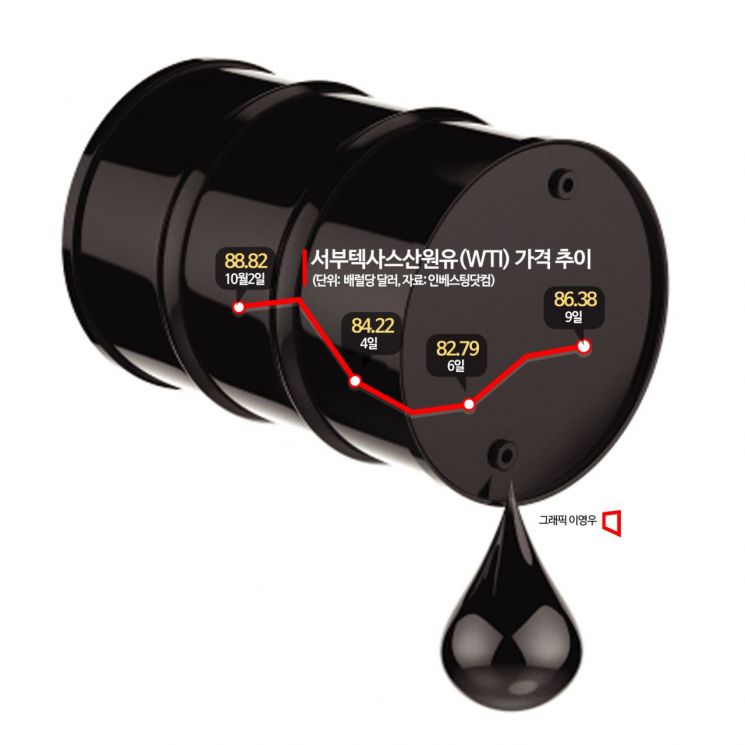
On the 9th (local time), the November delivery WTI price at the New York Mercantile Exchange rose 4.34% from the previous trading day to close at $86.38 per barrel. This is the highest closing price since the 3rd. The December Brent crude price also rose more than 4% that day, closing at $88.15 per barrel.
Neither Israel nor Palestine, the parties involved in the armed conflict, are oil producers. However, oil prices soared as Iran, a major oil-producing country, was reported to have supported Hamas's attack from behind the scenes. Concerns that Israel might directly attack the mastermind or that the United States might intervene, potentially turning the conflict into a proxy war between the U.S. and Iran, pressured oil prices. Earlier, The Wall Street Journal (WSJ) reported that Iran approved Hamas's operation to attack Israel.
Robbie Fraser, Global Research and Analysis Manager at Schneider Electric, said, "Oil production in Israel and the Gaza Strip, the Hamas stronghold, is zero," but analyzed, "Geopolitical risks are increasing, and oil prices are rising amid reports that Iran may have played a decisive role in this attack." Vivek Dhar, Energy Commodities Analyst at Commonwealth Bank, predicted, "If Western countries link Iranian intelligence agencies to Hamas's attack, Iran's oil exports will face risks."
On the third day of the war, uncertainty surrounding oil prices is growing as tensions in the Middle East intensify. Israel has promised strong retaliation, and Hamas has responded with threats to execute civilian hostages.
Israeli President Yitzhak Herzog condemned Hamas, saying, "There has never been a day since the Holocaust (the Nazi German genocide of Jews) when so many Jews were killed." Israeli Prime Minister Benjamin Netanyahu warned Hamas of "a difficult and terrible experience" and promised bloody retaliation. He declared, "We will change the Middle East," and warned, "This is just the beginning." The United States is also accelerating support for Israel by deploying aircraft carriers and warships to the eastern Mediterranean.
In response, Hamas threatened to execute Israeli civilian hostages as retaliation if Israel continues bombing civilian homes in the Gaza Strip while sustaining attacks on Israel. The death toll on both sides in Israel and Gaza exceeded at least 1,487, and the number of injured surpassed 6,326 on the third day of the war.
Oil prices near $100 per barrel... Three key variables
The direction of oil prices is expected to vary depending on how the war between Israel and Hamas unfolds. The main variables influencing future oil price movements include the possibility of escalation in the Middle East, such as Israel's direct attack on Iran, and whether the United States imposes sanctions on Iran. These are scenarios where market concerns could become reality.
Ed Mord, a Citigroup analyst, wrote in an investor memo, "The risk of Israel attacking Iran is increasing," and predicted, "Hamas's attack could push oil prices higher." Morgan Stanley said, "Neither Israel nor neighboring countries are major oil producers, so short-term risks to oil supply are limited, but the situation could change if the conflict spreads to other countries." Soci?t? G?n?rale forecasted that geopolitical tensions could cause oil prices to rise by up to $10 per barrel.
If the allegations of Iran's involvement are confirmed, the United States may strengthen oil sanctions against Iran, causing a supply shock in the market. Javier Blas, an energy and commodities columnist at Bloomberg News, said, "Even if Israel does not respond immediately to Iran, if the U.S. imposes stricter sanctions, it is highly likely to affect Iran's oil production," and predicted, "Oil prices could rise to $100 per barrel or potentially even higher."
Recently, Iran's oil production has exceeded 3 million barrels per day. During the Trump administration in 2020, daily oil sales plummeted to 400,000 barrels due to U.S. sanctions, but under the Biden administration's more conciliatory stance toward Iran, oil exports have increased.
Another factor that could affect future oil price movements is the possible delay in the normalization of relations between Saudi Arabia and Israel, which has been mentioned as one of the backgrounds for Hamas's attack on Israel. Citigroup said, "The possibility of a delay in the restoration of relations between Israel and Saudi Arabia is high," and added, "This reduces the likelihood that Saudi Arabia will end its voluntary production cut of 1 million barrels per day."
In this situation, Saudi Crown Prince Mohammed bin Salman declared that Saudi Arabia would side with Palestine, warning against further escalation such as an Israeli military invasion of the Gaza Strip. According to Saudi local media Al Arabiya, on the same day, Crown Prince bin Salman said in a phone call with Palestinian Authority President Mahmoud Abbas, "We will stand with Palestine and work to stop the conflict."

The market is increasing caution by observing past cases of sharp oil price hikes during Middle East wars. According to Chinese financial company Zhongxin Futures, oil prices soared 240% during the Gulf War in 1990. During the Iraq War in 2003 and the Libyan anti-government protests in 2011, oil prices rose by 45% and 40%, respectively.
However, some analyses suggest that the likelihood of a repeat of an oil shock like in the past is low, as Middle Eastern countries are calling for restraint in escalation or taking neutral stances. Egypt and T?rkiye have offered to mediate between both sides or urged restraint in escalation. Iran, accused of being behind Hamas's attack, criticized Israel, calling it "Palestine's legitimate self-defense."
© The Asia Business Daily(www.asiae.co.kr). All rights reserved.



















