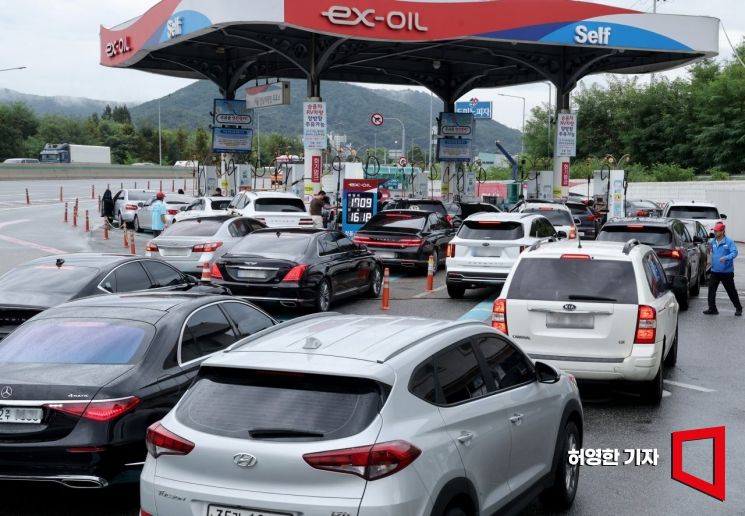
 Many customer vehicles are lined up at the Seoul Mannam Plaza gas station. Photo by Huh Younghan younghan@
International oil prices are rising again due to the Israel-Palestine war. Domestic fuel price burdens are also expected to increase. Before the war broke out, domestic gasoline and diesel prices had already risen for 13 consecutive weeks.
With the outbreak of the Israel-Palestine war, geopolitical tensions in the Middle East have escalated, causing international oil prices to surge more than 4%. On the 9th (local time), the November delivery West Texas Intermediate (WTI) crude oil price on the New York Mercantile Exchange closed at $86.38 per barrel, up $3.60 (4.3%) from the previous trading day.
The Palestinian armed faction Hamas launched a surprise attack on Israel on the Jewish Sabbath on the 7th, and Israel retaliated with airstrikes. This has heightened geopolitical tensions in the Middle East, where oil-producing countries are located. Some foreign media have reported that Iran is supporting Hamas's attack. There is also a possibility that this situation could escalate into a proxy war between the United States and Iran. The possibility of a continued rise in international oil prices cannot be ruled out.
Domestic gasoline and diesel prices at gas stations have continued to rise for 13 consecutive weeks. This is because oil-exporting countries collectively reduced crude oil supply due to a slowdown in global demand. International oil prices, which had stalled earlier this month, have turned upward again due to the war, and domestic fuel prices are expected to show fluctuations with a lag of about two weeks.
According to the Korea National Oil Corporation's oil price information service (OPINET), the average gasoline retail price nationwide in the first week of this month (2nd to 5th) was 1,796.0 KRW per liter, up 6.3 KRW from the previous week. In Seoul, where fuel prices are the highest domestically, the average gasoline price this week was 1,876.8 KRW per liter, rising 4.0 KRW during the same period, while Daegu, the lowest-priced region, also saw a 4.0 KRW increase to 1,761.2 KRW. Diesel prices rose 7.4 KRW per liter from the previous week to 1,700.2 KRW, surpassing the 1,700 KRW mark.
The government has begun checking the domestic oil and gas supply status and the impact of domestic and international oil prices due to the war. The Ministry of Trade, Industry and Energy held an emergency situation assessment meeting the day before. The government currently judges that there will be no disruption to domestic crude oil and liquefied natural gas (LNG) imports, as the conflict area is distant from the Strait of Hormuz, a major route for crude oil and gas imports to Korea.
The government stated, "Although the range of international oil price fluctuations has widened due to this situation, considering that it is still the early stage of the incident, movements in the international financial markets are expected to be limited. However, given the very high uncertainty regarding future developments, there is a risk of increased volatility in global financial markets, so we will remain vigilant and monitor the financial and foreign exchange markets in real time."
© The Asia Business Daily(www.asiae.co.kr). All rights reserved.

















