Claudia Goldin, a professor at Harvard University in the United States and the recipient of this year's Nobel Prize in Economics, is recognized as a figure who broke the 'glass ceiling' in the field of economics while researching gender gaps in the labor market from a historical perspective. She is a leading labor economist who has collected over 200 years of data from the United States and analyzed and identified how and why inequalities faced by women in the labor market have changed over time.
 Claudia Goldin, a professor at Harvard University in the United States and the 2023 Nobel Prize in Economics laureate, received a congratulatory call at her home in Cambridge, Massachusetts, on the 9th (local time).
 [Image source=Reuters Yonhap News]
On the 9th (local time), the Nobel Committee of the Royal Swedish Academy of Sciences announced the 2023 Nobel Prize in Economics, stating, "Professor Goldin has provided the first comprehensive explanation of women's income and labor market participation over centuries," and "We award her in recognition of her contribution to advancing our understanding of women's labor market outcomes."
Goldin, an economic historian and labor economist, drew attention to the discrimination issues faced by female workers, which had been largely overlooked in previous studies, through her 1990s book "Understanding the Gender Gap." She also gained recognition as a leading economist specializing in female labor economics by investigating the impact of oral contraceptives on women's economic activities and marriage, as well as the reasons why women's college enrollment rates have surpassed those of men.
In the past, the wage gap between women and men was attributed to differences in education levels, but now in most high-income countries, women's education levels are significantly higher than men's. Instead, Goldin's research also revealed that wage gaps arise at the birth of the first child and that women's participation in childcare is generally much higher. Even if men and women start on an equal footing, a significant wage gap emerges about ten years later due to childbirth and childcare processes.
In South Korea as well, Goldin is well known for her book published a few years ago, "Career and Family: The Long Journey Toward Equality for Women." In this book, she tracked the gender income gap among American college-educated women over five generations spanning more than 100 years and concluded that two-thirds of the income gap occurs within the same occupation rather than between different occupations, with childbirth being the main factor.
Furthermore, in another joint research paper, Goldin identified that one reason for the sharp increase in the number of female members in American symphony orchestras in the 1980s was the introduction of blind auditions that concealed gender and race. In a 2014 speech at the American Economic Association, she argued that allowing employers more flexibility in employees' working hours could reduce the gender wage gap. Most recently, she gained attention with her paper "Why Women Won," which documented the process through which women in various sectors of American society gained equal rights with men.
Jakob Svensson, chair of the Nobel Prize in Economics selection committee, stated, "Understanding women's roles in labor is important for society," and praised, "Thanks to Goldin's groundbreaking research, we have learned more about the fundamental causes of (gender gaps) and the barriers that need to be addressed going forward." The Nobel Committee also pointed out that women are still underrepresented in the global labor market.
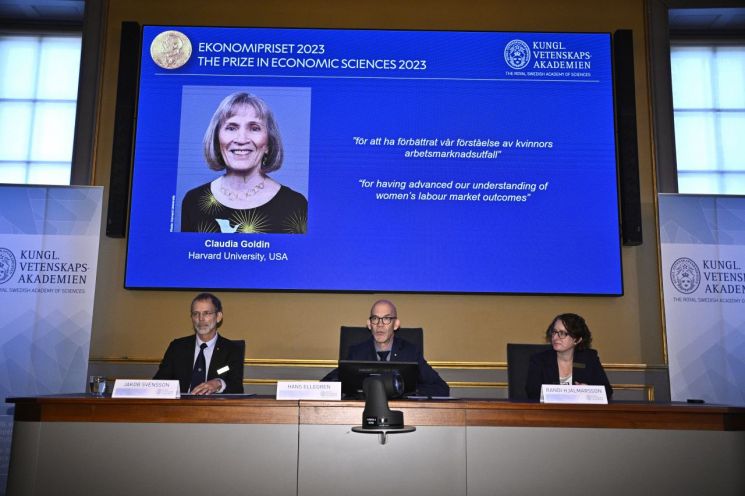
Born in New York in 1946, Professor Goldin majored in microbiology at Cornell University and earned her master's and doctoral degrees in economics from the University of Chicago. She became the first female tenured professor in Harvard University's economics department in 1990 and served as president of the American Economic Association in 2013. She was the third woman to hold this position after Alice Rivlin (1986) and Anne Krueger (1996). This background contributes to her reputation as a figure who has broken the glass ceiling in economics.
With Goldin receiving the award this year, the total number of female Nobel Prize in Economics laureates has increased to three. The Nobel Prize in Economics has been awarded 55 times from 1969 to this year, with a total of 93 laureates. The first female laureate was Elinor Ostrom, a professor at Indiana University, in 2009, and the second was Esther Duflo, the youngest laureate in history and recipient in 2019, a professor at MIT.
Local media have recently focused on the fact that a female economist was selected as the sole recipient of the Nobel Prize in Economics, which has often been awarded to men or jointly. Bloomberg News evaluated, "Professor Goldin combined economic history and economic approaches to show that the demand and supply for female labor were influenced by education and childcare-related decisions, technological innovations such as contraceptives, and changes in economic structures." The New York Times (NYT) reported, "Professor Goldin has long been a pioneer in this field." It was reported that Goldin received the news of her Nobel Prize in Economics while she was asleep. She shared her thoughts with major foreign media, saying, "I was happy," and "It is a very important award for those who want to understand why such significant changes are happening in this field, but there is still a large gap (in wages between men and women)."
The official name of the Nobel Prize in Economics is the "Sveriges Riksbank Prize in Economic Sciences in Memory of Alfred Nobel." Unlike the other five Nobel Prize categories established by Alfred Nobel's will, it was established based on funds donated by the Swedish Central Bank to the Nobel Foundation in 1968 to commemorate its 300th anniversary. With the announcement of this year's Economics Prize winner, the 2023 Nobel Prize winners have been finalized, starting with the Physiology or Medicine Prize on the 2nd, followed by the Physics Prize on the 3rd, the Chemistry Prize on the 4th, the Literature Prize on the 5th, and the Peace Prize on the 6th. A total of 11 Nobel laureates were awarded this year, of whom 7 (64%) are men. The average age of the laureates is 67.3 years. The award ceremony will be held during the "Nobel Week," which includes Nobel's death anniversary on December 10, in Stockholm, Sweden (for Physiology or Medicine, Physics, Chemistry, Literature, and Economics) and Oslo, Norway (for Peace).
© The Asia Business Daily(www.asiae.co.kr). All rights reserved.


















