Tsunami Advisory for Pacific Coast Including Honshu
Japan Meteorological Agency "Cause Unknown So Far"
The Japan Meteorological Agency issued a tsunami advisory for the Pacific coastal areas, including Honshu's Izu Islands, following an earthquake that occurred in the Pacific Ocean on the morning of the 9th. Although the tsunami advisory was lifted around noon the same day, there are still puzzled reactions as the cause of the tsunami has not been identified.
At around 5:25 a.m. that day, the Meteorological Agency reported an earthquake near Torishima, south of the Izu Islands, and issued consecutive tsunami advisories, predicting tsunamis up to 1 meter high along the coasts of the Izu Islands, Ogasawara Islands, Kochi Prefecture in Shikoku, Chiba Prefecture in the metropolitan area, and Miyazaki and Kagoshima Prefectures in Kyushu. At the time of issuing the advisory, the agency warned, "People in areas under the tsunami advisory should avoid approaching the sea and rivers."
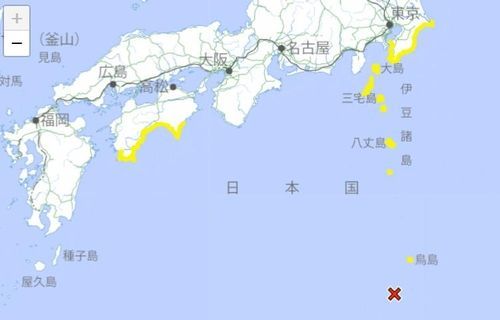 Tsunami advisory issued on the morning of the 9th for the Pacific coastal region of Japan
[Image source=Captured from Japan Meteorological Agency, Yonhap News]
The Meteorological Agency fully lifted the tsunami advisory around noon that day. Actual tsunami heights were observed to be about 10 to 60 cm, and no significant tsunami-related damage was confirmed.
Although a widespread tsunami advisory was issued along Japan's Pacific coast, the exact cause remains unclear. The Meteorological Agency only stated that the earthquake originated from an extremely shallow area near Torishima. However, no shaking of intensity 1 or higher was observed during this earthquake, and the agency could not even confirm the earthquake's magnitude. Typically, tsunamis occur when an earthquake of magnitude 6.5 or higher happens at a shallow depth underground. Therefore, experts find it difficult to explain the occurrence of tsunamis along a wide coastline from such a minor earthquake.
In an emergency press conference in the morning, the Meteorological Agency said, "It is still unknown whether the cause is volcanic eruption or seabed crustal movement." Professor Kenji Satake of the Earthquake Research Institute at the University of Tokyo told local broadcaster NHK, "This time, the earthquake magnitude is unknown, and it is somewhat unusual that a tsunami advisory was issued after actually observing a tsunami," adding, "There is a possibility that significant crustal movement or slipping occurred due to the movement of underground magma."
Earlier, on the 5th, a magnitude 6.6 earthquake occurred in the sea near Torishima, a location similar to where the tsunami advisory was issued this time, prompting a tsunami advisory for the Izu Islands area.
© The Asia Business Daily(www.asiae.co.kr). All rights reserved.

















