Korean Air Submits Remedies to EU for Asiana Acquisition
"Slot Transfer and Cargo Business Sale" Discussed
Government Pushes to Strengthen Aviation Industry Competitiveness
Korean Air plans to submit a corrective action plan to the European Union (EU) Commission this month to ease competition restrictions related to the Asiana Airlines merger. Approval from 14 mandatory reporting countries is required for the acquisition, but the EU, the United States, and Japan have yet to grant approval. Since the EU has historically applied stringent standards during corporate mergers, this decision is considered the 'final hurdle' in the acquisition process.
Previously, the EU Commission had planned to make a decision in early August but has postponed it. Industry insiders believe Korean Air may transfer some airport slots (takeoff and landing frequencies) to other airlines and include plans to sell Asiana Airlines' cargo division after the acquisition. Europe is concerned about a cargo business monopoly resulting from the Korean Air-Asiana merger, and these measures are intended to alleviate such concerns.
Various discussions have arisen around this acquisition because it is the first merger between major domestic full-service carriers (FSCs), and even after about three years since the official procedures began, no clear conclusion has been reached. If Korean Air submits the corrective plan this month, the industry expects the EU to review it over one or two months and announce results by the end of this year or early next year. If the EU hurdle is cleared, discussions in other countries are expected to progress, potentially completing the merger process by the first half of next year. Below is an examination of the key issues by topic.
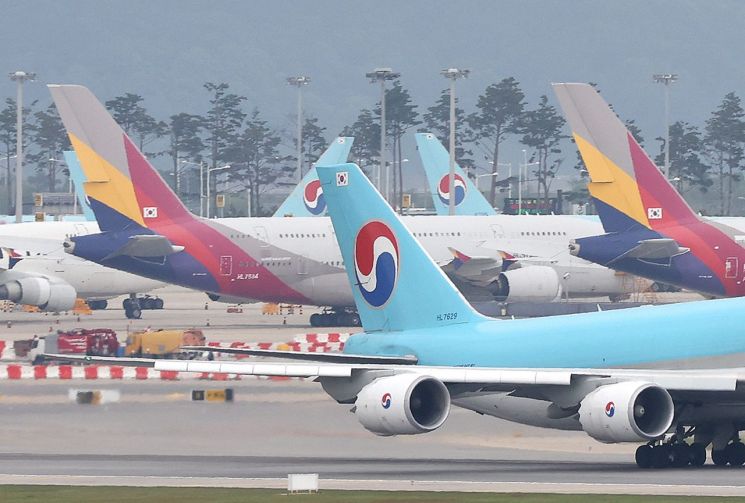
Unprecedented Big Deal: Why Was It Pursued?
The party that initially stepped forward to buy Asiana Airlines, which was facing deteriorating management conditions, was HDC Hyundai Development Company. However, it withdrew in 2020 as the aviation industry faltered due to COVID-19. In November of the same year, the Korea Development Bank announced an integration plan for Korean Air and Asiana Airlines, stating it aimed to enhance the competitiveness of the air transport industry. This integration plan was confirmed at the Industrial Competitiveness Enhancement Ministerial Meeting, which included senior officials such as the Minister of Strategy and Finance and the Vice Chairman of the Financial Services Commission.
For both Asiana Airlines, which urgently needed management normalization, and Korean Air, which was embroiled in a management rights dispute, this was the optimal scenario. The government, which had invested massive funds to prevent the companies from collapsing, also needed a drastic measure. The Korea Development Bank explained the background for promoting the integration at the time, stating, "With intensifying global competition in the aviation industry and the prolonged COVID-19 crisis, without fundamental efforts to restructure the aviation industry and improve competitiveness, the normalization of national airlines' management after COVID-19 is uncertain."
Except for countries with populations exceeding 100 million such as the United States, China, and Japan, most countries have reorganized their aviation sectors to have only one national carrier. Based on passenger and cargo transport performance, Korean Air ranked 19th and Asiana 29th globally, but their simple combined ranking would rise to around 7th. The division of national carriers was also eroding Incheon Airport's network competitiveness as a hub airport, which served as another rationale for the merger.
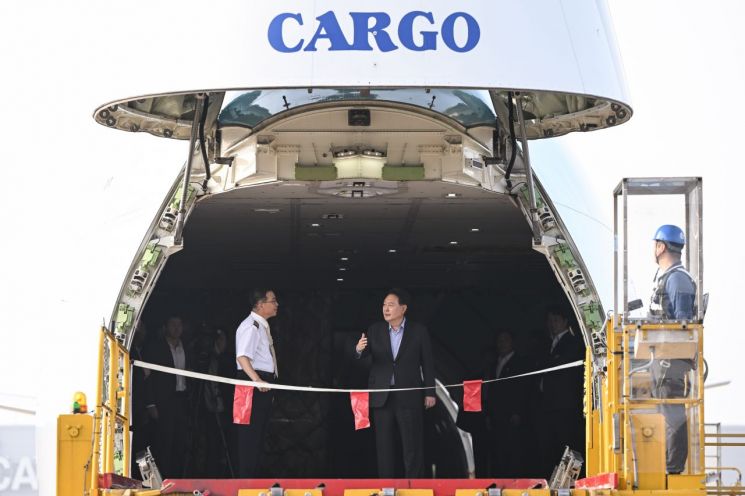 President Yoon Suk-yeol visited the Korean Air cargo terminal at Incheon International Airport on Yeongjongdo Island on the afternoon of the first day of the Chuseok holiday, September 28. He boarded a cargo plane bound for Tokyo, Japan, and received a briefing on the cargo flight operation plan from the captain.
 kane@yna.co.kr
(End)
Can Asiana Survive Independently?
During COVID-19, domestic airlines earned more revenue than expected from their cargo businesses. Asiana Airlines also profited from its cargo operations, but this was largely a windfall due to the unexpected boom caused by the pandemic. While demand for air cargo surged, belly cargo space in passenger aircraft actually decreased, leading to a global cargo crisis.
With the transition to an endemic phase, this situation has changed again. Although some cite Asiana Airlines' cargo business as a basis for its independent survival, the reality is uncertain. After the endemic, supply volumes increased, and more competitors entered the cargo market, returning Asiana's cargo business performance to normal levels. Due to massive borrowings, its debt ratio has worsened, making financial structure improvement practically impossible. As of the first half of this year, the company's debt ratio stood at 1741%. Interest expenses cause net losses even when operating profits are recorded.
If this acquisition fails again, it would pose a significant threat to the jobs of Asiana Airlines' employees. An industry insider said, "The third-party sale mentioned by some has low feasibility and would inevitably involve restructuring," adding, "Our aviation network would collapse, and there is a high possibility of losing transfer demand to China or Japan."
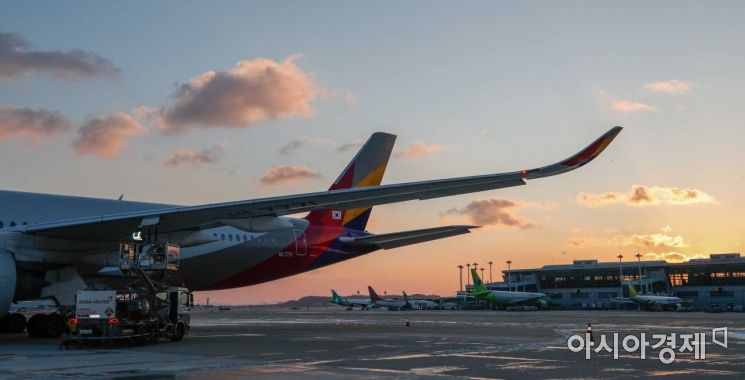 An Asiana Airlines official is conducting the final check while refueling a plane preparing for departure on the runway of Incheon International Airport Terminal 1.
 Yeongjongdo - Photo by Jinhyung Kang aymsdream@
Is Divesting Cargo and Returning Slots Problematic?
Competition authorities in South Korea and other countries have pointed out the reduction in competition after the acquisition. Korean Air's plan to sell Asiana's cargo business or transfer key slots is being pursued in this context.
Perceptions of the cargo business differ slightly between South Korean and foreign competition authorities. Earlier, the Korea Fair Trade Commission did not judge that competition in the cargo business would be restricted even if the two airlines merged. The Fair Trade Commission stated, "There are various competitors such as foreign airlines and cargo-only airlines, and there are few restrictions on slots, making new entry easy," concluding that "there is no competition restriction on any route."
The largest portion of South Korea's air cargo is semiconductors. Last year, total exports via airports amounted to about $229.2 billion, with semiconductors accounting for $127.6 billion, more than half. Since semiconductors are approached not merely as a trade item but from a security perspective, it is understood that Europe is also concerned about potential supply chain disruptions.
According to data compiled from Incheon International Airport Corporation and others, as of 2019, Korean Air accounted for about 37% of total cargo volume, and Asiana Airlines about 21%. Including low-cost carriers (LCCs), Korean airlines hold about 65%, while foreign airlines hold about 35%. Among the top 10 foreign cargo airlines by performance, only two are based in Europe. Even these are from Russia (AirBridgeCargo Airlines) and T?rkiye (Turkish Airlines), meaning no airlines are based within the EU.
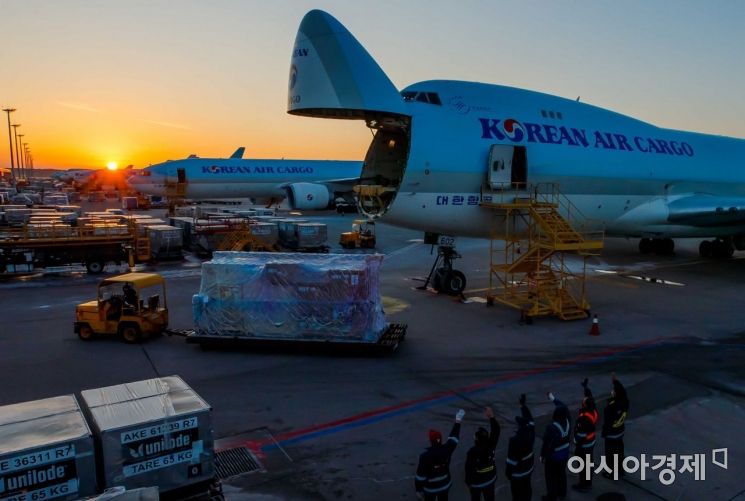 At the Korean Air cargo terminal of Incheon International Airport, officials are busily moving items to be loaded onto the cargo plane. / Yeongjongdo - Photo by Jinhyung Kang aymsdream@
Concerns about capital outflow related to transferring slots or selling the cargo business after integration are largely unfounded. This is because the European and American passenger routes with high demand and Asiana's cargo business are likely to be transferred or sold to domestic LCCs. For LCCs, this provides an opportunity to enter stable long-haul routes or the cargo market, which is expected to lead to balanced growth for the entire South Korean aviation industry.
In the case of European routes, even if slots are returned, consumer benefits are not expected to change significantly. The EU competition authorities identified Paris, Frankfurt, Rome, and Barcelona routes as subject to corrective measures. Spain operates under an open skies agreement, allowing for additional flights at any time, and Germany still has unused traffic rights, indicating some capacity.
© The Asia Business Daily(www.asiae.co.kr). All rights reserved.
![Clutching a Stolen Dior Bag, Saying "I Hate Being Poor but Real"... The Grotesque Con of a "Human Knockoff" [Slate]](https://cwcontent.asiae.co.kr/asiaresize/183/2026021902243444107_1771435474.jpg)


















