622 Types of Virtual Assets Distributed Excluding Duplicates... 183 'Kimchi Coins'
New Listings Surge 128%... Delistings and Cautionary Designations Increase
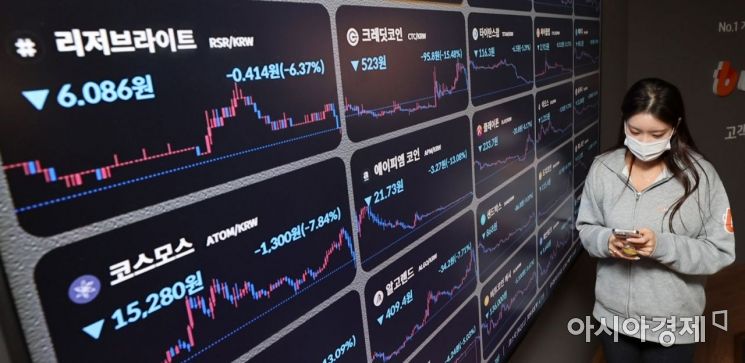 On the 10th, when the world's second-largest virtual asset exchange FTX faced a liquidity crisis, triggering a bank run and followed by Binance's withdrawal from the acquisition, virtual assets collectively declined, with Bitcoin plummeting 12%. The price board at the Bithumb Customer Support Center in Seocho-gu, Seoul, displayed the prices of major cryptocurrencies including Bitcoin. Photo by Kang Jin-hyung aymsdream@
The market capitalization of the domestic virtual asset market increased by 46% in the first half of this year. This is attributed to the rise in prices of virtual assets such as Bitcoin and the recovery of investor sentiment.
However, it still remains only half of what it was at the end of 2021, and the number of registered accounts as well as virtual asset users have been declining. Both new virtual asset trading support (listings) and trading suspensions (delistings) have significantly increased, indicating the need for caution in investment.
The Financial Intelligence Unit (FIU) under the Financial Services Commission announced on the 9th that the market capitalization of the domestic virtual asset market was KRW 28.4 trillion as of the end of June this year, a 46% (KRW 9 trillion) increase compared to KRW 19.4 trillion at the end of 2022. The FIU aggregated data submitted by 35 virtual asset operators, including 26 virtual asset exchanges (trading operators) and 9 wallet and custody operators, as of the end of June.
The price of Bitcoin rose from $16,547 per coin at the end of last year to $30,441 at the end of the first half of this year, an 81% increase, and the global virtual asset market capitalization (based on CoinMarketCap) also increased by 53%, from KRW 1,010 trillion to KRW 1,540 trillion.
However, compared to the end of 2021, the domestic virtual asset market remains significantly contracted. The year 2021 is known as the "Crypto Winter" (a period of virtual asset market downturn). The market capitalization of KRW 28.4 trillion as of the end of June is a sharp 48.6% decrease compared to KRW 55.2 trillion at the end of 2021.
The Financial Services Commission stated, "Investor sentiment in virtual assets recovered in the first half of the year due to expectations of easing global tightening policies and the anticipated launch of virtual asset exchange-traded funds (ETFs)," but also noted, "Volatility in trading increased due to expanded volatility in the U.S. financial market and strengthened regulations in the U.S. and European Union (EU)."
Among the top 10 domestic virtual assets by market capitalization in the first half, Bitcoin (BTC), Ripple (XRP), Ethereum (ETH), Dogecoin (DOGE), Cardano (ADA), and Solana (SOL) were also included in the global top 10 virtual assets.
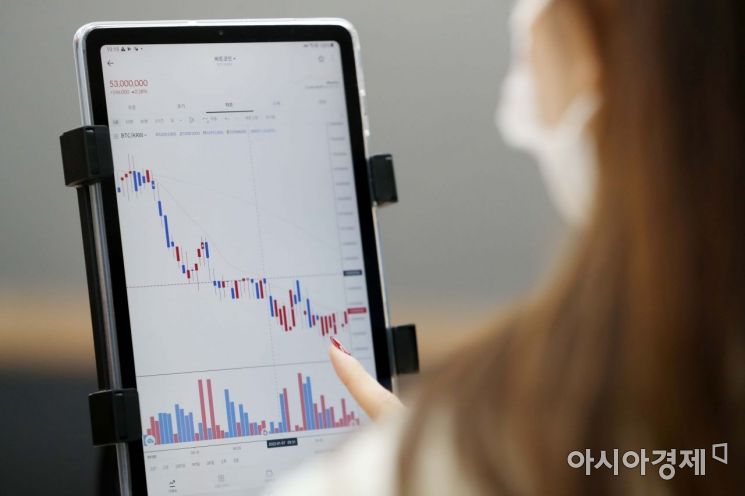 On the 7th, as the cryptocurrency prices continue to decline, a citizen is examining Bitcoin at the Bithumb Gangnam Customer Center in Seoul. Photo by Mun Ho-nam munonam@
The average daily trading volume of 26 virtual asset exchanges (trading operators) in the first half was KRW 2.9 trillion, a 1.3% (KRW 40 billion) decrease compared to KRW 2.94 trillion in the second half of last year.
The Korean won market accounted for most of the volume, while the average daily trading amount in the coin market was only KRW 1 billion. Notably, among coin market operators, five companies had an average daily trading amount of less than KRW 1 million.
Exchange revenue decreased by 1% (KRW 5.7 billion) from KRW 580.9 billion in the second half of last year to KRW 575.2 billion in the first half of this year, but operating profit increased by 82% (KRW 102.4 billion) from KRW 124.9 billion to KRW 227.3 billion during the same period.
The Korean won market increased by 46% to KRW 259.8 billion, and the coin market's operating loss decreased from KRW 53 billion to KRW 32.5 billion. Among 21 coin market operators, 10 had no trading fee revenue at all, and 18 were in a state of "complete capital erosion" with negative total capital.
The operating profit of virtual asset exchanges in the first half was 86.2% lower compared to KRW 1.64 trillion in the second half of 2021. User Korean won deposits, which are pending trading funds, amounted to KRW 4 trillion as of the end of June, an 11% (KRW 400 billion) increase compared to KRW 3.6 trillion at the end of last year.
The average daily trading amount of exchanges (KRW 2.9 trillion) and Korean won deposits (KRW 4 trillion) in the first half decreased by 74.4% and 47.4%, respectively, compared to KRW 11.3 trillion and KRW 7.6 trillion in the second half of 2021.
The number of exchange employees was 1,915 as of the end of June, down 8.5% (178 people) compared to the end of last year, and the number of personnel related to anti-money laundering (AML) tasks decreased by 9.7% (29 people) to 269.
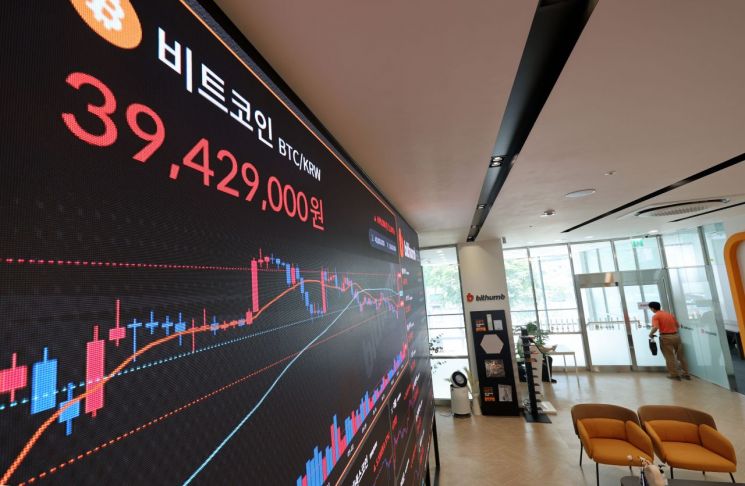
As of the end of June, there were 1,399 virtual assets traded domestically (including duplicates), a 2.7% (37 assets) increase compared to 1,362 at the end of 2022. However, excluding duplicate listings on exchanges, the number of virtual assets circulating domestically was 622, a 0.5% (3 types) decrease.
Among the 622 listed virtual assets, 366 were singly listed on only one domestic exchange, and half of these, 183, were "Kimchi coins," virtual assets issued by Koreans or mainly traded (over 80%) by domestic operators.
Among singly listed virtual assets, 34% (124 assets) had a market capitalization of less than KRW 100 million, and the Financial Services Commission explained that investors should be cautious of market risks such as sharp price fluctuations and lack of liquidity.
Newly supported (listed) virtual assets in the first half totaled 169 cases (including duplicates), a 128% surge compared to 74 cases in the second half of last year. New listings in the Korean won market increased by 184% to 91 cases, and the coin market increased by 86% to 78 cases.
On the other hand, delisted virtual assets in the first half also rose by 47% to 115 cases (including duplicates) compared to 78 cases in the second half of last year. Reasons cited included project risk (54%), investor protection risk (24%), market risk (20%), and technical risk (2%). The number of virtual assets designated as cautionary items in the first half was 154 cases (including duplicates), a 41% increase compared to 109 cases in the second half of last year.
The amount of external transfers (withdrawals) of virtual assets by domestic registered operators was KRW 29.7 trillion in the first half, of which KRW 6.6 trillion was subject to the Travel Rule (transfers over KRW 1 million to registered operators). The amount transferred (withdrawn) in a single transaction of KRW 1 million or more to pre-registered (whitelisted) overseas operators or personal wallet addresses was KRW 22.1 trillion in the first half, a 2.4% (KRW 5 trillion) increase compared to the second half of last year. These transfers are presumed to be mainly for arbitrage trading and other purposes.
The number of virtual asset users, which reached 6.9 million as of the end of June last year, decreased to 6,061,632 as of June this year. This is a 3% decrease compared to 6,272,676 at the end of 2022.
With an increase in dormant accounts, the number of registered accounts decreased even more than the number of users. The number of registered accounts dropped 19% from 11,776,115 at the end of last year to 9,495,013 at the end of June this year.
The age group that uses virtual assets the most is people in their 30s (1.81 million), accounting for 30% of the total (6.06 million). This proportion remained the same as in the second half of last year.
Following those in their 30s, the usage proportions were 1.74 million (29%) in their 40s, 1.15 million (19%) aged 20 or younger, 1.03 million (17%) in their 50s, and 330,000 (5%) aged 60 or older. Among users, 4.03 million (67%) held virtual assets valued at less than KRW 500,000.
Meanwhile, the custody assets of nine virtual asset wallet and custody operators amounted to KRW 3.1 trillion as of the end of June this year, a 29% (KRW 700 billion) increase compared to the end of the previous year. Revenue was KRW 19.8 billion, down 48% (KRW 18 billion) compared to the end of 2022, and operating profit was KRW 3.5 billion, down 71% (KRW 8.3 billion).
© The Asia Business Daily(www.asiae.co.kr). All rights reserved.



















