The world is on edge as violent clashes erupt between the Palestinian armed faction Hamas and Israel, 50 years after the Fourth Middle East War (Yom Kippur War) that triggered the 'oil crisis.' While there is a possibility of a short-term rise in international oil prices due to this war, analysts believe that unless the conflict drags on, it will not cause as severe a shock as it did half a century ago.
 A rocket launched by Palestinian militants from the Gaza Strip being intercepted by Israel's missile defense system, the Iron Dome.
 [Image source=AFP Yonhap News]
On the 7th (local time), Bloomberg News analyzed, "The similarities between October 2023 and October 1973 lie only in the surprise attack on Israel and the subsequent rise in oil prices," adding, "The global economy will not face another Arab oil embargo, but underestimating the possibility of a long-term higher oil price market would be a mistake."
October 1973 was the month when the Fourth Middle East War, the Yom Kippur War, broke out, initiated by surprise attacks on Israel by Egypt and Syria. This led to the first oil crisis, with the Arab Oil Exporting Countries (OAPEC) members imposing an oil embargo that caused oil prices to nearly triple, shaking the global economy.
However, this time, since Israel is not at war with Arab countries, the impact is expected to be limited. Bloomberg stated, "Arab countries are not attacking Israel," and "Arab nations such as Egypt, Jordan, Syria, and Saudi Arabia are watching the situation from the sidelines."
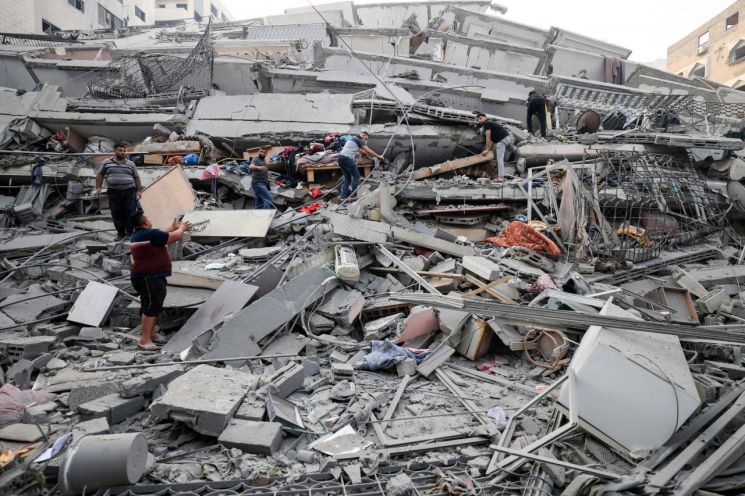
Another difference is that, unlike in 1973 when oil market demand surged sharply, the current increase is more moderate.
Regarding the movements of other oil-producing countries like Saudi Arabia, Bloomberg noted, "Just before the oil embargo in October 1973, OPEC countries unilaterally raised the official oil price by about 70%," and predicted, "(This time) Saudi Arabia will be satisfied with raising the oil price by 10-20% from the current $85 to just over $100 per barrel."
However, if Israel concludes that Iran is behind Hamas, the impact on the oil market could be greater, as the U.S. may strengthen sanctions against Iran. According to Bloomberg, the U.S. had allowed the circumvention of sanctions on Iranian oil exports to stabilize energy prices, which increased Iran's oil production by nearly 700,000 barrels per day. However, if the U.S. sanctions Iran, Russia's influence in the oil market could grow, so the U.S. is expected to act cautiously.
© The Asia Business Daily(www.asiae.co.kr). All rights reserved.
![Clutching a Stolen Dior Bag, Saying "I Hate Being Poor but Real"... The Grotesque Con of a "Human Knockoff" [Slate]](https://cwcontent.asiae.co.kr/asiaresize/183/2026021902243444107_1771435474.jpg)

















