Full-scale Testing of Institutional CBDC Utilization Begins
US Raises Privacy Concerns Over CBDC Data Collection
Bank of Korea: "Transaction Details Cannot Be Known and Are Not Needed"
The Bank of Korea has taken a full-scale step toward experimenting with the practical use of 'Central Bank Digital Currency (CBDC)' for actual deposits and payments, bringing the era of CBDC closer.
Once CBDC is introduced into daily life, it is expected to enhance transaction stability and transparency and drive innovation across various industries. However, concerns have also been raised that this process could accelerate the 'Big Brother era,' where the government monitors and controls individuals' financial and transaction activities.
According to the Bank of Korea on the 7th, the Bank of Korea and the government have decided to conduct a CBDC usability test for the general public in collaboration with the Bank for International Settlements (BIS). The test will be conducted from this month until the end of next year.
This test will focus on 'wholesale CBDC,' which is used for fund transfers and final settlements between financial institutions, rather than 'retail CBDC' that individuals or companies can use directly.
Deposit Tokens with Infinite Applications
Looking at the broader context, the Bank of Korea plans to convert a portion of the reserve funds that banks deposit with the Bank of Korea?equivalent to a certain percentage of financial liabilities such as deposits?into wholesale CBDC exclusively for participating banks in the test.
When the Bank of Korea issues wholesale CBDC, the respective banks will issue 'deposit tokens' as a payment and settlement method linked to it.
These deposit tokens are digital assets similar in form to regular deposits. Therefore, individuals (depositors) who receive deposit tokens from banks can use them to purchase goods or transfer funds to others.
Since deposit tokens are digital currency, they involve fewer intermediaries, resulting in significantly lower fees compared to card payments. Sellers can also receive payments almost in real-time (credit card payments typically take three business days to be deposited from the card company), making it convenient.
At first glance, this may seem like just a cheaper and more convenient payment method, but the most significant feature of deposit tokens is their programmability.
For example, when giving an allowance to a child using deposit tokens, it can be set to be used only for specific items. When donating to institutions or companies, the tokens can be programmed to be delivered only to those that meet the donor’s specified conditions.
The Bank of Korea expects that once the infrastructure utilizing wholesale CBDC is established, more diverse and innovative services will be introduced in the private sector.
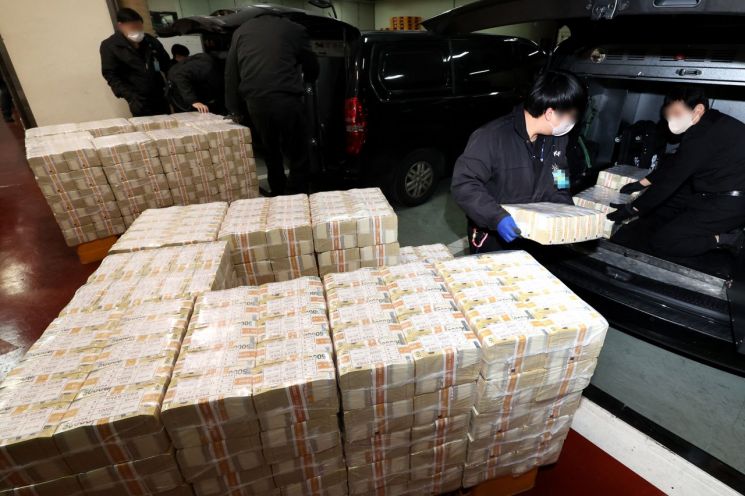 On the morning of January 16, Bank of Korea officials at the Gangnam Headquarters in Gangnam-gu, Seoul, are loading funds released ahead of the Lunar New Year holiday onto an armored vehicle.
 [Image source=Yonhap News]
Innovative but Concerns Over Surveillance and Control of Personal Transactions
Another commonly mentioned application is disaster relief funds. When the government distributes disaster relief funds using bank deposit tokens, conditions can be set to ensure the funds are used for consumption rather than savings, and the items eligible for purchase can be restricted.
However, in this case, concerns may arise that the government or central bank could more easily monitor and control individuals' financial and transaction activities.
In fact, in other countries discussing CBDC adoption, there are significant concerns about a 'surveillance society' resulting from the introduction of digital currency.
In the United States, the Federal Reserve recently passed a bill through the House Financial Services Committee that prohibits the Fed from issuing CBDC directly to individuals. This bill also includes provisions to prevent the Fed from collecting information on individuals' financial activities.
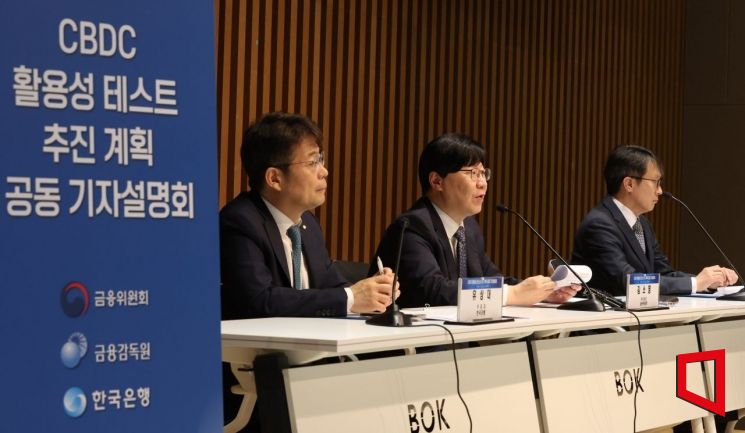 Kim So-young, Vice Chair of the Financial Services Committee (center), is speaking at the joint press conference on the plan to promote the CBDC usability test held on the afternoon of the 4th at the Bank of Korea Integrated Annex in Jung-gu, Seoul.
 From left, Yoo Sang-dae, Deputy Governor of the Bank of Korea, Vice Chair Kim, and Lee Myung-soon, Senior Vice Chair of the Financial Supervisory Service. Photo by Joint Press Corps
However, the Bank of Korea's position is that deposit tokens are not issued directly to individuals by the central bank but through bank accounts, so neither the government nor the Bank of Korea can know all personal transaction details, nor do they need to.
While there could be Big Brother issues with 'retail CBDC,' where the central bank directly opens accounts and issues payments to individuals, the Bank of Korea is not currently considering the introduction of retail CBDC.
A Bank of Korea official explained, "If the government wants to impose specific conditions when distributing disaster relief funds as deposit tokens instead of cash, it only needs to provide the programming conditions to the bank. Since the relief funds can only be used for that purpose, the government does not need to check each individual's transaction details."
The Bank of Korea and the government also plan to establish user protection measures during the CBDC usability test process.
Kim So-young, Vice Chairperson of the Financial Services Commission, said at a press briefing on the 4th, "Since this is a test of a payment and settlement method different from existing ones, there are concerns related to personal information and the protection of other users' property rights. We plan to prepare sufficient user protection measures, including technical measures such as encryption of transaction records and access rights, as well as explanatory measures by banks regarding users' property rights."
© The Asia Business Daily(www.asiae.co.kr). All rights reserved.
![User Who Sold Erroneously Deposited Bitcoins to Repay Debt and Fund Entertainment... What Did the Supreme Court Decide in 2021? [Legal Issue Check]](https://cwcontent.asiae.co.kr/asiaresize/183/2026020910431234020_1770601391.png)


















