Tokyo Electric Power Company Measures Radioactive Substance Concentration in Seawater
Tokyo Electric Power Company (TEPCO) announced on the 6th that the concentration of tritium, a radioactive substance in seawater in front of the Fukushima Daiichi Nuclear Power Plant, was measured for the first time after the start of the second phase of contaminated water discharge into the ocean, and it was found to be below the standard level.
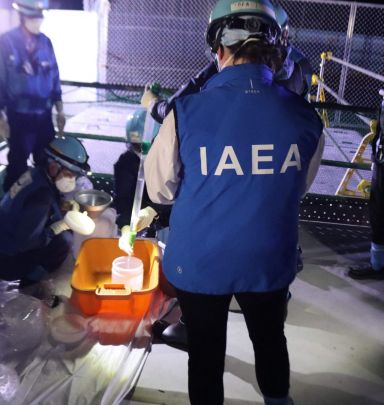 An International Atomic Energy Agency (IAEA) staff member is observing the sampling process of contaminated water from the Fukushima nuclear power plant in Japan last August.
 [Photo by AFP Yonhap News]
TEPCO stated that the analysis of seawater samples collected from 10 locations within a 3 km radius of the nuclear power plant on the afternoon of the day before the start of the second discharge phase showed that the tritium concentration was below the detectable lower limit of 10 becquerels (Bq) per liter.
If tritium levels exceeding 700 Bq per liter within 3 km from the plant or 30 Bq per liter at points farther away are detected, the discharge will be suspended. The International Atomic Energy Agency (IAEA) stated in a press release on the day before the start of the second discharge phase that "IAEA experts on site confirmed that the tritium concentration in the contaminated water for the second discharge is much lower than Japan's operational standards."
Earlier, during the first discharge period from August 24 to September 11, the analysis of tritium concentrations in seawater and fish collected around the nuclear power plant was also announced to be without issues.
© The Asia Business Daily(www.asiae.co.kr). All rights reserved.
![Clutching a Stolen Dior Bag, Saying "I Hate Being Poor but Real"... The Grotesque Con of a "Human Knockoff" [Slate]](https://cwcontent.asiae.co.kr/asiaresize/183/2026021902243444107_1771435474.jpg)
















