The three major domestic battery companies have invested tens of trillions of won in ternary (nickel-cobalt-manganese, NCM) lithium-ion batteries. However, four years from now, Korean and Japanese competitors are expected to begin mass-producing all-solid-state batteries, known as the "dream battery," which are safer and perform better than lithium-ion batteries. When all-solid-state batteries hit the market, NCM batteries might lose their place. Simply put, some people think they could follow the same path as CRT TVs, which disappeared after the advent of LCDs.
The company leading the timeline for mass production of all-solid-state batteries is Samsung SDI. It is about 2 to 3 years ahead of LG Energy Solution and SK On. Samsung SDI has set a goal to mass-produce all-solid-state batteries in 2027 after actual installation tests in electric vehicles. In the first half of this year, it established the 'S Line,' the first all-solid-state battery pilot line in Korea, at its Suwon research center. At the '53rd Anniversary Founding Ceremony' last June, Samsung SDI President Choi Yoon-ho said, "We are preparing to produce all-solid-state battery prototypes in the second half of the year." Samsung SDI has secured customers aligned with the 2027 mass production schedule and is in discussions with multiple automakers.
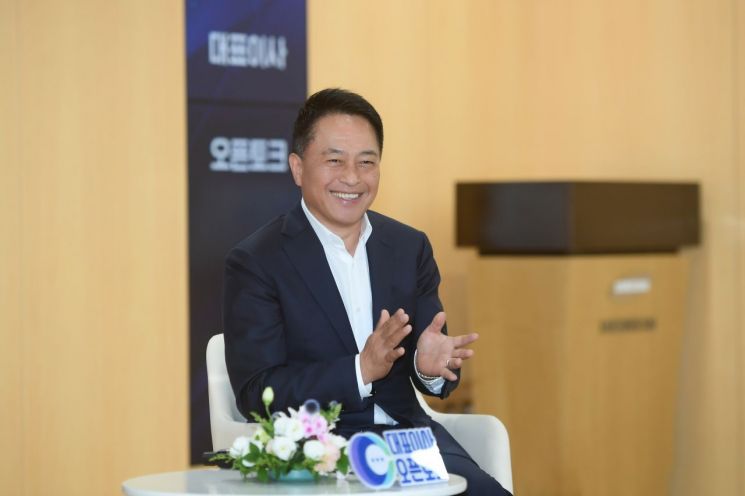 Choi Yoon-ho, President of Samsung SDI, is listening attentively to the remarks of employees at the '53rd Anniversary Founding Ceremony' held on June 29 at the Giheung plant in Yongin, Gyeonggi Province. On that day, President Choi said, "We have entered the full-scale execution phase to take a step closer to Samsung SDI's vision this year," adding, "We have completed the establishment of the all-solid-state battery pilot line and are preparing to produce prototypes in the second half of the year."
 [Photo by Samsung SDI]
Although slightly behind Samsung SDI, other domestic battery companies, strong players in the NCM market, are also preparing to produce all-solid-state batteries. SK On plans to develop all-solid-state battery prototypes in the second half of next year and begin commercialization in 2028. LG Energy Solution aims for commercialization of all-solid-state batteries by 2030. The reason the three battery companies are preparing for all-solid-state production is that they believe all-solid-state batteries are likely to become mainstream in the long term. The issue is when, that is, the timing.
Even if they succeed in producing all-solid-state batteries, it does not mean electric vehicles equipped with them can be driven immediately. The process of testing safety and performance and negotiating with automaker customers takes several years. The same process was followed when lithium-ion batteries were commercialized. There are still many technical problems to solve and new manufacturing process facilities to establish. A senior official in the battery industry said, "Even if all-solid-state batteries are actually produced, it will take up to five years to conduct numerous tests, meet customer specifications, coordinate vehicle launch schedules with automakers, and actually supply the batteries." From the perspective of the three leading NCM battery companies, the longer it takes, the better.
On the other hand, Samsung SDI is making every effort to accelerate the commercialization timeline. For example, the company plans to develop prototypes and conduct customer tests simultaneously. They will create Prototype 1 and deliver it to customers; while customers test it, they will improve the shortcomings and create Prototype 2, which will again be delivered for testing. Instead of completing a specific prototype and then handing it over, they will work together from the development stage so that customers can immediately review prototype performance. A Samsung SDI official said, "It will cost a lot because we are developing more than one prototype, but reducing time is more important."
The biggest competitor cited by domestic battery companies is the Japanese automaker Toyota. In June, Toyota announced that its goal is to commercialize all-solid-state batteries around 2027-2028. Although this is later than the previous target of 2025, Toyota is still regarded as the most proactive company in all-solid-state battery development. Toyota holds over 1,000 patents related to all-solid-state batteries. It is the company with the most related patents worldwide. A battery industry official said, "Japanese companies have been ahead in development, but who dominates the market is another matter," adding, "Abundant factory production capacity and early yield stabilization capabilities are also important."
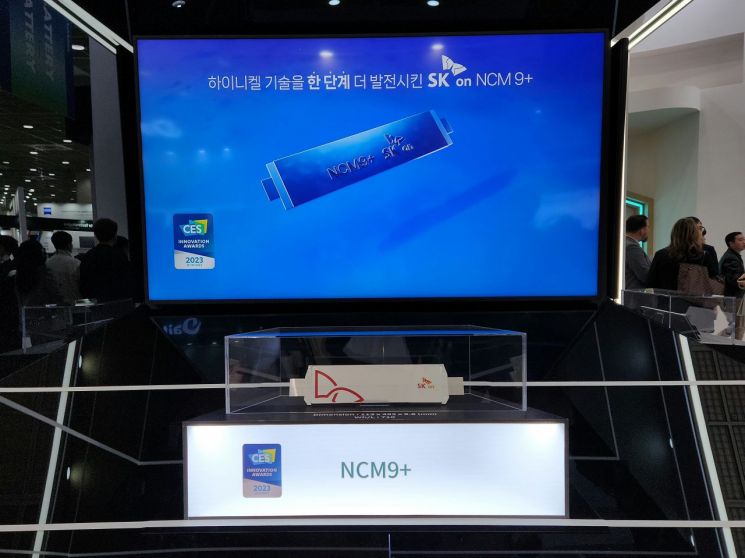 NCM9+ battery displayed at the SK On booth at 'InterBattery 2023'. SK On received the Vehicle Technology and Advanced Mobility Innovation Award for the NCM9+ battery at the world's largest home appliance and IT exhibition held in January this year.
 [Photo by Choi Seoyoon]
The industry consensus is that even if all-solid-state batteries appear around 2027, NCM batteries will not disappear immediately. It is assessed that there is still a long time until the all-solid-state battery blooming period. It takes five years from prototype to testing to mass production. Even after mass production, the initial vehicle installation rate is expected to be around 1%. To feel a sense of crisis, the market share needs to exceed 40%, and until then, lithium-ion batteries are expected to maintain a high share in the electric vehicle market. A battery industry official said, "In the early 2000s, it was said that CRT TVs would disappear due to LCD TVs, but CRT TVs lasted another 10 years."
It will also take more time to achieve price competitiveness after market entry. Initially, all-solid-state batteries are likely to be expensive and only used in high-end vehicles. Another battery industry official said, "By the time all-solid-state batteries are commercialized, lithium-ion battery prices will have dropped further, so it is more likely that they will coexist rather than all-solid-state batteries taking over the market."
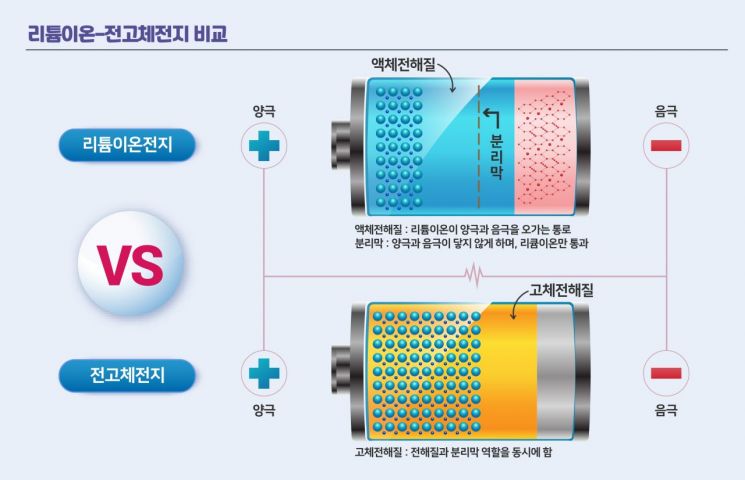 Comparison of Lithium-ion Batteries and All-solid-state Batteries [Image source=Korea Electrotechnology Research Institute]
Professor Lee Deok-hwan, Emeritus Professor at Sogang University, said, "Lithium-ion batteries are the result of revolutionary development, to the extent that three scholars who developed related technologies received the Nobel Prize in Chemistry," adding, "All-solid-state batteries seem to have started from an engineering idea to reduce the fire and explosion risks, which are drawbacks of NCM batteries."
Professor Lee explained using TNT (trinitrotoluene), a solid explosive, as an example, saying there is no scientific basis to assume that all solids are necessarily safe. He also said that it is chemically impossible for ions to pass through solids, which is common chemical knowledge. He said, "Everyone acknowledges the necessity of all-solid-state batteries to succeed NCM batteries, but if they cannot actually be made or are too expensive even if mass production succeeds, it will be a pipe dream," adding, "We must keep all possibilities open, including improvements to NCM batteries, and prepare accordingly."

◆All-solid-state battery = A next-generation battery that replaces the electrolyte, which can explode when impacted or overheated, with a solid. Unlike lithium-ion batteries, it has a very low risk of fire. Without liquid and separators, its size is about half. The driving range when fully charged is about 800 km, superior to lithium-ion batteries (about 500 km), making it a 'game changer' that could overturn the battery industry landscape. Currently, its price is tens of times higher than lithium-ion batteries, but with technological advances and mass production, prices will drop, eliminating the need to use existing lithium-ion batteries. The core raw materials that make up the cathode and anode in all-solid-state batteries have not yet been determined. Various combinations of minerals are being tested.
© The Asia Business Daily(www.asiae.co.kr). All rights reserved.



















