A Sharp Drop of $15.8 Billion Compared to January This Year
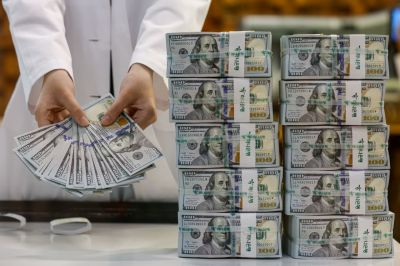 On August 14th, an employee is organizing dollars at the Hana Bank Counterfeit Response Center in Jung-gu, Seoul. Photo by Jinhyung Kang aymsdream@
Recently, amid growing volatility in the won-dollar exchange rate due to prolonged tightening expectations by the U.S. Federal Reserve (Fed), South Korea's foreign exchange reserves, which serve as a 'safety net,' have decreased for two consecutive months.
According to the Bank of Korea on the 6th, South Korea's foreign exchange reserves at the end of last month stood at $414.12 billion, down $4.18 billion from the previous month. This marks a decline for two consecutive months following August's decrease of $3.5 billion.
Considering that the foreign exchange reserves reached approximately $429.967 billion in January this year, there has been a sharp drop of more than $15.8 billion over eight months.
The recent strengthening of the dollar against the won, driven by expectations that the Fed's tight monetary policy stance will last longer, is analyzed as the cause of the decrease in foreign exchange reserves.
The Bank of Korea explained, "The dollar conversion amount of foreign currency assets in other currencies decreased, and measures to ease volatility in the foreign exchange market were implemented, leading to a reduction in foreign exchange reserves."
According to the Bank of Korea, the U.S. dollar index surged by 3% last month.
Breaking down the foreign exchange reserves by asset type, securities ($372.59 billion) decreased by $6.44 billion, Special Drawing Rights (SDR) at the International Monetary Fund (IMF) ($14.8 billion) decreased by $250 million, and the IMF position, which is the reserve tranche position at the IMF ($4.54 billion), decreased by $60 million.
Deposits, which correspond to cash ($17.4 billion), increased by $2.56 billion, and gold maintained the same $4.79 billion as the previous month since it is recorded at the purchase price without reflecting market prices.
The government defends the value of the won by selling dollars in the market when the won-dollar exchange rate surges, utilizing foreign exchange reserves in the process. Therefore, foreign exchange reserves typically play a dual role in supporting both fiscal soundness and national creditworthiness.
When foreign exchange reserves are sufficient, national creditworthiness improves; conversely, insufficient reserves can increase instability in the foreign exchange and financial markets. Especially during times like recently, when a strong dollar intensifies exchange rate instability, foreign exchange reserves become even more crucial.
The won-dollar exchange rate hit a yearly high of 1,363.5 won on the 4th, then closed at 1,350.5 won, down 13.0 won from the previous day's closing price (1,363.5 won), showing significant volatility.
As South Korea's foreign exchange reserves have decreased significantly recently, the country's global ranking in foreign exchange reserves dropped one notch to 9th as of the end of August.
China holds the largest reserves at $3.1601 trillion, followed by Japan ($1.2512 trillion), Switzerland ($865.2 billion), India ($598.2 billion), Russia ($581.7 billion), Taiwan ($565.5 billion), and Saudi Arabia ($426.9 billion). Hong Kong is positioned just above South Korea with $418.4 billion.
© The Asia Business Daily(www.asiae.co.kr). All rights reserved.
![Clutching a Stolen Dior Bag, Saying "I Hate Being Poor but Real"... The Grotesque Con of a "Human Knockoff" [Slate]](https://cwcontent.asiae.co.kr/asiaresize/183/2026021902243444107_1771435474.jpg)
















