Not Guilty Verdict for Dangerous Driving Causing Injury under Special Act
Application of Violation of Road Traffic Act
The prison sentence of a Ministry of Land, Infrastructure and Transport official who caused the death of one family member and injured the rest of the family due to drunk driving has been finalized.
According to the legal community on the 5th, the Supreme Court's First Division (Presiding Justice Seo Kyunghwan) upheld the original sentence of two years in prison for Kim (39), who was indicted on charges including dangerous driving causing death under the Act on the Aggravated Punishment of Specific Crimes.
The court stated the reason for dismissing the appeal was that "there was no error in the lower court's judgment that violated the rules of logic and experience, exceeded the limits of free evaluation of evidence, or misunderstood the legal principles regarding the establishment of the crime of dangerous driving causing death or injury under the Act on the Aggravated Punishment of Specific Crimes."
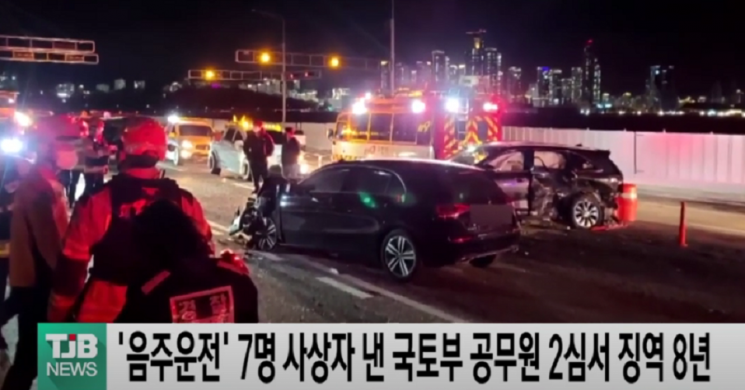
Kim was indicted on charges of dangerous driving causing death or injury under the Act on the Aggravated Punishment of Specific Crimes and drunk driving under the Road Traffic Act for causing casualties to a family of seven by hitting a passenger car that was stopped sideways while attempting a U-turn on the road in front of the 'Geumgang Pedestrian Bridge' in Sejong-ri, Yeongi-myeon, Sejong City, on April 7 last year, while in a state of severe intoxication with a blood alcohol concentration of 0.169%, which corresponds to license cancellation level.
At the time, the accident occurred on a two-lane one-way road with a speed limit of 50 km/h, but Kim was driving at 107 km/h, more than twice the limit, when the accident happened. The front part of the Mercedes-Benz passenger car driven by Kim strongly collided with the left side of the victim vehicle, a Sorento van, and a 42-year-old woman riding in the back seat of the Sorento was transported to the hospital but died.
The 62-year-old man driving the victim vehicle sustained injuries requiring about seven weeks of treatment, and the 59-year-old woman in the front passenger seat suffered lumbar and pelvic fractures requiring six months to a year of treatment. The other six victims sustained injuries requiring treatment ranging from two weeks to several months. Among the passengers were children aged 5, 6, and 8.
The prosecution judged that Kim caused death or injury while driving in a state where normal driving was difficult due to intoxication and indicted him on charges of dangerous driving causing death or injury under the Act on the Aggravated Punishment of Specific Crimes.
In court, Kim argued that he could not have foreseen the victim's abnormal driving and that there was no negligence or causal relationship because the accident could not have been avoided even if he had obeyed the speed limit. He claimed that the victim vehicle crossing the road to make an illegal U-turn, like the vehicle ahead, was a situation generally unforeseeable by a driver, so there was no causal relationship between his failure to observe the speed limit and the accident.
However, the first-instance court did not accept Kim's argument.
The court found Kim negligent for driving at more than twice the speed limit while intoxicated and without using high beams at night, which did not secure sufficient visibility. Although it was possible that the accident could have occurred even if Kim had not been drinking and had obeyed the speed limit, the court reasoned that if Kim had obeyed the speed limit, the recognition and reaction time until he noticed the victim vehicle and applied the brakes would have been shortened, significantly reducing the impact and preventing the death or injury of the occupants of the victim vehicle.
However, the court found it difficult to recognize the charge of dangerous driving causing death or injury under the Act on the Aggravated Punishment of Specific Crimes applied by the prosecution.
The Supreme Court holds the position that "unlike the drunk driving offense under the Road Traffic Act, the crime of dangerous driving causing death or injury under the Act on the Aggravated Punishment of Specific Crimes requires that the driver be in a state where normal driving is actually difficult due to the influence of alcohol, regardless of whether the blood alcohol concentration exceeds the statutory minimum limit."
The court judged that based on the black box footage of the accident vehicle and the police investigation report submitted by the prosecution, it was difficult to acknowledge that Kim was in a state of intoxication that made normal driving difficult at the time of the incident.
Ultimately, the court acquitted Kim of the charge of dangerous driving causing death or injury under the Act on the Aggravated Punishment of Specific Crimes but found him guilty of violating the Road Traffic Act (causing death and injury), which is included in the indictment due to absorption, and sentenced him to one year and four months in prison.
Kim's unfavorable sentencing factors included that, as a high-ranking public official who should set an example, he caused an irreversible result of a victim's death by drunk and speeding driving. Favorable sentencing factors considered were that Kim was a first-time offender with no criminal record, had prepaid 115 million won in deductible insurance payments for victim compensation, and that the victim driver was also negligent, so all responsibility for the accident could not be placed solely on Kim.
In the second trial, conducted due to appeals from both Kim and the prosecution, the prosecution's argument for a harsher sentence was accepted, and the sentence was increased to two years in prison.
The court considered as favorable sentencing factors that Kim admitted to all charges and showed remorse during the second trial, deposited 100 million won to the family of the deceased victim and 5 million won each to the six injured victims as criminal deposits, had no prior criminal record, and that the victim driver was also negligent.
Nevertheless, the court stated, considering Kim's high blood alcohol concentration and driving at a speed significantly exceeding the speed limit at the time of the incident, "the defendant's guilt cannot be taken lightly."
The court said, "One victim died, and the injuries to the other victims are very serious. Due to this accident, the victims and their families will have to endure lifelong mental trauma that cannot be healed, and they are still petitioning for severe punishment against the defendant."
Furthermore, the court stated, "Although the victim's negligence appears to be a significant cause of the accident and the extent of the damage, crimes caused by drunk and speeding driving must be strictly punished considering the risk of accidents and social harm. In light of this, the defendant's guilt is heavy, and a substantial prison sentence corresponding to this is inevitable."
Finally, the court concluded, "Considering all circumstances, the original sentence for the defendant was somewhat light and inappropriate. Therefore, the prosecution's claim of inappropriate sentencing is valid, and the defendant's claim of inappropriate sentencing is invalid."
The Supreme Court also found no problem with the second trial court's judgment.
© The Asia Business Daily(www.asiae.co.kr). All rights reserved.
![Clutching a Stolen Dior Bag, Saying "I Hate Being Poor but Real"... The Grotesque Con of a "Human Knockoff" [Slate]](https://cwcontent.asiae.co.kr/asiaresize/183/2026021902243444107_1771435474.jpg)
















