Statistics Korea 'September Consumer Price Trends'
Petroleum Products -4.9%... Decline Narrowed
Impact of Increased Volatility in International Oil Prices
Fresh Food & Fruits Up 6.4%, 24.4% Increase
Last month, consumer prices rose by 3.7% compared to the same month last year, marking the largest increase in five months. This was due to a recent surge in international oil prices and a significant rise in agricultural product prices during the Chuseok holiday. The government expects agricultural product prices to gradually stabilize during the harvest season, but forecasts that rising oil prices will continue to impact inflation next month.
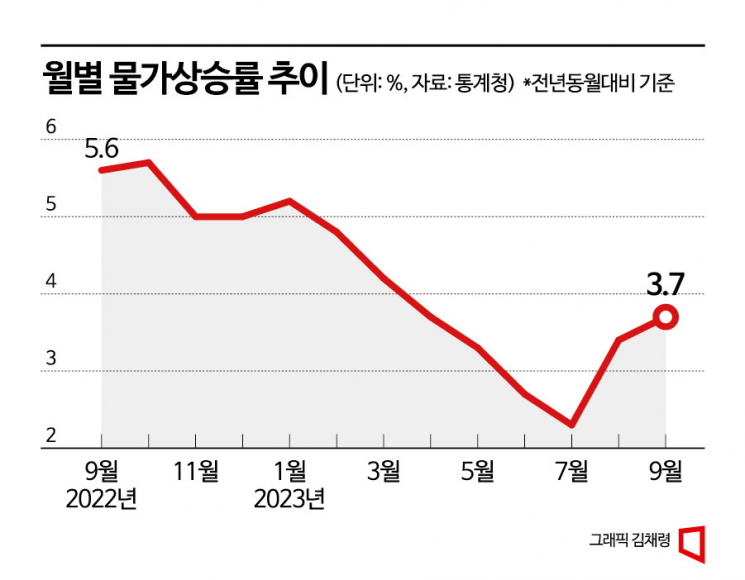
According to the 'September Consumer Price Trends' released by Statistics Korea on the 5th, the consumer price index last month was 112.99, up 3.7% from the same month last year. This is a 0.3 percentage point increase from the previous month and the largest rise in five months since April (3.7%). The consumer price inflation rate, which recorded 5.2% in January this year, slowed to 2.3% in July but increased again to 3.4% last month, with the rate of increase growing further.
The main cause of last month’s price increase was a sharp rise in petroleum products. Although petroleum prices fell 4.9% compared to a year ago, continuing a downward trend for eight consecutive months, the rate of decline significantly narrowed compared to July (-25.9%) and August (-11.0%). The contribution of petroleum products to the overall inflation rate also rose from -1.49 percentage points in July to -0.57 percentage points in August and -0.25 percentage points in September. Kim Bo-kyung, Economic Trend Statistics Officer at Statistics Korea, analyzed, "The slowdown in the decline of petroleum prices due to rising international oil prices expanded the increase in industrial product prices," adding, "The 0.3 percentage point rise this month appears to be influenced by the increase in petroleum prices caused by the upward trend in international oil prices."
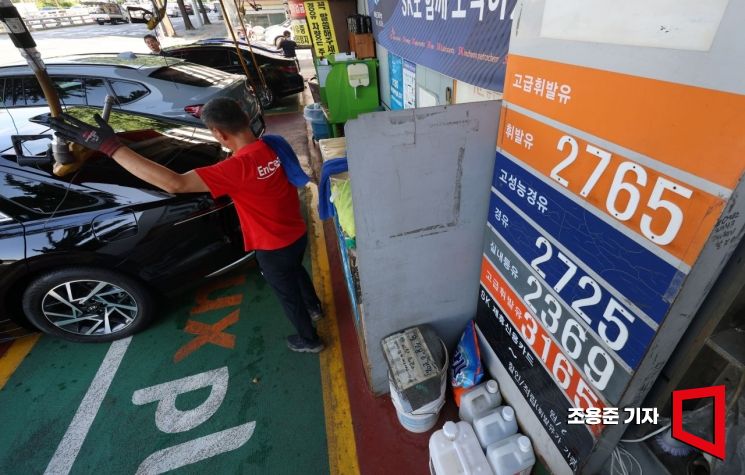 Despite the extension of the fuel tax reduction measure, gasoline prices have continued to rise for the eighth consecutive week as international oil prices keep climbing. On the 6th, the prices for gasoline and diesel were displayed at a gas station in Seoul. Photo by Yongjun Cho jun21@
International oil prices have become increasingly volatile with rapid rises and falls. According to the New York Mercantile Exchange and the UK ICE Futures Exchange, the price of West Texas Intermediate (WTI) crude oil surpassed $93.68 per barrel on the 27th of last month but fell to $84.22 per barrel as of the previous day. Prices dropped amid growing expectations that economic slowdown due to high interest rates would reduce oil demand. However, the Saudi Arabian government issued an official statement on the same day, announcing it would continue production cuts until the end of the year, leaving the possibility of further price increases open. Rising oil prices also affected energy and transportation public utility fees. Last month, electricity, gas, and water prices rose 19.1% compared to the same month last year. If energy and transportation fees continue to rise, they will act as pressure factors on consumer price inflation.
Last month, prices of agricultural, livestock, and fishery products also rose 3.7% year-on-year, driving inflation. In particular, agricultural products (7.2%) recorded the largest increase in 11 months since October last year (7.3%). Items heavily influenced by sunlight and rainfall, such as apples (54.8%), tomatoes (30.0%), and peaches (40.4%), saw significant price increases. The government diagnosed that production decreased due to adverse weather conditions during the early growth period caused by this summer’s heatwaves and heavy rains. Accordingly, the living cost index, composed of frequently purchased and high-expenditure items, rose from 3.9% in August to 4.4% last month. Within the living cost index, the food price increase rate was 4.6%, higher than the non-food price increase rate of 4.2%. The fresh food index rose 6.4% during the same period, with fresh fruits surging 24.4%.
The government stated that the core inflation rate, which excludes volatile food and energy prices and shows the underlying inflation trend (3.3%), remained at the same level as in August. The ‘agricultural products and petroleum products excluded index’ used by Korea rose 3.8% year-on-year, with only a 0.1 percentage point decrease from the previous month, and the OECD’s core inflation index, which excludes food and energy, remained at 3.3% during the same period. It was added that the price increase rate for personal services also slowed (from 4.3% to 4.2%), indicating a continued deceleration in service prices.
However, it is uncertain whether inflation will settle at the government’s year-end target rate of 3.3%. This is because inflationary pressures continue to grow due to the high likelihood of prolonged high interest rates in the U.S. and increased volatility in international oil prices. The Bank of Korea stated in its 'September Monetary and Credit Policy Report' published last month, "The cumulative impact of rising cost factors so far is slowing the pace of inflation deceleration, while the resumption of group tours from China and accumulated excess savings after the pandemic may lead to demand-side pressures, potentially delaying the slowdown in inflation."
The government has decided to focus all efforts on stabilizing prices for low-income households to minimize the shock caused by recent uncertainties in international oil prices. At an emergency economic ministers’ meeting held at the Government Seoul Office, Deputy Prime Minister and Minister of Economy and Finance Choo Kyung-ho said, "We will strengthen industry cooperation and on-site inspections to prevent excessive price hikes on petroleum products compared to international oil prices, and proactively prepare a 'winter heating cost plan' within this month."
© The Asia Business Daily(www.asiae.co.kr). All rights reserved.
!["The Woman Who Threw Herself into the Water Clutching a Stolen Dior Bag"...A Grotesque Success Story That Shakes the Korean Psyche [Slate]](https://cwcontent.asiae.co.kr/asiaresize/183/2026021902243444107_1771435474.jpg)

















