Subway Base Fare Raised to 1,400 Won
Reboarding System and Applicable Sections Need Verification
Starting from the 7th, the basic fare for the Seoul metropolitan subway will increase by 150 won. Additionally, the previously piloted 'subway re-entry system' will be officially implemented. However, since the application of transfer fares and re-entry may vary depending on the situation, passengers need to check in advance.
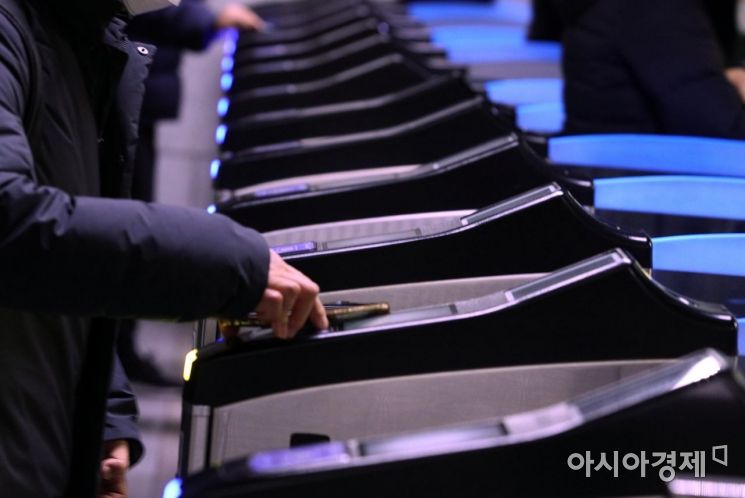
◆Bus and subway transfer passengers pay the same fare= According to Seoul city and others on the 5th, from the first subway ride on the 7th, the basic fare for the metropolitan subway will increase by 150 won from the existing 1,250 won to 1,400 won (based on transportation card).
Although the subway basic fare is rising, the fare for passengers transferring between bus and subway remains the same as before. This is because the transfer fare is based on the highest basic fare among the public transportation used. Currently, since the basic fare for branch and main buses is 1,500 won, this is used as the standard. Even with the subway basic fare raised to 1,400 won, it is still lower than the bus basic fare, so there will be little change.
However, an additional 150 won increase in subway fares is scheduled for the second half of next year, making change inevitable. In that case, the subway basic fare will become 1,550 won, which is higher than Seoul’s branch and main bus basic fare of 1,500 won, making the subway basic fare the standard for transfer fares. This means transfer fares will uniformly increase by 50 won.
However, passengers transferring between subway and village buses will experience the full 150 won increase since the subway basic fare is the standard. For village buses, the basic fare is 1,200 won, so the subway basic fare already serves as the transfer fare standard.
The increased subway basic fare will be applied simultaneously across all metropolitan subway sections including Seoul, Incheon, Gyeonggi, and Korail. For cash rides, the fare will be adjusted from 1,350 won to 1,500 won, an increase of 150 won. Early morning discount (based on transportation card, 20% discount) will rise from 1,000 won to 1,120 won, an increase of 120 won. Youth fares will increase by 80 won to 800 won, and children’s fares will increase by 50 won to 500 won.
◆'15-minute re-entry' introduced, but only in Seoul= Along with this, from the 7th, the subway re-entry time in Seoul will be extended from 10 minutes to 15 minutes. The subway re-entry system has been piloted by Seoul city since July 1. With the official introduction of this system, the re-entry time is expanded to 15 minutes.
However, there are important points to note. Subway re-entry is considered a transfer, so only one transfer is applied. Therefore, additional fares may occur depending on the travel distance. Also, it is only available once during subway use and only for users of prepaid or postpaid transportation cards.
Additionally, re-entry must be at the same station, same line, and same exit to qualify. For example, if a passenger alights at Sadang Station on Line 2 and re-enters at Sadang Station on Line 2, the transfer applies. But if they alight at Sadang Station on Line 2 and re-enter at Sadang Station on Line 4, the transfer does not apply, and an additional basic fare of 1,400 won will be charged.
It should also be remembered that this system is limited to sections within Seoul city. The existing applicable sections are those operated by Seoul Metro: Line 1 from Seoul Station (underground) to Cheongnyangni Station (underground), Line 3 from Jichuk Station to Ogeum Station, Line 4 from Jinjeop Station to Namtaeryeong Station, Line 6 from Eungam Station to Bonghwasan Station, and Line 7 from Jangam Station to Onsu Station. Lines 2, 5, 8, and 9 are applied throughout their entire sections, and the re-entry system is newly introduced on the Ui-Sinseol Line and Sillim Line. The re-entry system does not apply to Gyeonggi Province, Incheon, or Korail sections. Gyeonggi Province, Incheon, and Korail did not participate in the pilot operation of this system. In particular, there is strong opposition from Gyeonggi Province and Incheon, which bear 46% of the metropolitan area transfer loss compensation fund.
Seoul city plans to continue discussions for cooperation. A Seoul city official said, "This matter has already undergone one round of policy agency consultation," and added, "We plan to continuously request participation in the system."
© The Asia Business Daily(www.asiae.co.kr). All rights reserved.
![Clutching a Stolen Dior Bag, Saying "I Hate Being Poor but Real"... The Grotesque Con of a "Human Knockoff" [Slate]](https://cwcontent.asiae.co.kr/asiaresize/183/2026021902243444107_1771435474.jpg)










