The three major indices of the U.S. New York stock market showed mixed trends in early trading on the 4th (local time) as Treasury yields fell following weaker-than-expected private employment data.
At around 10:04 a.m. at the New York Stock Exchange, the Dow Jones Industrial Average was trading at around 32,951, down 50.68 points (0.15%) from the previous close. Meanwhile, the large-cap-focused S&P 500 index rose 1.49 points (0.04%) to 4,230, and the tech-heavy Nasdaq index gained 39.53 points (0.3%) to 13,099.
Currently, within the S&P 500, energy, industrial, and financial stocks are declining, while consumer discretionary, technology, and materials stocks are rising. In particular, energy stocks have seen notable declines due to falling international oil prices. Phillips 66 dropped 4% from the previous close, and Devon Energy fell more than 3%. Cal-Maine Foods is down over 8% after reporting weak sales. Apple is showing a slight decline after KeyBanc Capital Markets downgraded its investment rating. Intel is trading sideways after announcing the spin-off of its specialized business serving defense and communications sectors. Tesla is showing gains close to 2%.
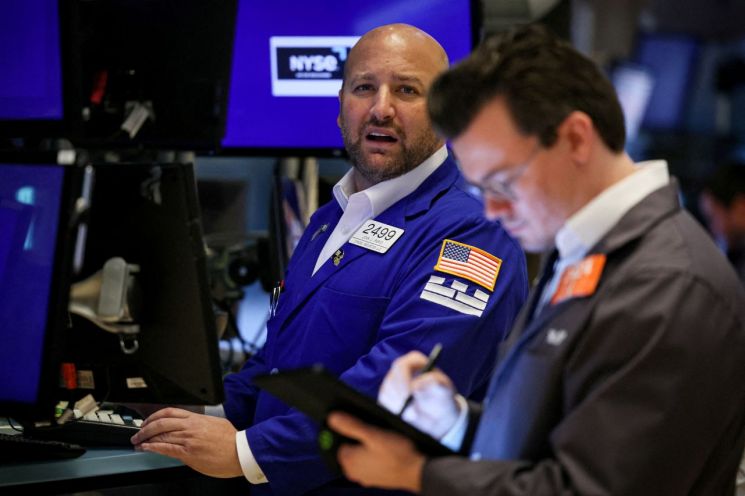
Investors closely monitored Treasury yield movements along with the economic data released that day. According to ADP, U.S. private sector employment increased by 89,000 jobs in the month, significantly below the expected 150,000. This is a clear slowdown compared to the 180,000 increase in August. ADP Chief Economist Nela Richardson commented, "There has been a significant decline in job growth this month." This result contrasts with the previous day's Job Openings and Labor Turnover Survey (JOLTs), which exceeded expectations. The August private sector job openings were recorded at 9.61 million, surpassing the Dow Jones estimate of 8.8 million, which had heightened concerns about Federal Reserve tightening.
With the ADP employment data falling short of expectations, Treasury yields retreated from the highest levels since 2007 recorded the previous day. In the New York bond market, the 10-year U.S. Treasury yield dropped to around 4.77%. The 2-year yield, sensitive to monetary policy, is trading near 5.11%. The U.S. Dollar Index, which measures the dollar's value against six major currencies, fell slightly to around 106.9. The Chicago Board Options Exchange (CBOE) Volatility Index (VIX), known as Wall Street's "fear gauge," hit the 20 level before declining.
As a result, investors' attention is focused on the September employment report to be released on the 6th. The Fed believes that to achieve its 2% inflation target, below-trend growth and a cooling labor market are necessary. If employment data continue to exceed expectations, concerns about Fed tightening will inevitably increase. Wall Street forecasts that nonfarm payrolls for September will slow to 163,000 compared to the previous month. The direction of the unemployment rate, which hit a high of 3.7% in August?the highest since February 2022?is also seen as critical. Additionally, weekly unemployment claims data will be released the following day. The September ISM Services PMI released that day came in at 53.6, below both expectations and August's figure.
Warnings continue in the market regarding the recently rising Treasury yields. Jeffrey Gundlach of DoubleLine Capital, known as the "Bond King," warned on X (formerly Twitter) that "the spread between the 2-year and 10-year yields has narrowed from 108 basis points a few months ago to 35 basis points," signaling a recession in the bond market. Typically, an inversion where short-term yields exceed long-term yields is considered a litmus test for recession.
Oil prices are declining. West Texas Intermediate (WTI) crude is trading around $86 per barrel, down more than 3% from the previous day. Brent crude also fell about 3%, dropping to the $88 per barrel range.
© The Asia Business Daily(www.asiae.co.kr). All rights reserved.
![Clutching a Stolen Dior Bag, Saying "I Hate Being Poor but Real"... The Grotesque Con of a "Human Knockoff" [Slate]](https://cwcontent.asiae.co.kr/asiaresize/183/2026021902243444107_1771435474.jpg)
















