Announcement of Plan to Promote 'CBDC Usability Test'
The Bank of Korea, the Financial Services Commission, and the Financial Supervisory Service will jointly conduct an experiment in cooperation with the Bank for International Settlements (BIS) to build future currency infrastructure. This experiment is being carried out to explore the optimal CBDC design model suitable for Korea’s financial and economic conditions amid the increasing intensity of central bank digital currency (CBDC) research and development by major countries.
In particular, this experiment is a public-private joint project involving not only the three institutions but also multiple banks. Analysts note that this marks a step forward in CBDC utilization, as the institutions collaborate to establish a CBDC network for the issuance and circulation of institutional CBDCs and private digital currencies.
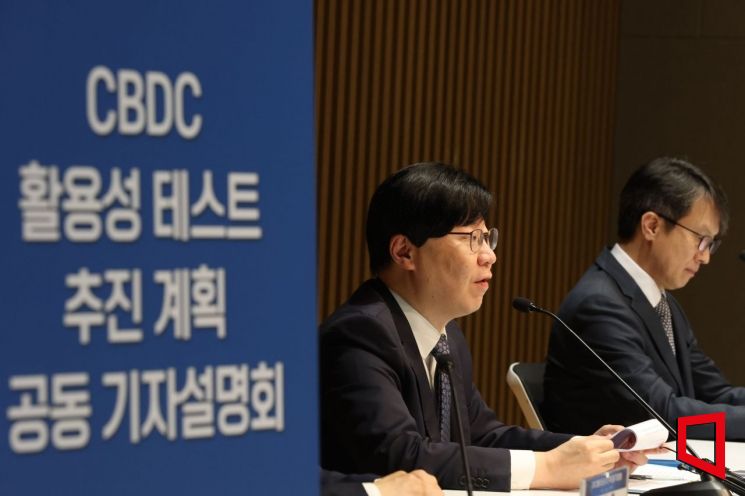 Kim So-young, Vice Chair of the Financial Services Commission (first from the left), is speaking at the joint press conference on the plan to promote the usability test of CBDC held on the afternoon of the 4th at the Integrated Annex of the Bank of Korea in Jung-gu, Seoul.
 From the left, Vice Chair Kim and Lee Myung-soon, Senior Vice Chair of the Financial Supervisory Service. Photo by Joint Press Corps
On the 4th, the Bank of Korea held a joint press briefing with the Financial Services Commission and the Financial Supervisory Service to announce plans to promote a "CBDC usability test."
CBDC refers to a new form of currency issued digitally by central banks. Depending on the scope of use and users, CBDCs can be implemented as retail (general-purpose) or wholesale (institutional) types. Previously, the Bank of Korea conducted simulation research (August 2021 to June 2022) and "linkage experiments with financial institutions" (July 2022 to December 2022), focusing on retail CBDCs, conducting multifaceted research and development on technology, legal and institutional issues, and ripple effects.
This CBDC usability test will primarily focus on "institutional CBDCs," which are used for fund transactions and final settlements between financial institutions. This is similar to the current practice where banks use deposits (reserve funds) in accounts opened at the central bank to conduct fund transactions and final settlements.
Banks will provide digital payment means (tokenized deposits) available to the general public within the "CBDC network" built by the Bank of Korea using distributed ledger technology. The CBDC network consists of the CBDC system and external linkage systems, and within this network, institutional CBDCs and three types of private digital currencies (deposit tokens, e-money tokens, and special payment tokens) will be issued.
These payment means will circulate within the new currency infrastructure established by the Bank of Korea and jointly managed with the Financial Services Commission and the Financial Supervisory Service.
The selection process for system developers will begin today, and detailed information can be found on the Korea ON-line E-Procurement System (www.g2b.go.kr). An explanatory session for system developers and banks is scheduled for October. The Bank of Korea, the Financial Services Commission, and the Financial Supervisory Service will disclose detailed information such as specific use cases and participating banks by the end of November, and after preparations including system construction, a general public participation test is planned to commence around the fourth quarter of next year.
This test will not only include technical experiments in a virtual environment such as proof of concept but also provide opportunities for the general public to participate in limited tests of some use cases, allowing them to directly experience the utility of new digital payment means.
The Bank of Korea, the Financial Services Commission, and the Financial Supervisory Service have also conducted thorough discussions on institutional aspects during the test preparation process. Considering consistency with current laws, only banks will participate in this test, and real transaction tests for some use cases will utilize only "deposit tokens." Whether to expand the test in stages will be decided later after comprehensively reviewing related institutional issues following this test. The three institutions plan to continuously monitor related matters to ensure that real transaction tests involving the general public can be conducted under sufficient user protection measures within the current legal framework.
The BIS has actively shared research and development experience related to future currency systems, including CBDCs, from the initial preparation stage of the test. In particular, experts from the BIS Innovation Hub and Monetary and Economic Department provided technical advice on the design and construction of the "CBDC network." Based on prior discussions, a joint report including the significance of the test and detailed design models was published with the Bank of Korea.
Furthermore, the three institutions have formed a working-level consultative body with related ministries such as the Ministry of Economy and Finance and affiliated organizations to ensure smooth progress of the test, and will continue technical cooperation with the BIS.
The Bank of Korea stated, "This test is expected to lay the foundation for implementing various innovative payment and financial services differentiated from existing services by presenting a pilot model of future currency infrastructure reflecting IT technological advancements." It emphasized, "It can also contribute to establishing ways for new types of financial products, such as tokenized securities, to be traded efficiently through safer payment means."
© The Asia Business Daily(www.asiae.co.kr). All rights reserved.
![Clutching a Stolen Dior Bag, Saying "I Hate Being Poor but Real"... The Grotesque Con of a "Human Knockoff" [Slate]](https://cwcontent.asiae.co.kr/asiaresize/183/2026021902243444107_1771435474.jpg)

















