Eurozone Housing Prices Down 1.7% Year-on-Year in Q2
Europe's Largest Economic Engine Germany Falls Nearly 10%
Shadow of Eurozone Economic Recession
In the second quarter of this year, European housing prices fell for the first time in nine years. Housing prices in Germany, the largest economic engine in Europe, dropped by nearly 10%. As corporate activities and private consumption shrink, the real estate market's weakness has become more apparent, leading to analyses that the shadow of economic recession is deepening in Europe.
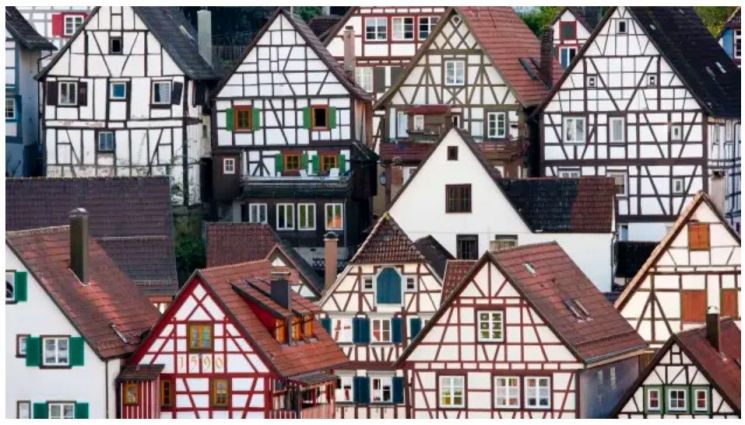
According to Eurostat, the European Union's (EU) statistical office, on the 3rd (local time), housing prices in the Eurozone fell by an annualized rate of 1.7% in the second quarter compared to the same period last year. This is the first decline in Eurozone housing prices in nine years since 2014. In the previous quarter, prices had risen by 0.4%. Housing prices in the EU region surged about 50% from 2015 until last year.
The decline is attributed to the increased burden of purchasing homes as central banks prolonged their high-intensity tightening policies amid inflation. The European Central Bank (ECB) raised its benchmark interest rate from 0% to 4.5% at an unprecedented pace starting in July 2022. As a result, commercial banks increased mortgage rates and tightened lending standards. This increased borrowing costs, leading to a decrease in housing demand.
The largest drop in housing prices was in Germany, Europe's largest economy, with an annualized decline of 9.9%. Denmark and Sweden also saw decreases of 7.6% and 6.8%, respectively. In contrast, Eastern European countries such as Croatia, Bulgaria, and Lithuania experienced price increases of 13.7%, 10.7%, and 9.4%, respectively.
Luis de Guindos, Vice President of the ECB, recently stated in an interview with foreign media regarding the decline in German housing prices, "It is not entirely surprising," adding, "There are clear signs of overvaluation that need to be corrected." He further noted, "Commercial real estate is the main concern for the ECB in terms of financial stability," but also emphasized, "Attention should be paid to the more resilient residential real estate sector."
The impact of the crisis in the European economy, which has recently entered a recession phase, is also reflected in housing prices. Germany, where housing prices fell the most, recorded economic growth rates of -0.4% in Q4 last year and -0.1% in Q1 this year, marking two consecutive months of negative growth, followed by 0% growth in Q2 compared to the previous quarter. The energy crisis triggered by the Ukraine war, inflation, high-intensity tightening, and the economic slowdown in China, Germany's largest trading partner, have all contributed to this. Germany's industrial production, a key economic indicator, decreased by 0.8% in July compared to the previous month, continuing a three-month decline. The outlook is even bleaker. The International Monetary Fund (IMF) forecasts that Germany will shrink by 0.3% this year, making it the only G7 country expected to experience negative growth. Additionally, five major German economic research institutes, including the Halle Institute for Economic Research, have projected an annual growth rate of -0.6% for this year.
The market already views Europe as having entered a recession. One of the representative leading economic indicators, the Eurozone manufacturing activity, shows a sharp contraction. The Eurozone Manufacturing Purchasing Managers' Index (PMI), compiled by S&P Global, fell again from 43.5 in August to 43.4 in September. A PMI above 50 indicates economic expansion, while below 50 indicates contraction. As the Eurozone economy rapidly cools, there is a prevailing analysis that the ECB has ended its tightening cycle, but the current high interest rates are expected to persist for some time. The recent surge in international oil prices may also delay the timing of interest rate cuts.
Bert Colijn, an economist at ING, stated, "The Eurozone economy is already in recession, and signs of further weakening are emerging," adding, "Due to the impact of restrictive monetary policy on the economy, overall economic sluggishness is expected to continue."
© The Asia Business Daily(www.asiae.co.kr). All rights reserved.

















