Military Academy Dropouts Nearly Double in 5 Years
Highest Dropout Rate Immediately After Enrollment
"Minimize Cadets Leaving Military Service on Their Own"
It has been identified that more than 500 cadets voluntarily left the military academies that train army officers over the past five years.
According to the Ministry of National Defense's data on 'Voluntary Withdrawals from Each Military Academy,' disclosed on the 3rd by Song Ok-ju, a member of the National Assembly's National Defense Committee from the Democratic Party of Korea, 545 cadets withdrew from military academies from 2019 to September of this year.
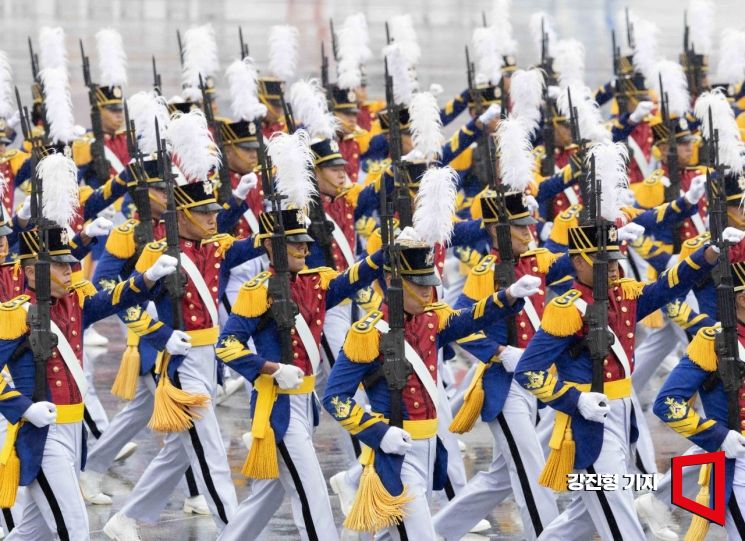 On the morning of the 26th of last month, cadets from the Korea Military Academy were marching in formation at the 75th Armed Forces Day ceremony held at Seoul Airport in Seongnam, Gyeonggi Province. Photo by Joint Press Corps
By year, the numbers increased annually: 74 in 2019, 93 in 2020, 91 in 2021, and 146 in 2022. This year, as of September, 141 cadets have already left the schools. By grade level, a cumulative total of 176 first-year cadets withdrew over the past five years, drawing attention. Additionally, 72 second-year, 226 third-year, and 71 fourth-year cadets were recorded as having withdrawn.
Although the number of third-year withdrawals is the highest, this is because the Korea Army Academy at Yeongcheon selects cadets who have graduated from two-year colleges or have at least sophomore standing in four-year universities, considering them as third-year cadets upon admission. In other words, excluding the Korea Army Academy at Yeongcheon, the withdrawal rate is highest among first-year cadets immediately after enrollment.
Cadet withdrawals have been criticized as an immediate waste of national budget. It typically costs over 200 million KRW of national funds over four years to train one cadet. This amount includes direct costs such as salary, meals, uniforms, personal items, ammunition, and educational materials, as well as indirect costs like personnel management, equipment and facility maintenance, and fuel.
There are also concerns about potential problems in producing personnel who will grow into military officers. Considering the thinning pool of young officers, urgent measures are needed.
Representative Song stated, “The Ministry of National Defense and each military branch must analyze the current situation through accurate organizational diagnosis and prepare alternatives to minimize the number of cadets voluntarily leaving the military.”
The main cause of cadet withdrawals is cited as issues with officer treatment. According to the government's pledge of a '2 million KRW monthly salary for soldiers,' the monthly salary for sergeants (including allowances) will rise to 2.05 million KRW by 2025. In contrast, the starting salary for junior officers at step 1 is 1.78 million KRW, which could be surpassed by soldiers’ pay by 2025 if public servant wage increase rates continue.
Earlier, it was revealed that half of the universities operating the Army ROTC (Reserve Officers' Training Corps) system failed to fill their candidate quotas, raising further concerns. The competition rate for ROTC candidates in the first half of this year was the lowest ever at 1.6 to 1, prompting the Army to begin additional recruitment on the 1st of last month.
© The Asia Business Daily(www.asiae.co.kr). All rights reserved.
![Clutching a Stolen Dior Bag, Saying "I Hate Being Poor but Real"... The Grotesque Con of a "Human Knockoff" [Slate]](https://cwcontent.asiae.co.kr/asiaresize/183/2026021902243444107_1771435474.jpg)
















