Hyundai Motor Labor and Management, Special Agreement for Future Co-Growth
Plan to Promote Multifunctional and Multipurpose New Factory
Likely to Produce Small-Scale Convertible and Limited Editions
Increased Possibility of Concept and Prototype Market Release
Hyundai Motor Company's labor and management agreed on several additional points related to future business during this year's wage collective bargaining. Known as the 'Special Agreement on Future Co-Growth,' it refines in more detail how to proceed with the mid- to long-term new businesses that they had broadly agreed upon so far.
Primarily, it is a measure to prepare for future new businesses. Since jobs in the powertrain sector, such as engines and transmissions, are expected to decrease due to the electrification transition, the agreement also aims to eliminate employment insecurity spreading among the labor union and individual union members.
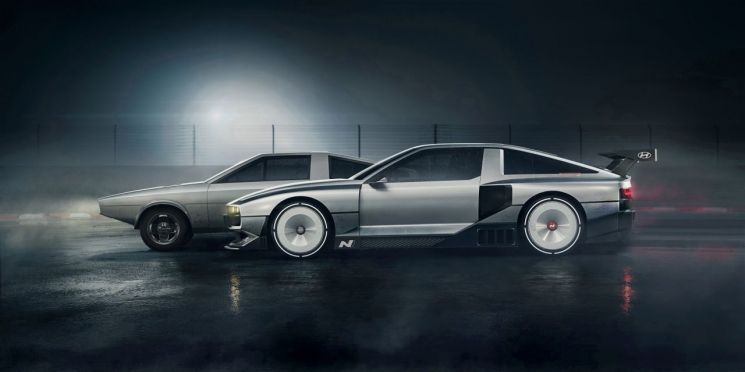 Hyundai N Vision 74. It is a hybrid system combining a battery motor and hydrogen fuel cells, making it Hyundai Motor Company's high-performance brand N's first hydrogen hybrid rolling lab. The rolling lab was created for the purpose of actual driving during the development stage to refine various technologies.
 Among the detailed agreements, the notable point is the plan to promote a multifunctional and multipurpose production plant. It will produce ultra-high-end models or limited edition vehicles to be developed in the future. Models for new concept demonstrations will also be made here. It is expected that cars like the Genesis Convertible introduced in the U.S. last year, the high-performance hydrogen fuel cell hybrid car N Vision 74, and the Pony Coupe restored after 40 years and unveiled this year will be produced at this plant.
So far, concept models like the Genesis Convertible and N Vision 74, prototypes, and pre-mass production verification vehicles have typically been produced at the research institute level. This involves ordering parts separately and going through the process of direct manufacturing. Most leading research stages of major manufacturers, including new car development and production, are similar. It is reported that producing such prototypes or concept models costs several hundred million won just for manufacturing, excluding development costs.
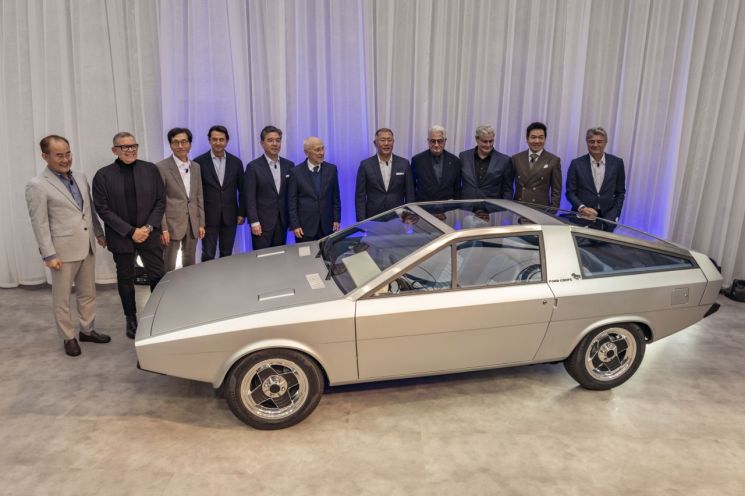 Pony Coupe concept restoration model unveiled in May this year. From the left: Vice President Kim Yong-hwa, Peter Schreyer, former Hyundai Motor President Lee Chung-gu, President Jose Munoz, President Jang Jae-hoon, Giorgio Valteri, Chairman Chung Eui-sun, Giorgetto Giugiaro, President Luc Donckerwolke, Vice President Lee Sang-yup, Fabrizio Giugiaro
 Presenting concept models or prototypes and having a final assembly line, commonly called a complete vehicle factory, to produce mass-produced cars are entirely different stages. By establishing a mass production system together with partners, production costs can be reduced while improving quality. It is possible for manufacturers to offer cars to consumers at tens of millions of won while leaving a certain margin on development costs because of this specialized mass production process.
The company official stated that the exact start time, scale, and specific models to be produced at the upcoming multifunctional and multipurpose plant have not yet been decided. Typically, complete vehicle factories consider an annual production of 200,000 to 300,000 units as an efficient scale. Hyundai Motor's Ulsan plant, considered the world's largest, has five plants from Plant 1 to Plant 5, producing about 1.4 million units annually. The new plant is expected to be smaller in scale than these. Demand for high-priced limited edition models is also not very high.
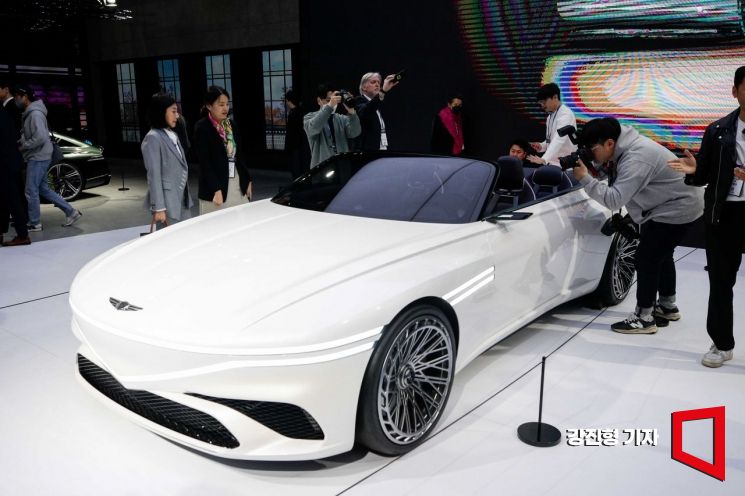 At the '2023 Seoul Mobility Show Press Briefing' held in March this year, the 'Genesis X Convertible' was unveiled. Photo by Jinhyung Kang aymsdream@
The new plant aligns with the company's pursued direction. In a situation where technological competition surrounding future mobility such as electrification and software-based vehicles is intensifying, Hyundai Motor is encouraging new attempts both internally and externally, emphasizing the need to establish itself as a 'first mover.' The Ioniq 5 N, praised for opening a new horizon in high-performance electric vehicles, was developed against this backdrop. The hydrogen fuel cell-based hybrid high-performance car is still in the research stage but is the world's first.
If a system capable of mass-producing new cars applying new concepts or technologies at a level accessible to consumers is established, it is expected to respond more agilely to market demand. Additionally, for the high-end brand (Genesis) to establish itself in markets other than Korea and the U.S., it is likely judged that relying solely on large-scale mass-produced models or a limited lineup as now would not be easy. Even Mercedes-Benz's E-Class offers not only the basic sedan but also wagon (estate), coupe, and cabriolet versions. Small-scale limited editions are also one of the means to enhance brand loyalty.
© The Asia Business Daily(www.asiae.co.kr). All rights reserved.
!["I'd Rather Live as a Glamorous Fake Than as a Poor Real Me"...A Grotesque Success Story Shaking the Korean Psyche [Slate]](https://cwcontent.asiae.co.kr/asiaresize/183/2026021902243444107_1771435474.jpg)


















