Letter from 1493 to be auctioned at Christie's this month
Expected winning bid over 2 billion KRW
A printed copy of a letter written by explorer Christopher Columbus to announce the discovery of the New World is appearing at auction for the first time.
On the 30th of last month (local time), the British daily The Guardian reported that a rare Latin translation of the letter Columbus wrote in 1493 will be offered at this month's Christie's auction. This is an early printed edition of a letter written by Columbus, and the auction's winning bid is expected to reach $1.5 million (approximately 2.03 billion KRW).
Felipe Fern?ndez-Armesto, Columbus's biographer, described the event contained in this letter as "the first report of a voyage that completely changed the world." The letter was printed using early printing presses to quickly deliver the news of Columbus's discovery of the New World to elite Europeans at the time. According to The Guardian, the letter offered at this auction was kept as a private collection in Switzerland for nearly 100 years.
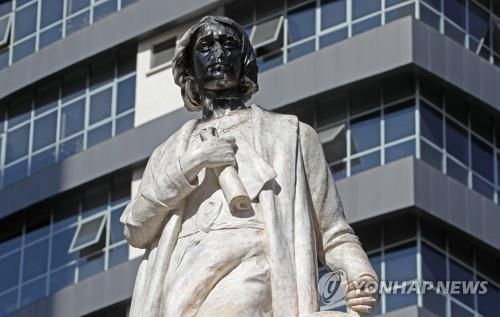
Christie's described this letter as "the earliest Columbus letter available," explaining that Columbus's letters at the time were published internationally and sparked the first 'media frenzy.'
Columbus discovered the island of San Salvador in the West Indies, part of the American continent, 33 days after leaving Spain in 1492. His discovery can be seen as effectively opening the colonial sea routes for Europe. After returning to Europe, Columbus sent this letter to the Spanish royal treasurer in 1493.
In the letter, Columbus wrote, "I led a fleet and sailed to India, where I discovered islands inhabited by many people," and "Above all, I claimed (these islands) for the king and queen." He then praised the abundant nature of the islands he saw and described the natives he met there as "very timid, generous without much suspicion, and foolish."
Historians regard this letter as propaganda marking the beginning of European colonization of the New World.
Jeffrey Simcox, a professor at the University of California, Los Angeles (UCLA), said, "It is important that this letter spread widely thanks to the printing press at the time," adding, "The Spanish royal court used cutting-edge technology to send copies to other European royal courts to prove their claims." Subsequently, the news contained in this letter spread rapidly not only through diplomatic channels but also through commercial channels.
Theo Lewis, a medieval history professor at the same university, explained, "This letter shows how skilled Columbus was at promotion," adding, "The influence of this letter was that it announced he had sailed west and reached the islands of India. However, of course, this was not true."
William Phillips, a Columbus expert at the University of Minnesota, USA, said, "Columbus did not recognize the achievement he had accomplished," and evaluated the letter as "self-promotion and propaganda, a 15th-century version of 'fake news.'"
Columbus, originally from Italy, sailed west under the sponsorship of Queen Isabella I of Castile and King Ferdinand II of Aragon in Spain. Although he arrived at islands in America, he believed he had reached the East Asian region and maintained that belief until his death.
Meanwhile, evaluations of Columbus by later generations are polarized. From a European perspective, Columbus is an explorer who pioneered new sea routes, but in America, he is seen as a figure who exploited indigenous people and plundered resources, laying the groundwork for European imperialist colonial rule. In the United States, Columbus statues and monuments have been removed, and many states have decided to commemorate the federal holiday "Columbus Day" (the second Monday of October) as "Indigenous Peoples' Day" instead.
© The Asia Business Daily(www.asiae.co.kr). All rights reserved.

















