Recently, international oil prices have reached their highest point in 13 months, posing a major risk to the 'low in the first half, high in the second half' economic outlook for the latter half of the year. The rise in international oil prices has led to increases in the prices of petroleum and chemical products, as well as energy charges such as electricity and gas, which could further stimulate inflation.
According to the New York Mercantile Exchange on the 29th (local time), the November delivery West Texas Intermediate (WTI) crude oil futures price was $90.79 per barrel. Although it decreased by 1.00% compared to the previous day, it still maintained a high price in the $90 range. Previously, on the 27th, WTI reached $93.68 per barrel, marking the highest level since August 29 of last year.
The sharp rise in international oil prices is due to expanded concerns over supply disruptions following Saudi Arabia and Russia's decision to extend production cuts. Additionally, a significant decrease in U.S. crude oil inventories also influenced the price. According to the U.S. Energy Information Administration (EIA), U.S. crude oil inventories fell by 2.169 million barrels from the previous week to 416.287 million barrels.
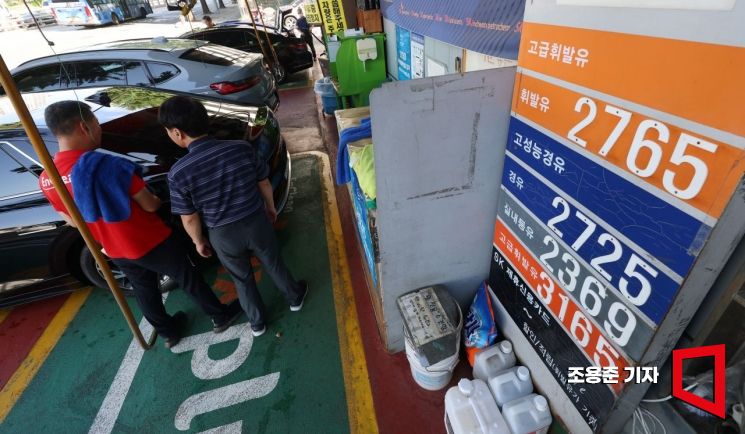 As international oil prices continue to rise despite the extension of the fuel tax reduction measure, gasoline prices have been increasing for the eighth consecutive week. On the 6th, the prices for gasoline and diesel were displayed at a gas station in Seoul. Photo by Jo Yongjun jun21@
The problem is that as oil prices continue to rise, inflationary pressures are increasing. There is immediate pressure to raise public energy charges such as electricity and gas. According to Statistics Korea, electricity, gas, and water charges rose by 21.1% year-on-year last month. The consumer price inflation rate last month was 3.4%, marking the largest increase since April, with electricity, gas, and water charges contributing 0.71 percentage points to inflation. Considering that the upward trend in international oil prices typically affects wholesale electricity prices with at least a three-month lag, this suggests that Korea Electric Power Corporation's electricity purchase costs could soar this winter.
Import prices are also on the rise due to high oil prices. Last month, import prices increased by 4.4% compared to the previous month, marking the largest increase in 17 months. Rising import prices could widen the trade deficit. Domestic gasoline prices are also soaring. According to the Korea National Oil Corporation's oil price information service Opinet, as of 12 noon on the same day, the average nationwide gasoline price was 1,794.50 KRW per liter, slightly up from 1,794.41 KRW the previous day. The average gasoline price sold at gas stations nationwide in the fourth week of this month was 1,789.7 KRW per liter, up 13.39 KRW from the previous week.
 Deputy Prime Minister and Minister of Economy and Finance Choo Kyung-ho, Bank of Korea Governor Lee Chang-yong, Financial Services Commission Chairman Kim Ju-hyun, and Financial Supervisory Service Governor Lee Bok-hyun are attending the Emergency Macroeconomic and Financial Meeting held at the Bankers' Hall in Myeong-dong, Jung-gu, Seoul on the 21st, engaging in discussion. Photo by Jo Yong-jun jun21@
The possibility of a U.S. federal government shutdown is also increasingly becoming a variable in the external economy. A shutdown occurs if the budget is not passed before October 1, resulting in the suspension of all functions except essential services. There are concerns that U.S. economic uncertainties could escalate into global financial instability.
However, despite concerns over rising international oil prices and a potential U.S. shutdown, the government has analyzed that the overall economic trend is improving in the second half compared to the first half. On the 27th, Deputy Prime Minister and Minister of Economy and Finance Choo Kyung-ho, at the SK Hynix site in Icheon, said, "The economic trend has started to gradually enter a recovery phase from the bottom," and added, "Exports will turn positive in October or, at the latest, November."
© The Asia Business Daily(www.asiae.co.kr). All rights reserved.


















