There is a growing possibility that prices will rise further after the Chuseok holiday, the largest traditional holiday in Korea. The decision on whether to raise electricity rates in the fourth quarter of this year is imminent, and with additional increases in milk prices, consumer burdens are expected to grow.
According to government departments on the 29th, the Ministry of Economy and Finance and the Ministry of Trade, Industry and Energy will decide next month whether to raise electricity rates for the fourth quarter of this year. Korea Electric Power Corporation (KEPCO) raised electricity rates by 6.9 won per kilowatt-hour (kWh) in the second quarter of last year and has increased rates quarterly up to the second quarter of this year. Following a 13.1 won per kWh increase in the first quarter, rates were raised by 8.0 won per kWh last month, marking a total increase of 40.4 won over five increments.
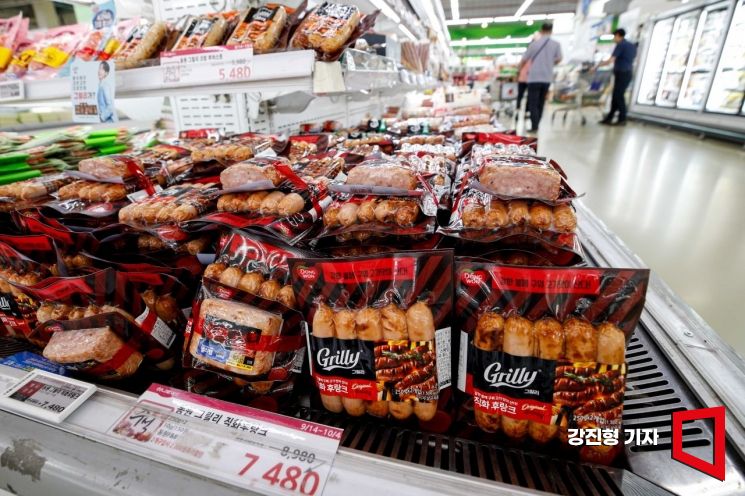 Sausages are displayed on the sales counter at Hanaro Mart Yangjae Branch in Seocho-gu, Seoul. Photo by Jinhyung Kang aymsdream@
The reason KEPCO has implemented rate hikes every quarter is due to growing deficits caused by freezing electricity rates despite rising international energy prices. As of June, KEPCO's total debt exceeded 200 trillion won. With ongoing deficits, KEPCO maintains that a rate increase is necessary in the fourth quarter as well. Kim Dong-cheol, the newly appointed KEPCO president, emphasized at his inauguration, "In a situation where international oil prices and exchange rates are soaring again, normalizing electricity rates is absolutely necessary."
If electricity rates increase further, consumer price inflation is likely to accelerate. According to Statistics Korea, last month the inflation rates for electricity and city gas prices were 25.0% and 21.4% respectively compared to the same period last year. Electricity prices have maintained a double-digit increase for one year and six months, peaking at 29.5% in January this year after recording 11.0% in April last year. Gas prices also surged up to 36.2% in October last year and continue to maintain an increase rate in the 20% range.
Milk Price Increase Realized in October
Following the rise in raw milk prices, milk prices are also inevitably increasing. After Seoul Milk, Maeil Dairies and Namyang Dairy Products are scheduled to raise the prices of fresh milk starting next month. Maeil Dairies will sequentially raise the ex-factory prices of products using domestic raw milk, such as milk, processed milk, fermented milk, and cheese, from the 1st of next month according to distribution channels. Convenience store prices will be raised from November 1.
Namyang Dairy Products will also raise the ex-factory price of its flagship product, Mat-it-neun Milk GT 900ml, by about 4.6%, and other dairy products by an average of 7% starting next month. Earlier, Seoul Milk announced a price increase for fresh milk, raising the convenience store price of its ‘Na 100% Milk’ 1L product from 3,050 won to 3,200 won, a 4.9% increase, starting next month.
The dairy industry states that price increases are unavoidable due to rising costs of raw milk, sugar, packaging materials, processing, and logistics. Previously, the Dairy Promotion Association, a consultative body between the dairy farming and dairy industries, agreed on a raw milk price increase of 88 won per liter (8.8%) for drinking milk and 87 won (10.9%) for processed milk. The base price for drinking milk is 1,084 won per liter, and for processed milk, 887 won.
Concerns are emerging that milk price increases could trigger a wave of milkflation (milk + inflation), with prices of processed foods using milk as a main ingredient?such as bread, coffee, and ice cream?rising consecutively.
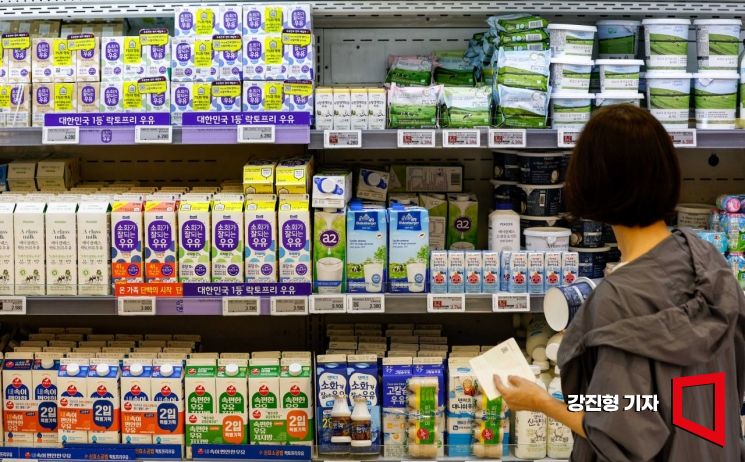 Milk is displayed at a large supermarket in Seoul on the 30th, where the crude oil price is expected to increase by about 69 to 104 won per liter. Photo by Jinhyung Kang aymsdream@
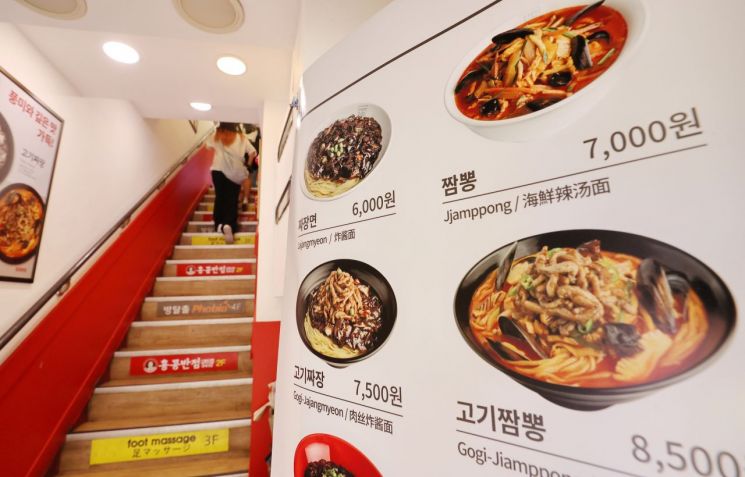
Jajangmyeon at 7,000 Won... Dining Out Costs Soar
The price of jajangmyeon, a staple meal for ordinary people, is approaching 7,000 won, and the price of bibimbap has surpassed 10,000 won. According to data from the Korea Consumer Agency’s True Price, the average price of seven dining-out menu items in Seoul increased by 35.3% compared to August 2014 as of last month.
Specifically, the price of jajangmyeon rose from 4,500 won to 6,992 won, a 55.4% increase. Bibimbap increased from 7,818 won to 10,423 won, up 46.2%, and naengmyeon rose from 7,864 won to 11,231 won, up 42.8%. Kimchi jjigae set meals increased from 5,636 won to 7,846 won (39.2%), kalguksu from 6,500 won to 8,962 won (37.9%), samgyeopsal (pork belly) for 200g from 14,117 won to 19,150 won (35.7%), and samgyetang from 13,500 won to 16,846 won (24.8%), all showing increases.
The persistent rise in dining-out prices is due to complex factors such as international food prices and labor cost increases. According to the Ministry of Agriculture, Food and Rural Affairs, food material costs account for the largest share of dining-out operating expenses at 41%, followed by labor costs at 34%, rent at 10%, commissions at 8%, and taxes at 7%. Although grain prices peaked in the second quarter of last year following the Russia-Ukraine war in February, prices for sugar, milk, and other items remain high.
According to a report titled "Recent Consumer Price Trends: Risk Factors and Uncertainty of Outlook" published by the National Assembly Research Service, the domestic consumer price inflation rate, which had been on a downward trend this year, rose back to the 3% range in August, and the core inflation index, which reflects the long-term trend of prices, has been exceeding the overall inflation rate for several months since March.
The National Assembly Research Service explained, "Among domestic inflation risk factors under these internal and external conditions, in the energy sector, there is the possibility of a reduction in the 'fuel tax elasticity rate' and additional increases in 'electricity and city gas rates.' In terms of agricultural and food prices, there are upward price pressures due to steady increases in production input costs and international agricultural product price increases caused by factors such as El Ni?o, including sugar."
© The Asia Business Daily(www.asiae.co.kr). All rights reserved.
![Clutching a Stolen Dior Bag, Saying "I Hate Being Poor but Real"... The Grotesque Con of a "Human Knockoff" [Slate]](https://cwcontent.asiae.co.kr/asiaresize/183/2026021902243444107_1771435474.jpg)


















