National Assembly Legislative Research Office Publishes 'Recent Consumer Price Trends: Risk Factors and Uncertainty in Outlook'
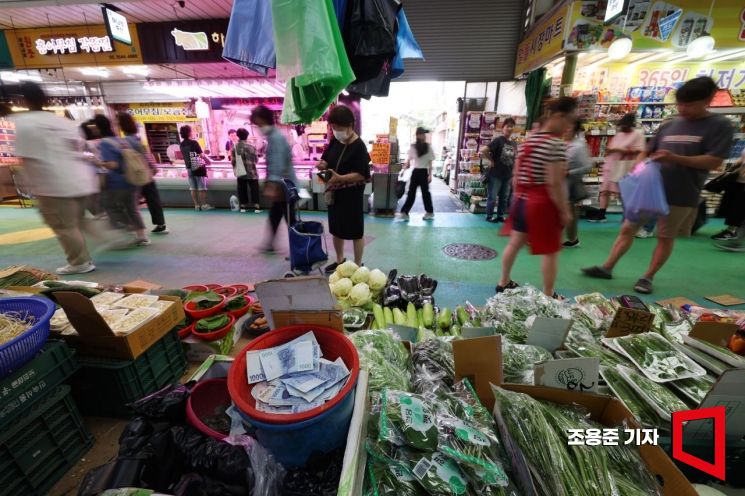 On the 21st, one week before the Chuseok holiday, Mangwon Market in Mapo-gu, Seoul, is bustling with people looking to purchase ancestral ritual items. Photo by Jo Yongjun jun21@
There is a diagnosis that special caution is needed in financial and fiscal policies as the instability of future inflation paths is increasing.
On the 30th, the National Assembly Legislative Research Office stated this in 'Recent Consumer Price Trends: Risk Factors and Instability of Outlook.' The consumer price inflation rate, which seemed to stabilize downward recently, rose back to the 3% range in August, and the core price index, which shows the long-term trend of inflation, has also exceeded the total index inflation rate since March.
The report said, “Due to frequent recent weather anomalies, geopolitical risks, and the production cut stance of oil-producing countries, energy and agricultural product prices are becoming unstable. At the same time, the economic and financial indicators of major countries and monetary and fiscal policy responses are influencing the situation, resulting in a mixed pattern of upward and downward inflation risks.”
Recently, international oil prices have surpassed $90 again since November last year, reaching record highs due to the voluntary production cut extension measures by Saudi Arabia and Russia. If market expectations of future supply shortages are reflected, speculative demand will also increase, raising the possibility of further price increases.
However, the report noted, “There is also downward pressure on energy prices due to China's weak domestic and external demand and high unemployment.” It added, “Under these domestic and international conditions, the reduction of the 'fuel tax elastic rate' and the possibility of additional increases in 'electricity and city gas rates' could act as domestic inflation risk factors.”
Regarding agricultural product prices, it stated, “Along with inflationary pressure due to the steady increase in production input costs, the influence of El Ni?o is expected to continue until early next year, so the possibility of accelerating inflationary pressure on agricultural products originating from emerging countries cannot be overlooked at any time.”
The report said, “Considering a series of discussions, the future inflation path appears unstable,” adding, “As the directions of major countries' economic indicators and policy responses differ, upward and downward inflation pressures are mixed, making it difficult to find a consensus on inflation outlook.” It also said, “There is a possibility of public utility fee adjustments, including fuel tax, in the second half of this year, so future consumer prices are expected to be greatly influenced by the timing and duration of government policy implementation.” It continued, “While avoiding symptomatic treatment, special attention is needed to ensure that economic indicators such as the economy, finance, and fiscal policy are harmonized precisely.”
© The Asia Business Daily(www.asiae.co.kr). All rights reserved.

















