14% Larger and Up to 30% Brighter Than Mini Moon
Rises First from Dokdo... 6:23 PM Seoul Time
This year's Chuseok full moon is expected to be unusually large and bright. On the 29th, the last supermoon of the year will rise on Chuseok day.
A supermoon is an astronomical phenomenon that occurs when the moon orbits closest to the Earth, appearing 14% larger and up to 30% brighter than a micromoon (a full moon that rises when the moon is farthest from the Earth).
In particular, this supermoon is only 1% different in size from last month's super blue moon. A blue moon refers to the occurrence of two full moons in one month. On this day, a cosmic show is also scheduled, with Saturn shining to the upper right and Jupiter to the lower left of the supermoon at the center.
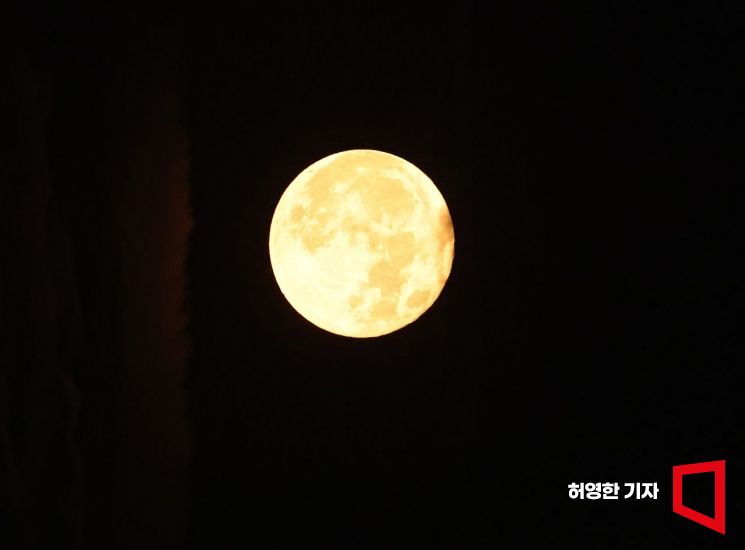 The 'Super Blue Moon,' which appears largest as it comes closest to Earth, rose over Seoul on the night of August 31. Photo by Heo Younghan younghan@
The supermoon will first rise at 6:03 PM on Dokdo Island. In Busan and Ulsan, it will rise at 6:14 PM, and in Seoul, it will be at 6:23 PM. In Incheon, the full moon can be seen at 6:24 PM. The highest point of the moon (based on Seoul) will be at 12:37 AM on the 30th, just past midnight.
A full moon occurs when the moon and the sun face each other in a straight line with the Earth in between. Among these, a supermoon is a full moon that rises when the moon is closest to the Earth in its orbit. The moon orbits the Earth in an elliptical shape, with an average distance of 384,400 km. The closest distance to Earth (perigee) is 363,396 km, and the farthest (apogee) is 405,504 km.
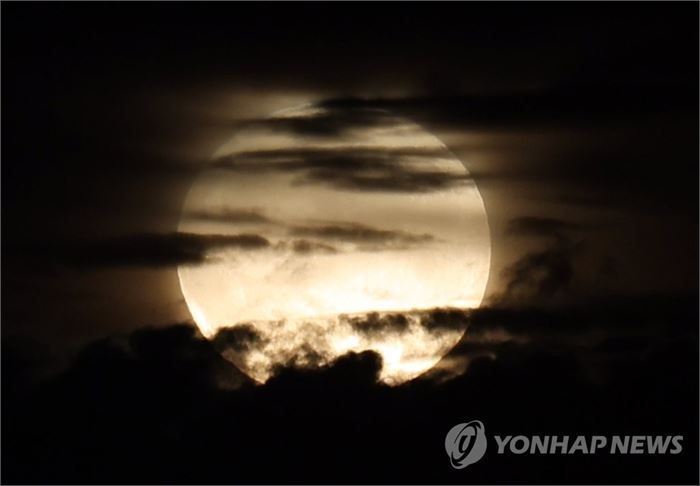
The term supermoon is not an official astronomical term. It was coined in 1979 by astrologer Richard Nolle. There is no agreed official definition of a supermoon. According to Nolle's criteria, a supermoon is a full moon that occurs when the moon is within 90% of its closest distance to Earth on its orbit. By this standard, the moon must be within an average of 367,607 km from Earth to qualify as a supermoon.
Supermoons usually appear 3 to 4 times a year. Consecutive occurrences are not uncommon. This year, there have been four supermoons: on July 3, August 1, August 30, and now the Chuseok full moon. In 2024, four consecutive supermoons can be observed starting from August.
Meanwhile, on the 28th, when the supermoon rises, fine dust levels nationwide are expected to be at a 'moderate' level, allowing for a clear night sky. Morning low temperatures are forecasted to be between 12 and 20 degrees Celsius, and daytime highs between 23 and 28 degrees Celsius. Most regions nationwide will experience a temperature difference of 10 to 15 degrees Celsius between day and night.
© The Asia Business Daily(www.asiae.co.kr). All rights reserved.
![User Who Sold Erroneously Deposited Bitcoins to Repay Debt and Fund Entertainment... What Did the Supreme Court Decide in 2021? [Legal Issue Check]](https://cwcontent.asiae.co.kr/asiaresize/183/2026020910431234020_1770601391.png)

















