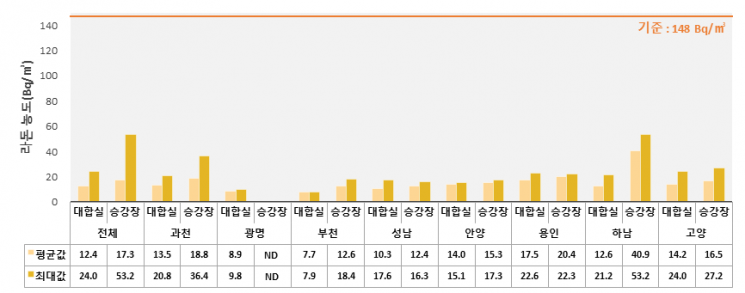
Radon levels in all 39 underground subway stations in Gyeonggi Province were found to be below the standard limits, indicating they are safe.
The Gyeonggi Provincial Institute of Health and Environment announced on the 28th that it conducted indoor air quality tests for radon pollution at 39 underground subway stations (Lines 3, 4, 5, 7, 8, and Suin-Bundang Line) within Gyeonggi Province, confirming that all were within the standard limits and at a "safe level."
From April to July this year, the institute installed radon detection devices at two locations?the platforms and concourses?of each underground station and analyzed the results using a long-term measurement method by collecting the devices after more than 90 days of monitoring.
The average radon concentrations by city/county were analyzed as follows: ▲ Gwacheon (5 stations) 16.5 Bq/㎥ ▲ Gwangmyeong (2 stations) 8.9 Bq/㎥ ▲ Bucheon (6 stations) 10.6 Bq/㎥ ▲ Seongnam (9 stations) 11.5 Bq/㎥ ▲ Anyang (3 stations) 14.6 Bq/㎥ ▲ Yongin (2 stations) 19.0 Bq/㎥ ▲ Hanam (4 stations) 23.9 Bq/㎥ ▲ Goyang (8 stations) 15.4 Bq/㎥.
These levels are very low and safe compared to the indoor air quality recommended standard of 148 Bq/㎥ for multi-use facilities at all measurement points.
Radon concentrations in underground stations are known to be related to environmental conditions, geological characteristics, the level of outdoor air inflow (operation level of ventilation systems), and underground depth.
The institute explained that operating air conditioning facilities and regularly replacing filters in air purification systems are important methods for managing indoor air quality in underground stations, including radon.
Hong Sun-mo, Head of the Fine Dust Research Department at the Gyeonggi Provincial Institute of Health and Environment, said, "As a result of this survey, residents using underground stations in the province can use the subway without anxiety about radon. We will continue to conduct radon surveys to protect residents' right to know and health, and provide resident-centered living environment services."
© The Asia Business Daily(www.asiae.co.kr). All rights reserved.

















