5060 Generation Accounts for 58% Share... Increasing Every Year
Songpa-gu Signs Business Agreement with 10 Organizations Including Post Office
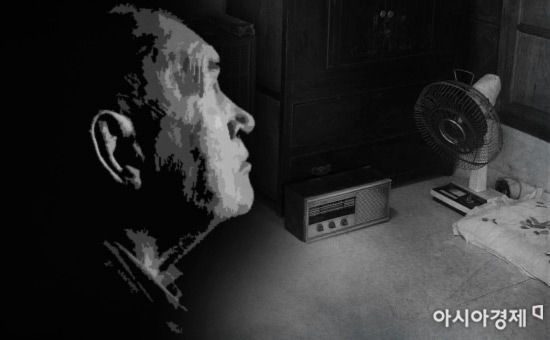
Each year, 3,378 people die alone. The proportion of solitary deaths among people in their 50s and 60s is 58.6%, accounting for more than half of the total, and the rate of solitary deaths among men is four times higher than that of women. The average annual increase rate of solitary deaths over the past five years is 10.0% for men and 5.6% for women. These statistics come from the Ministry of Health and Welfare's first-ever "Solitary Death Survey" conducted last year in South Korea (to be conducted every five years).
Solitary death is defined as a death where ① a person living alone, isolated from family, relatives, and others around them, ② dies alone due to suicide, illness, or other causes, and ③ the body is discovered after a certain period of time has passed. This definition is based on the "Act on the Prevention and Management of Solitary Deaths," which came into effect in April 2021.
The role of local governments in preventing and responding to solitary deaths is increasing. Last year, the Seoul Metropolitan Government established the Socially Isolated Household Support Center at the Seoul Welfare Foundation. They support the operation of an artificial intelligence (AI) check-in service for socially isolated households at risk of solitary death and have created a system that integrates data from social isolation support projects to establish a 24-hour smart care system. They also run a hotline connection project for isolated households utilizing local characteristics such as goshiwon (small lodging houses) and real estate.
Related activities by autonomous districts are also increasing. Songpa-gu recently signed a "Memorandum of Understanding on Solitary Death Prevention and Welfare Blind Spot Discovery and Support" with 10 organizations including the post office, Cowon Energy, and KEPCO MCS.
Postal workers and meter readers who visit homes for their duties notify the district office if they find households suspected to be in crisis, such as those with overdue electricity, water, or gas bills, sudden changes in usage, or accumulated mail in mailboxes. These workers act as welfare blind spot monitors by reporting such cases to Songpa-gu Office through the KakaoTalk channel "Songpa Hope Talk," and then the district office takes action.
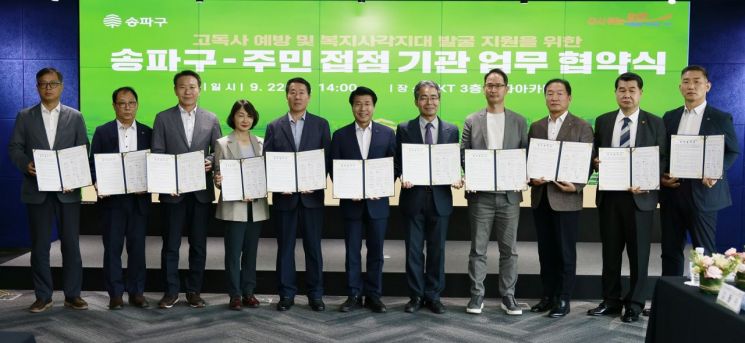 Songpa-gu has signed business agreements with organizations closely related to residents' lives, including Songpa Post Office, Gangdong Waterworks Office, National Health Insurance Service Songpa Branch, Seoul Housing and Communities Corporation Songpa Residential Safety Comprehensive Center, Cowon Energy Service, KEPCO MCS Gangdong Songpa Branch, Songpa Pharmaceutical Association, Korea Goshiwon Association, Korea Association of Realtors Songpa Branch, and Songpa Social Welfare Council. (Photo by Songpa-gu)
Gangnam-gu conducts focused check-ins on 1,235 households identified as at risk of solitary death. The check-in services include twice-weekly phone calls by KT, weekly AI check-ins, and smart plug services that detect risks by measuring changes in TV and electricity usage and lighting brightness. Among the selected risk group, 850 households receive these check-in services. The 385 households that do not wish to receive the check-in services are directly managed by welfare planners at the local community centers.
Gangdong-gu signed a "In[人]Plug Project Business Agreement" last month with the Gangdong-gu branch of the Korea Association of Realtors and is promoting the project targeting several neighborhoods with a high proportion of single-person households. Realtors inform landlords about the project during lease contracts, and if landlords or realtors notice situations such as tenants neglecting mail or falling behind on rent payments, they report these to the local community center.
Based on the pilot operation results, Gangdong-gu plans to expand the project to cover the entire district next year. Along with the In[人]Plug project, the district plans to actively use a reward system for reporting households in crisis to encourage participation from landlords and others. In Jongno-gu, services such as "health drink and milk delivery," "AI check-in service," "care robot service," and "Health-Irang service" are being implemented.
Recent surveys show that there are about 52,000 single-person households in Seoul classified as at risk of solitary death.
© The Asia Business Daily(www.asiae.co.kr). All rights reserved.


















