Airlines Must Minimize Vacancies and Generate Profit
Sales Prices Set Below Price Ceiling
Prices Vary by Booking Class Even for Same Seat
Due to Various Benefits and Condition Differences
"Use Airline Promotions and Buy on Low-Demand Departure Dates"
Early Bird and 'Ttaengcheori' Deals Also Effective Methods
Since the recent Chuseok holiday, airports have been bustling with people traveling abroad. According to data from Incheon International Airport Corporation and Korea Airports Corporation, approximately 1.54 million people traveled overseas from the 27th of last month to the 3rd of this month. This number is about 300,000 more (based on Incheon Airport) compared to the Chuseok holiday period before the COVID-19 pandemic in 2019.
The hot topic when traveling abroad is undoubtedly airline tickets. Most of the travel budget is spent on airfare and accommodation. Everyone wants to buy airline tickets that are as cheap as possible while offering many benefits. However, even if you take the same plane and the same seat, prices vary. Even when searching under the same conditions, prices often change after a few days. Why do airline ticket prices fluctuate so much?
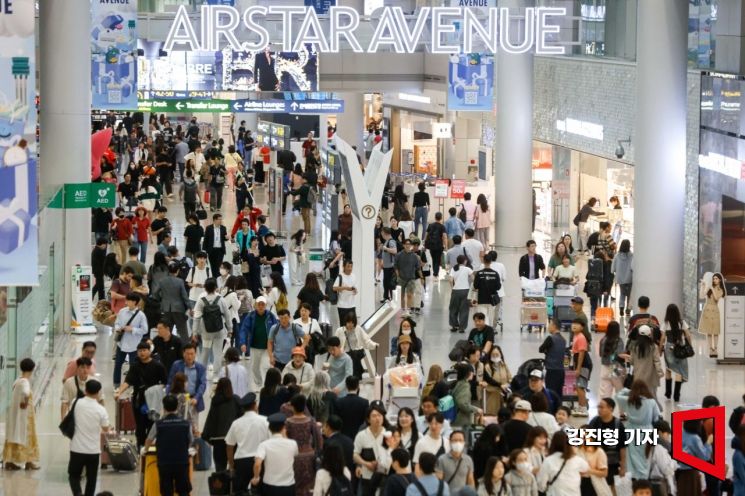 On the 27th, ahead of the Chuseok holiday, the duty-free area of Terminal 1 at Incheon International Airport is bustling with travelers. Photo by Jinhyung Kang aymsdream@
Airplanes have characteristics different from other modes of transportation. Operating a flight costs more money. It is also difficult to quickly increase the number of flights like buses or trains. Since the loss is greater when seats remain empty, airlines prioritize eliminating empty seats. However, they cannot just sell tickets cheaply without considering profitability.
For international flights, each route has a government-approved published fare (price ceiling) authorized by the Ministry of Land, Infrastructure and Transport. Airlines set their selling prices below this ceiling. The selling price varies depending on the seat class and booking class. Within the same seat class, prices differ by booking class according to whether ticket changes and refunds are allowed or not, seat upgrade availability, mileage accrual rates, and so on.
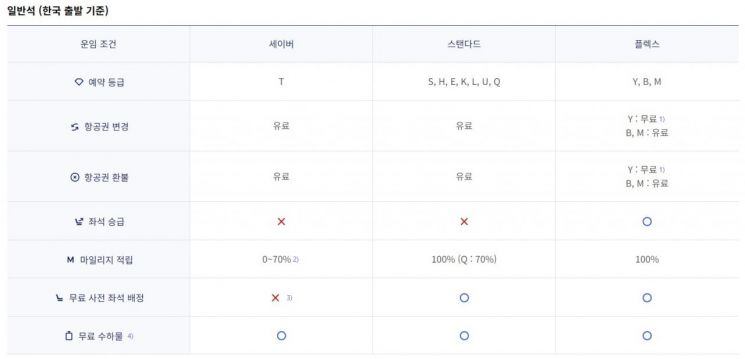
In the case of Korean Air, seat classes are divided into First Class, Business Class, and Economy Class. For booking classes, First Class currently only has the F class. Prestige Class is divided into J, C, D, I, and R. Among these, there are Flex (J), Plus (C), and Standard (D, I, R) categories. Economy Class is divided into Flex (Y, B, M), Standard (S, H, E, K, L, U, Q), and Saver (T). For example, on the Incheon-Amsterdam route, even within the same Economy Class, purchasing tickets under different booking classes (L class and Y class) results in a price difference ranging from a minimum of 1,520,200 KRW to a maximum of 1,972,000 KRW.
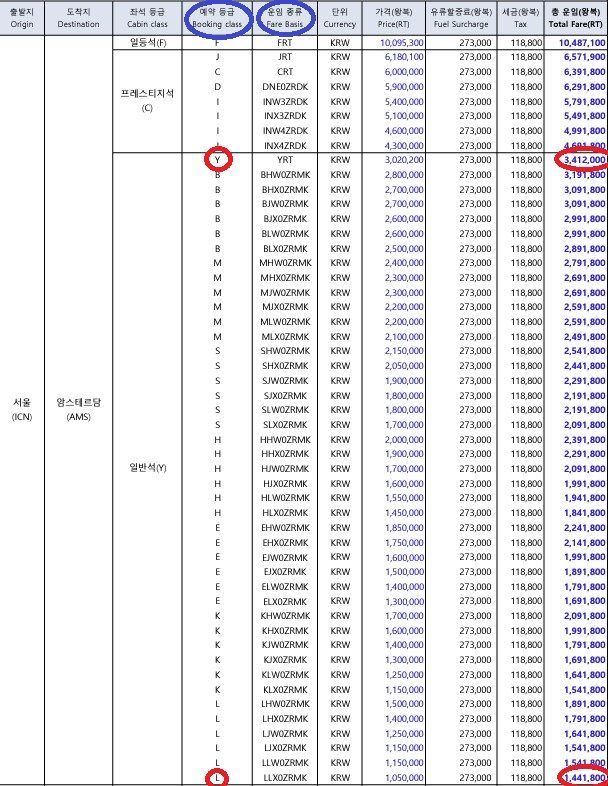 Even for the same economy class, there is a price difference when purchased under different reservation classes (see the red circle). The price for the same reservation class also varies depending on the departure time and peak season. The combination of letters written below the fare type (blue circle) indicates these conditions.
 [Photo by Korean Air website capture]
There are also price differences within the same booking class. Prices are structured considering various factors such as departure time, peak or off-peak seasons, and more. The alphabet combinations in the fare types represent these price factors. Booking classes can be confirmed on the electronic ticket issuance confirmation or boarding pass. If you want to know before booking, you can check the fare tables posted on each airline’s website to find the corresponding price range.
You can book airline tickets according to the situation by referring to these booking classes. However, if you want the cheapest price regardless of benefits, the approach is different. First, do not rely solely on price comparison sites like Skyscanner. These sites help find the lowest price, but when you actually click on the lowest price, conditions such as partner card discounts are often complicated. It is better to use them as a reference while also checking airline promotions, open markets (like Wemakeprice), and travel agency websites (like Modetour) for comparison. Then, you can get even cheaper prices by applying various credit card discounts. Low-Cost Carriers (LCCs) regularly have discount periods. For example, Jeju Air runs ‘JJ Members Week,’ selling discounted tickets once a month for members. These tickets are available for booking two months before the departure date.
By day of the week, Tuesday is the cheapest day to depart. Weekend demand is naturally high, and from Wednesday to Friday, there is demand from people taking vacations to travel. Monday has more demand than Tuesday due to business travelers. Thursday is the cheapest day to arrive.
If your schedule is not urgent, early bird ticket reservations through early booking are advantageous. Booking usually starts 3 to 4 months before the departure date. Last-minute ‘ttangcheori’ tickets are available on travel agency websites at least one week before departure. ‘Ttangcheori’ refers to the urgent sale of unoccupied group seats purchased by travel agencies.
© The Asia Business Daily(www.asiae.co.kr). All rights reserved.



















