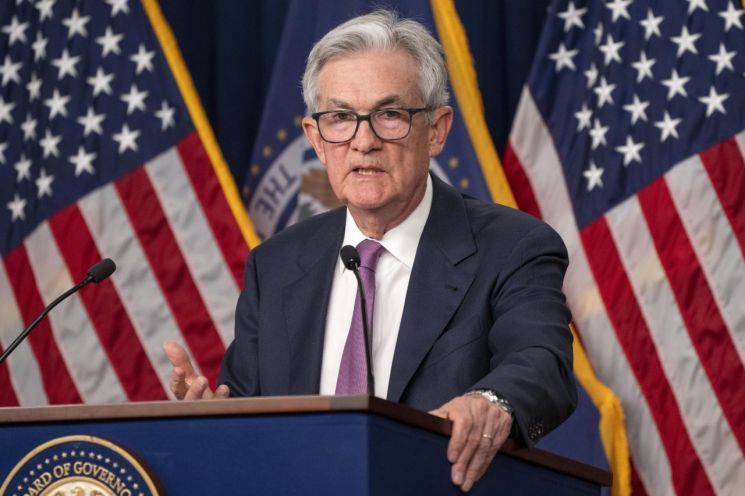
 Jerome Powell, Chairman of the U.S. Federal Reserve (Fed), is holding a press conference on the 14th (local time) in Washington DC after concluding the Federal Open Market Committee (FOMC) regular meeting. [Image source=Yonhap News]
Small and mid-cap stocks are struggling in the U.S. stock market. This is attributed to increased investor caution toward small and mid-cap stocks, which generally have weaker financial structures, amid expectations of prolonged high interest rates.
According to major foreign media on the 27th (local time), the Russell 2000 index, which focuses on small and mid-cap stocks, has fallen 11% from its peak over the past two months. This decline is larger than the 7% drop in the S&P 500 index, which is centered on large-cap stocks, during the same period.
The Russell 2000 index dropped 7% just this month. Compared to its all-time high during the U.S. stock market boom in 2021, it has plummeted by more than 27 percentage points, while the S&P 500 index fell by only 11 percentage points over the same period.
The larger decline in small and mid-cap stocks compared to large-cap stocks is due to the impact of interest rate hikes. One foreign media outlet pointed out that "small and mid-cap stocks, which are more sensitive to external environmental changes, reacted more strongly to the negative factor of interest rate hikes."
For U.S. small and medium-sized enterprises (SMEs), about 30% of their total debt is subject to variable interest rates. In contrast, only 6% of the debt of large companies included in the S&P 500 index is subject to variable interest rates. This structure makes SMEs relatively more vulnerable to the risk of increased interest burden due to rising interest rates compared to large companies.
According to Ned Davis Research, the interest expenses of companies included in the S&P 600 Small Cap index reached an all-time high in the second quarter of this year.
With the prolonged interest rate hikes, the funding cost burden for small businesses is expected to increase further. Ed Clissold, a U.S. equity analyst at Ned Davis Research, said, "Small businesses are more easily exposed to the shadow of fear from ongoing interest rate hikes and economic recession," adding, "The current interest rate environment is an uncharted territory that small businesses have never experienced before."
© The Asia Business Daily(www.asiae.co.kr). All rights reserved.

















