Discussed Once in the National Assembly, Failed to Pass the Committee
"Legal Grounds for Regulation Must Be Established First"
As Chuseok approaches, the number of political party banners has significantly increased nationwide, prompting local governments to enact regulatory ordinances one after another. However, the fundamental solution, the bill amendment, is still dormant in the National Assembly. In local political circles, there are also remarks that it will be difficult to pass the bill in the National Assembly ahead of next year's general election.
According to the National Assembly on the 2nd, the National Assembly's Public Administration and Security Committee held the 1st Subcommittee on Bill Examination on the 18th of last month to review 13 bills titled "Partial Amendment to the Act on the Management of Outdoor Advertisements and the Promotion of the Outdoor Advertising Industry," which regulate political party banners. However, the review was concluded through a clause-by-clause examination (a method of reading and reviewing the bill one clause at a time). Since the Bill Examination Subcommittee decided to continue the review, discussions on related bills are expected to resume no earlier than next month, after the conclusion of the government audit.
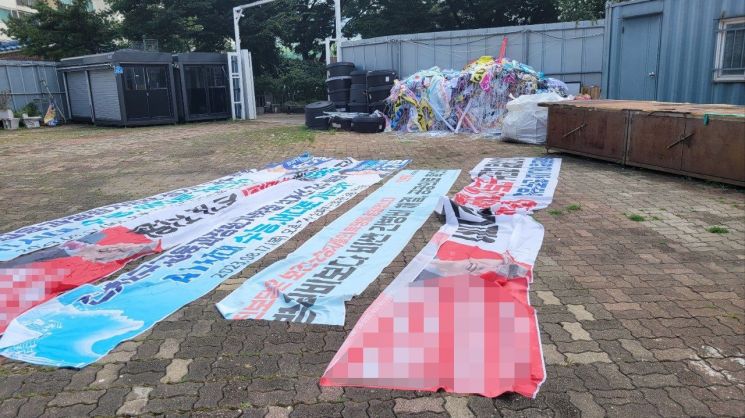
Political party banners have been flooding since the Outdoor Advertisement Act was amended last December. According to this law, it is possible to install banners about party policies and current issues without local government permission or notification. In response, the Ministry of the Interior and Safety established guidelines to prevent excessive installations and implemented them in May. According to the Ministry's data, 3,680 complaints about political party banners were received in May, when the guidelines were enforced. This is a 12% decrease compared to 4,195 complaints in April, but complaints have continued since then.
Accordingly, local governments are independently preparing ordinances to regulate political party banners. The Ulsan City Council announced on the 26th of last month that it would promulgate and enforce the "Partial Amendment to the Ordinance on the Management of Outdoor Advertisements and the Promotion of the Outdoor Advertising Industry in Ulsan."
Incheon City amended an ordinance in June this year to allow political party banners to be installed only on designated bulletin boards and limited to four per National Assembly electoral district, becoming the first in the nation to implement such regulation. However, the Ministry of the Interior and Safety filed a lawsuit with the Supreme Court, arguing that it violated the current Outdoor Advertisement Act. Nevertheless, the Supreme Court dismissed the case on the 14th of last month, affirming the legitimacy of the regulation. Busan and Gwangju also enacted related ordinances this month, and places like Andong in Gyeongbuk and Sejong are pushing for ordinance enactment.
Meanwhile, Seoul, the largest local government in the country, is delayed in enacting an ordinance. Although the Seoul City Council's related ordinance passed the Urban Planning Balance Committee, it was not submitted as an agenda item at the plenary session held on the 15th of last month.
Local political circles point out that this is related to next year's general election. A local political figure said, "Chuseok is the last major opportunity for candidates hoping to run in the general election to promote themselves," adding, "Since the posting of political banners is restricted from December 12, 120 days before the general election, promotional banners are concentrated around Chuseok."
To solve this issue, an amendment to the higher-level Outdoor Advertisement Act is ultimately necessary. The amendment bill proposed by Lee Man-hee, a member of the People Power Party, adds the number and size of political party banners and installation locations to be specified by presidential decree, and stipulates measures for violating advertisements. Additionally, it adds advertisements excluded from the application of Article 8 of the Act to the grounds for administrative enforcement. This legally enables control over political party banners.
An official from the Ministry of the Interior and Safety said, "We agree on the necessity to restrict political party banners, but the current law does not provide grounds for regulation," adding, "If the law is amended, local governments will be able to manage banners based on it."
© The Asia Business Daily(www.asiae.co.kr). All rights reserved.
![Clutching a Stolen Dior Bag, Saying "I Hate Being Poor but Real"... The Grotesque Con of a "Human Knockoff" [Slate]](https://cwcontent.asiae.co.kr/asiaresize/183/2026021902243444107_1771435474.jpg)
















