Announcement of Measures to Revitalize Housing Supply
55,000 Units Supplied in the Seoul Metropolitan Area
'Fast Track' Advanced by 6 Months
Prompt Resumption of Permits and Construction Waiting
The government has decided to supply a total of 120,000 new units in the public sector, including an additional 55,000 public housing units mainly in the metropolitan area such as the 3rd phase new towns. Various support measures will also be implemented to improve conditions for private housing projects, such as extending the maturity of project financing (PF) and providing guarantee support. However, some critics point out that the effectiveness of the measures will be limited because no specific schedule has been announced and mid- to long-term strategies are missing.
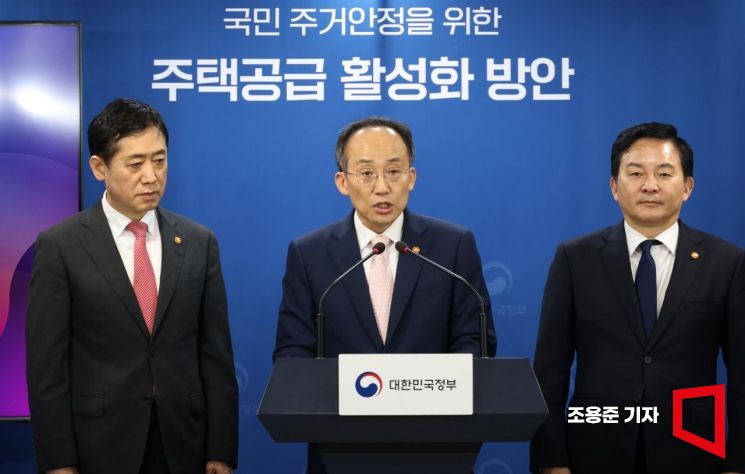 Deputy Prime Minister and Minister of Economy and Finance Choo Kyung-ho (center), Minister of Land, Infrastructure and Transport Won Hee-ryong (right), and Chairman of the Financial Services Commission Kim Ju-hyun announced the "Measures to Revitalize Housing Supply" on the 26th at the Government Seoul Office in Jongno-gu, Seoul. / Photo by Jo Yong-jun jun21@
A total of 120,000 units supplied including 3rd phase new towns, new sites, and public conversion... Supply period shortened by 6 months
According to the 'Housing Supply Activation Plan' announced by the government on the 26th, a total of 120,000 units will be supplied, including 30,000 units in the 3rd phase new towns in the metropolitan area, 65,000 units in new sites expanded to 85,000 units (an increase of 20,000 units), and 5,000 units converted from private to public supply. Additionally, for the 76,000 public sale units and 35,000 public rental units planned for construction this year, the government plans to accelerate supply by shortening the approval process by up to six months or more through a 'fast track' system that simultaneously approves district plans and housing project plans.
Various support measures have also been introduced to promptly resume the backlog of private permits and construction starts. For ongoing projects, sufficient public guarantees will be provided to ensure smooth financing, and financial supply from policy and private financial institutions will be expanded. To strengthen the housing ladder role, construction funds for non-apartment housing will be supported (through fund support and new guarantee products), and the criteria for considering applicants as non-homeowners for subscription purposes will be relaxed. Furthermore, to ensure that urban supply proceeds quickly and without interruption, disputes over construction costs in redevelopment projects will be prevented and resolved early, and procedural improvements will be implemented to speed up progress.

Through this plan, the government aims to achieve the target of 470,000 units (permits) this year to the fullest extent, supply over 1 million units by next year, and expand the capacity to exceed the current administration’s goal (2.7 million units + α).
Leading supply indicators all show decline... Concerns over supply shortage intensify
The reason the government announced the supply measures is that recent leading indicators related to supply have all shown a decline, raising concerns about a supply cliff within the next 2 to 3 years.
According to the ‘August Housing Statistics’ released by the Ministry of Land, Infrastructure and Transport, the nationwide housing permit volume from January to August this year was 212,757 units, a 38.8% decrease compared to the same period last year (347,458 units). During the same period, the number of housing starts also sharply dropped by 56.4% to 113,892 units from 261,193 units in the previous year. The number of completed houses nationwide up to August this year was 239,059 units, down 7.6% from 258,669 units in the same period last year.
Another leading indicator of housing supply, the number of pre-sale units, also significantly decreased. As of August this year, the cumulative nationwide pre-sale of multi-family housing was 94,449 units, down 42.3% compared to the same period last year. Considering that housing supply (move-in) usually occurs 2 to 3 years after construction starts and 3 to 5 years after permits are issued, concerns are raised that a supply shortage may occur in the next 2 to 3 years.
"Policy intentions are positive... A long time is needed to feel the effects"
Experts positively evaluated the government’s active measures to resolve the contracted housing supply caused by high interest rates and inflation.
Ham Young-jin, Head of the Zigbang Big Data Lab, said, "The government’s active expression of willingness to supply housing to resolve the polarization in the pre-sale market, inflation, and the cooling of PF loans is positive," adding, "They have prepared supplementary measures to prevent the spread of insolvency and accelerate overall housing supply by providing liquidity to construction companies and customized support by PF project type."
However, there are also criticisms that the perceived effects of the supply measures will be limited considering the time required until actual supply.
Yoon Ji-hae, Research Team Leader at Real Estate R114, analyzed, "The supply content that can produce short-term effects seems to be additional volume secured in the 3rd phase new towns and shortening of public project procedures," adding, "Parts that require regulatory normalization, redevelopment project procedure improvements, and non-apartment regulation reforms need parliamentary discussion, so effects can be expected over a somewhat longer term."
Lee Eun-hyung, Research Fellow at the Korea Institute of Construction Policy, said, "The overall policy intention is positive, but the effects are expected to be limited," pointing out, "Since housing supply expansion has become very difficult since the US interest rate hikes last year, there are limits to offsetting external factors with domestic policies."
© The Asia Business Daily(www.asiae.co.kr). All rights reserved.


















