As Antibody Rates Rise Due to Natural Infection, Vaccination Avoided
Over 20 Million Doses Already Discarded
61.42 Million Doses of Vaccines Scheduled for Domestic Introduction
It has been revealed that a significant portion of COVID-19 vaccines are being discarded due to surplus. There are calls for measures to minimize the amount of waste.
According to data from the National Assembly Budget Office's audit on the 28th, as of the end of July this year, out of the COVID-19 vaccines introduced domestically, 134.48 million doses were actually used for vaccination, while 23.28 million doses were discarded. Additionally, the amount of vaccines expiring within the third and fourth quarters of this year and by the end of next year is estimated to be around 33.1 million doses. If vaccinations are not administered during this period, a considerable amount of vaccines will have to be discarded again.
The problem is that the demand for COVID-19 vaccines is rapidly decreasing. While the vaccination rate for additional shots during last winter was only 13%, it has been confirmed that about 97% of the entire population has antibodies through natural infection and vaccination, so the utilization of COVID-19 vaccines is also expected to continue declining.
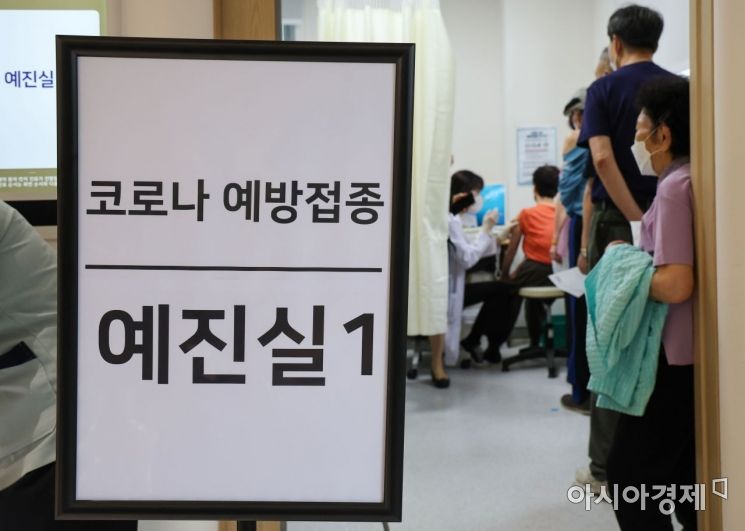 On April 25, the day the 4th COVID-19 booster vaccination began for those aged 60 and over who had made prior reservations, citizens waiting for their vaccinations were seen at Bumin Hospital in Gangseo-gu, Seoul. 2022. 4. 25 Photo by Joint Press Corps
The government confirmed that it secured 262.7 million doses of COVID-19 vaccines as of the end of July this year. Among these, 201.28 million doses have been delivered, and 61.42 million doses are having their supply schedules adjusted considering vaccine expiration dates and future COVID-19 response management systems. This structure inevitably leads to an accumulation of stockpiled vaccines.
The government has decided to introduce new vaccines based on the 'XBB.1.5 variant,' a sublineage of the Omicron variant, in preparation for this winter. The Korea Disease Control and Prevention Agency has contracted to bring in a total of 15 million doses within this year. Although the legal classification of COVID-19 as an infectious disease has been downgraded to level 4, the government has made this year's vaccinations free for all citizens aged 12 and older nationwide.
The Budget Office commented on vaccine supply issues, stating, "There is discussion on the need to prepare effective measures in response to the decreased demand for vaccination due to reduced severity and fatality rates of COVID-19, the downgrade of the COVID-19 crisis level, and the increase in population with hybrid immunity from natural infection and vaccination." It pointed out, "It is necessary to continuously pursue efficient utilization of the COVID-19 vaccine budget and enhancement of vaccine utilization through active negotiations with pharmaceutical companies to adjust vaccine supply schedules, switch planned imports to new vaccines, and actively promote overseas donations to minimize future waste, as well as thorough management of remaining stock."
© The Asia Business Daily(www.asiae.co.kr). All rights reserved.
![Clutching a Stolen Dior Bag, Saying "I Hate Being Poor but Real"... The Grotesque Con of a "Human Knockoff" [Slate]](https://cwcontent.asiae.co.kr/asiaresize/183/2026021902243444107_1771435474.jpg)
















