Region Usually at -54°C Rises to -10°C
"Natural Cause of Antarctic Climate Variability"
Last year, temperatures near the eastern coast of Antarctica were recorded to be 39 degrees Celsius higher than average, setting a new global record for abnormal heat, according to a study.
On the 24th (local time), the Washington Post (WP) reported that Edward Blanchard-Leggett, a geoscientist at the University of Washington, found in his March study last year that the strongest abnormal heat ever recorded in Antarctica had occurred.
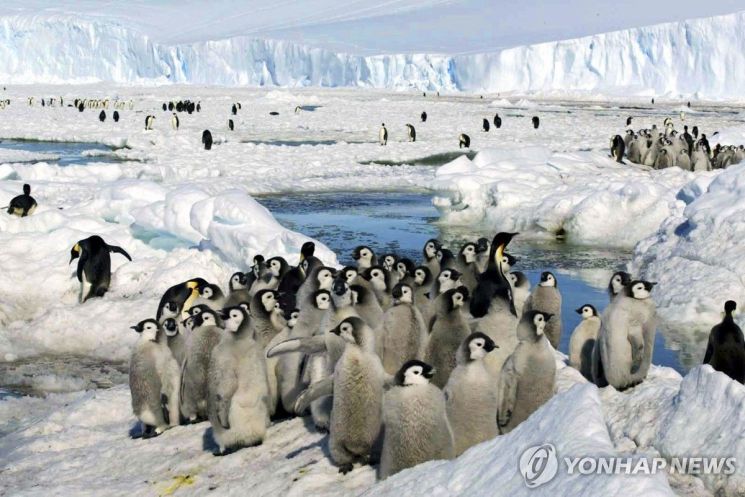
The research team analyzed that on March 18 last year, the temperature recorded on the eastern coast of Antarctica was a staggering 39 degrees Celsius higher than the average. March marks the transition to autumn in Antarctica, with average temperatures around minus 54 degrees Celsius. However, on March 18 last year, the temperature soared to minus 10 degrees Celsius. This was even higher than the highest temperatures recorded during the Antarctic summer.
Researchers present on site in Antarctica at the time wore shorts due to the relatively warm weather, and some even took off their shirts. Blanchard-Leggett told WP, "It was an incredibly surprising event," adding, "The degree of abnormal temperature was the highest ever measured worldwide."
The team investigated how such a heatwave could occur during a period of low sunlight and concluded that natural variability in Antarctic climate, rather than global warming, was the cause.
Typically, winds blow from west to east in Antarctica, blocking warm air from the northern regions and maintaining cold temperatures. However, last year, the winds lost their way, allowing warm air from southern Australia to flow into Antarctica in just four days. Blanchard-Leggett claimed, "This was probably the first time such rapid movement occurred in such a short period."
The study stated that such large weather fluctuations are not unusual in polar regions. According to global weather station data and computer simulations, significant temperature changes beyond normal levels occurred at high latitudes. In regions below latitude 48 degrees, such as Europe and the United States, abnormal temperature changes of this magnitude rarely occurred.
Blanchard-Leggett explained that large temperature anomalies occur at high latitudes because there is more cold air near the land. While air generally cools in the atmosphere, high latitude areas have abundant snow and ice, resulting in colder air near the land. When warmer air above suddenly descends, abnormal heat can occur. This phenomenon is especially frequent in winter, and last year's Antarctic heatwave was caused by this effect.
However, the study noted that the impact of global warming on the Antarctic abnormal heat record is not yet clearly evident. The report stated that computer model analyses, considering variables such as increased greenhouse gas emissions, showed that climate change contributed about 2 degrees Celsius to the heatwave.
Nonetheless, some experts pointed out that climate change might have influenced unmeasurable factors such as changes in wind patterns that brought the warm air.
Blanchard-Leggett also added, "If such heatwaves become more common within 50 or 100 years, we might see unexpected consequences."
© The Asia Business Daily(www.asiae.co.kr). All rights reserved.
!["The Woman Who Threw Herself into the Water Clutching a Stolen Dior Bag"...A Grotesque Success Story That Shakes the Korean Psyche [Slate]](https://cwcontent.asiae.co.kr/asiaresize/183/2026021902243444107_1771435474.jpg)
















