EU Commission President Visits China, Delivers Critical Remarks
The European Union (EU) criticized China's close ties with Russia. It also argued that China needs to address various issues, including economic and trade unfairness.
According to foreign media such as Germany's AFP and the US's Reuters, Valdis Dombrovskis, the EU Executive Vice President for Economy and Trade, who is visiting China, said on the 25th in a speech at Tsinghua University in China that China's stance on the Ukraine war is a variable in the overall relationship between Europe and China.
Vice President Dombrovskis criticized China for not condemning Russia's invasion of Ukraine. He also said that "the image of China perceived by not only European consumers but also businesses could be adversely affected." He also expressed difficulty in understanding China's stance supporting the Russian war.
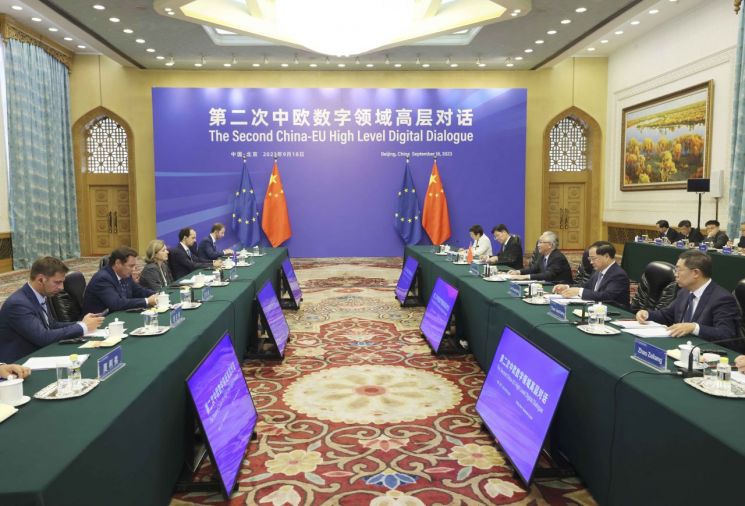
Since Russia invaded Ukraine in February last year, China has taken a neutral stance and cooperated with Russia. Western assessments suggest that China's actions are a driving force enabling Russia to maintain its capabilities despite sanctions from the US and the EU. In this situation, there is also a possibility that the West may pressure China to end the Ukraine war.
However, Vice President Dombrovskis stated that the EU has no intention of decoupling by cutting economic ties with China. He also urged China to work on mitigating the risks that the EU perceives. In particular, he pointed out the need to improve issues such as economic and trade unfairness and the recently implemented Foreign Relations Law and Counter-Espionage Law in China.
China's position regarding these remarks is that "there is no problem with China." Wang Wenbin, spokesperson for the Chinese Ministry of Foreign Affairs, said at a regular briefing that "China has always upheld the rule of law principles and protected the legitimate rights and interests of individuals and organizations," adding, "We will provide a favorable business environment characterized by marketization, rule of law, and internationalization for the legitimate operations of foreign companies in China."
He also said, "China is an important cooperation partner of the EU," and "If de-risking leads to de-Chinaization, it would eliminate opportunities, cooperation, stability, and development." Regarding issues such as the Counter-Espionage Law, he explained, "All judicial activities in China are conducted based on facts and laws," and "there is no need to worry if companies operate legally."
© The Asia Business Daily(www.asiae.co.kr). All rights reserved.

















