After Board Resolution on Merger, Stock Price Slumps... Falls Below Planned Purchase Price
Seo Jung-jin's Eldest Son Seo Jin-seok Officially Appears as Chairman of Celltrion Board
Low Expectations for Merger Effects of Celltrion and Celltrion Healthcare
According to the Financial Supervisory Service on the 26th, Celltrion and Celltrion Healthcare will accept merger opposition statements from existing shareholders until the 20th of next month ahead of the extraordinary general meetings to approve the merger plan of the two companies. Shareholders who have submitted opposition statements can exercise their stock purchase rights from the 23rd of next month until November 13th. Celltrion and Celltrion Healthcare are actively promoting the post-merger blueprint to ensure that the scale of stock purchase rights exercised does not exceed 1 trillion won.
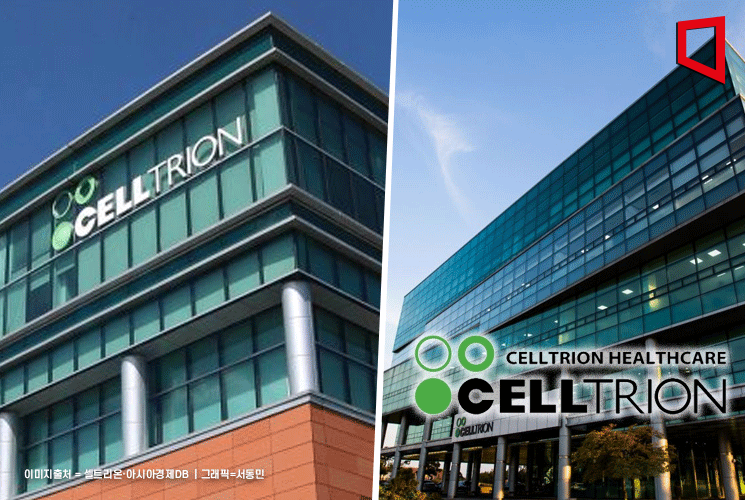
However, since mid-this month, the stock prices of the two companies have been on a downward trend, making the success of the merger uncertain. The proposed purchase prices presented by Celltrion and Celltrion Healthcare are 150,813 won and 67,251 won, respectively. The stock prices of both companies are below the proposed purchase prices. On the previous day, Celltrion closed at 139,300 won, and Celltrion Healthcare at 61,700 won.
In a situation where the stock price is similar to or lower than the proposed purchase price, it is advantageous for individual shareholders to express opposition first and then decide whether to exercise the stock purchase rights based on subsequent stock price trends. The merger decision will be made at the extraordinary general meetings of Celltrion and Celltrion Healthcare on the 23rd of next month. As the merger is a special resolution agenda, it must be approved by at least two-thirds of the voting rights of shareholders present and at least one-third of the issued shares at the shareholders' meeting. If the merger plan is approved at the shareholders' meeting, the merger can be completed within six months.
If the scale of stock purchases due to the exercise of stock purchase rights exceeds 1 trillion won, the merger contract may be canceled. As of the first half of this year, Celltrion and Celltrion Healthcare had separate cash and cash equivalents of 566.6 billion won and 209.7 billion won, respectively. If the stock purchase funds are insufficient, they plan to raise funds through borrowing from financial institutions.
Celltrion's stock price, which rose to 184,100 won on April 13th, has fallen below 140,000 won. Unlike the first quarter, which met market expectations, the second quarter performance this year was sluggish. Market expectations were sales of 652.7 billion won and operating profit of 210.8 billion won, but actual results showed sales of 575.4 billion won and operating profit of 191.3 billion won. These figures represent decreases of 3.5% and 3.8%, respectively, compared to the same period last year. After the second-quarter results were disclosed, downward revisions of this year's performance estimates continued, and the stock price has been declining.

The merger effect, which individual shareholders expected to be a catalyst for a stock price rebound, is also not significant. Celltrion held a board meeting on the 17th of last month and resolved the merger plan. The stock price, which had risen on merger expectations until then, has not gained momentum since the board resolution. The stock price trend of Celltrion Healthcare, which is linked to Celltrion's performance, is not much different. Kiwoom Securities researcher Heo Hyemin explained, "Celltrion Healthcare recorded an operating profit of 34.1 billion won in the second quarter, falling short of the market expectation of 54.6 billion won," adding, "Due to increased direct sales costs in the U.S. and research and development expenses, the operating profit margin decreased by 4 percentage points compared to the previous quarter."
Celltrion has yet to present a clear card for a stock price turnaround. Celltrion expects to achieve sales of 3.5 trillion won next year if the merger is completed as planned. Before the merger, Celltrion Healthcare could not sell biosimilars purchased from Celltrion below cost in overseas markets. It was difficult to operate in countries with low drug prices. After the merger, the supply price can be set based on Celltrion's manufacturing cost. With a lower cost ratio and greater price negotiation power, it is expected that the sales regions can be expanded. Hana Securities researcher Park Jaekyung said, "As direct sales have been shifted in major regions such as Europe and the U.S., the proportion of fixed costs has increased," adding, "It is necessary to increase sales volume to improve performance."
Despite the expected merger effects, some in the securities industry point out that achieving the targets will not be easy. A financial investment industry official said, "The market expectation for the integrated Celltrion next year is around 3.3 trillion won," adding, "It will be difficult to raise estimates until news that could affect performance in the U.S. and Europe is confirmed."
Due to the low performance expectations after the merger, institutional investors and foreigners have continued to sell. Institutions have recorded a net sale of 630,000 shares from August 1st to the previous day. During the same period, foreigners showed a selling bias of 330,000 shares.
Seo Jung-jin, chairman's eldest son and Celltrion board chairman Seo Jin-seok, appeared publicly for the first time on the 12th to explain the new businesses Celltrion is pursuing after the merger. Chairman Seo spoke as a speaker at 'Korea Investment Week (KIW) 2023.' He emphasized that Celltrion is building an independent medical data bank and is promoting new drug development using artificial intelligence (AI). By setting targets based on big data that can demonstrate actual efficacy and conducting experiments through a biofoundry, it is expected to reduce the time and cost required for new drug development.
Chairman Seo, a KAIST Ph.D. graduate, serves as the board chairman of Celltrion and Celltrion Pharm. At the Celltrion regular shareholders' meeting held in March, Chairman Seo said, "I will closely promote product development and merger and acquisition (M&A) related businesses together with Chairman Seo, who has the ability and network."
Opinions are divided on Chairman Seo, born in 1984, mentioning AI-based new drug development in public ahead of the merger. Chairman Seo's strong leadership is an indispensable success factor for Celltrion to establish itself as a leading company in the global biosimilar market. Trust in Chairman Seo is high among individual shareholders. This is why there was little opposition when Chairman Seo, who stepped down from management in 2021, returned after two years.
From the perspective of existing shareholders who have watched Chairman Seo overcome crises with quick decision-making and strong drive for a long time, trust in Chairman Seo is relatively lacking. Although Chairman Seo appeared publicly amid analyses that the merger is part of the succession process, his presence was not significant. A financial investment industry official explained, "Succession issues in the domestic stock market often do not help the stock price much," adding, "The merger alone carries considerable uncertainty, and this issue amplifies curiosity about the leadership that will lead the integrated Celltrion."
© The Asia Business Daily(www.asiae.co.kr). All rights reserved.
!["The Woman Who Threw Herself into the Water Clutching a Stolen Dior Bag"...A Grotesque Success Story That Shakes the Korean Psyche [Slate]](https://cwcontent.asiae.co.kr/asiaresize/183/2026021902243444107_1771435474.jpg)

















