Basic Principles such as Freedom, Fairness, Safety, Innovation, and Welfare
Emphasis on Legal Protection of Digital Assets and Guarantee of Digital Work and Rest
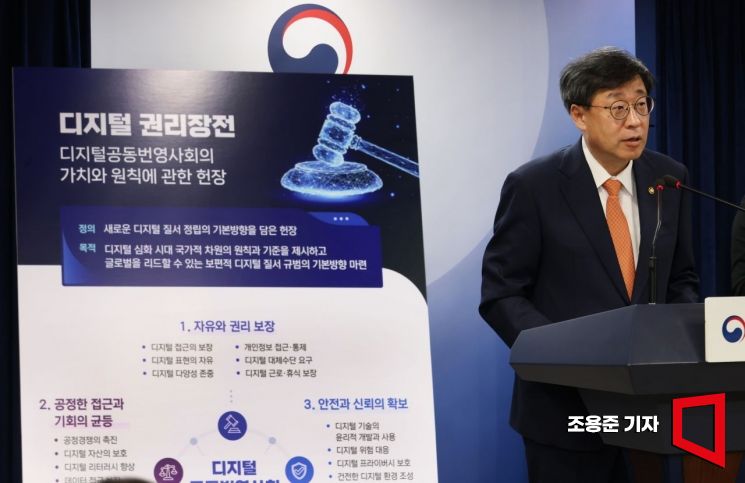 Park Yungu, Vice Minister of the Ministry of Science and ICT, is giving a presentation on the "Digital Bill of Rights and Future Plans" on the 25th at the Government Seoul Office in Jongno-gu, Seoul. Photo by Jo Yongjun jun21@
The Ministry of Science and ICT has announced the charter 'Digital Bill of Rights' to establish universal digital order norms suitable for the digital era. It reflects global common values while incorporating South Korea's digital innovation experiences and philosophy. To move beyond a mere declarative meaning, the ministry will also work on legal and institutional reforms based on this charter.
On the 25th, Park Yoon-kyu, the 2nd Vice Minister of the Ministry of Science and ICT, held a press conference at the Seoul Government Complex and unveiled the Digital Bill of Rights, which contains the universal rights of citizens and the responsibilities of each stakeholder to realize a 'Digital Prosperity Society.'
Vice Minister Park stated, "Today (the 25th), the Digital Bill of Rights was reported at the Cabinet meeting presided over by President Yoon Suk-yeol," adding, "President Yoon urged all ministries to actively prepare AI and digital plans applicable to their respective duties and to unite efforts so that South Korea can lead the establishment of global standard systems."
Earlier, starting with the New York Initiative in September last year, President Yoon has continued discussions on the 'new digital order' with global scholars and various business leaders at the Davos Forum, Harvard University, Paris Sorbonne University, G20 Summit, and UN General Assembly. Notably, at the 'Digital Vision Forum' held at New York University, he presented five fundamental principles of the 'Digital Bill of Rights' in his keynote speech.
The Digital Bill of Rights is a charter that presents national-level standards and principles suitable for the deepening digital era and outlines the basic direction of universal digital order norms that can lead globally. It consists of a preamble containing the background and purpose, followed by six chapters and 28 articles in the main text.
Specifically, Chapter 1 stipulates the basic principles for realizing a 'Digital Prosperity Society.' The basic principles include: ▲ Guaranteeing freedom and rights in the digital environment ▲ Fair access to digital resources and equal opportunities ▲ A safe and trustworthy digital society ▲ Promotion of digital innovation based on autonomy and creativity ▲ Enhancement of human welfare, totaling five principles.
From Chapters 2 to 6, the universal rights of citizens and the responsibilities of stakeholders (state, corporations, citizens) to implement the five basic principles are defined in the form of detailed principles. Chapter 2 covers 'Guarantee of Digital Access,' ensuring non-discriminatory access to kiosks and similar devices from the perspective of 'freedom and rights guarantee,' 'Access and control of personal information' guaranteeing the right to view, correct, delete, and transmit one's information, and 'Guarantee of digital labor and rest' related to platform work and remote work.
Chapter 3 stipulates 'Protection of digital assets,' ensuring that digital assets such as data and digital works receive proper legal and policy protection, and 'Improvement of digital literacy' to bridge the digital divide. However, it does not explicitly address the perspective on AI-created works. Vice Minister Park commented, "AI-created works are a different issue from the Digital Bill of Rights," adding, "Currently, the Ministry of Culture, Sports and Tourism is reviewing copyright infringement and the recognition of AI copyrights related to AI learning."
Chapter 4 presents principles such as 'Response to digital risks,' emphasizing that digital risks must be managed through systematic systems, and 'Ethical development and use of digital technologies.' Chapter 5 includes content on the need for 'Regulatory improvement' to eliminate unreasonable regulations unsuitable for the digital environment, support for digital innovation such as fostering professionals and investing in research and development. Chapter 6 emphasizes the need for international efforts to form 'Digital international norms' and to bridge the digital divide between countries.
Vice Minister Park explained that the Digital Bill of Rights reflects global common values while incorporating South Korea's unique characteristics, such as emphasizing digital literacy improvement and digital innovation.
The government plans to actively participate in discussions on AI and digital norms in international organizations such as the UN and OECD, as well as in the United States and the United Kingdom, based on the Digital Bill of Rights. Vice Minister Park said, "President Yoon also agrees on the necessity of discussions at the international level," adding, "We plan to carry out various activities to establish international organizations together with the Ministry of Foreign Affairs and related ministries."
Additionally, the government plans to make practical efforts to resolve issues in the deepening digital era and to refine specific laws and systems based on the Digital Bill of Rights. It will prepare laws suitable for the deepening digital era, including the 'Artificial Intelligence Act' and the 'Digital Inclusion Act,' and support the revision of policies and systems of related ministries according to the Digital Bill of Rights through surveys such as the 'Digital Deepening Response Status Survey.'
However, regarding the 'control tower' to lead the currently dispersed digital-related discussions across ministries, Vice Minister Park said, "There are no concrete discussions yet." He added, "I believe the Ministry of Science and ICT is in a position to actively support discussing and resolving various issues based on technical and institutional expertise."
Vice Minister Park stated, "We will strive to solve the problems our society faces in the deepening digital era based on the Digital Bill of Rights and closely cooperate with the international community to make it a global standard for digital norms," and "Since this is the first charter encompassing the entire digital field including AI, South Korea will lead the global normative order."
© The Asia Business Daily(www.asiae.co.kr). All rights reserved.
![Clutching a Stolen Dior Bag, Saying "I Hate Being Poor but Real"... The Grotesque Con of a "Human Knockoff" [Slate]](https://cwcontent.asiae.co.kr/asiaresize/183/2026021902243444107_1771435474.jpg)
















