Agreement Reached with Producer Federation Hosting Major Studios
Strike to Begin in May, Demands Include Re-screening Revenue Adjustment
Details of Agreement Not Disclosed... Actor Union Continues Strike
The Writers Guild of America (WGA), which has been on strike since May in Hollywood, the "movie capital" of the United States, reached a tentative agreement on the 24th (local time) with major studios such as Netflix and Warner Bros. The possibility of resuming production of some TV programs that had been halted due to the strike has significantly increased.
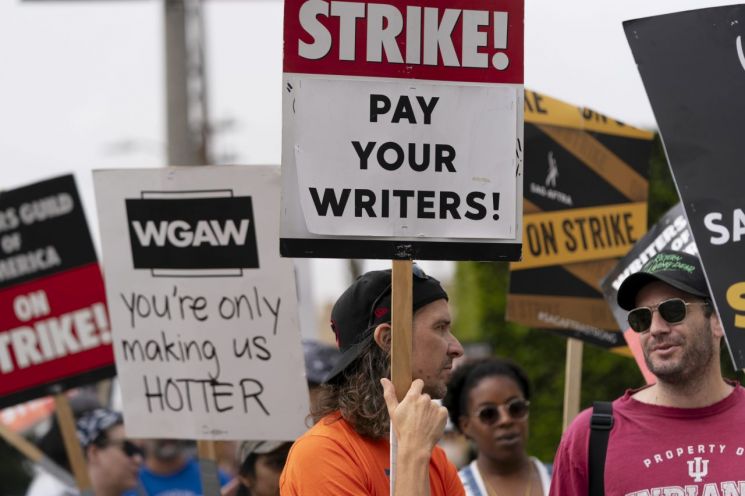
According to Bloomberg and other sources, the WGA announced that it had signed a three-year preliminary agreement with the Alliance of Motion Picture and Television Producers (AMPTP), the studios' negotiating group. The WGA stated, "We have reached an exceptional agreement that includes meaningful benefits and protections for writers."
This agreement came 146 days after the WGA began its strike. Approximately 11,500 Hollywood film and television writers affiliated with the WGA have been on a full strike since May 2, demanding recognition of writers' rights amid the streaming and artificial intelligence (AI) era, as they renegotiate revenue and rights with major studios.
Hollywood writers demanded that major studios recalculate residual payments, which are royalties paid to writers, directors, and actors each time viewers watch works on streaming platforms. They also urged resolution of copyright issues arising from the emergence of generative AI. Additionally, they requested increases in base pay, strengthened health and pension benefits, and improvements to unfair audition practices.
The specific details of the agreement between the WGA and AMPTP have not been disclosed. However, a source indicated that the writers made some concessions on key issues, including wage increases. In return, studios agreed to hire a certain number of writers when producing TV programs and established a structure where writers receive bonuses if a program becomes popular on streaming services.
Negotiations, which had been deadlocked until last month, began to make progress this month as top executives from major studios personally joined the talks. Netflix CEO Ted Sarandos, Warner Bros. CEO David Zaslav, Universal Studios CEO Donna Langley, and Disney CEO Robert Iger reportedly sat at the negotiation table on the 20th.
Based on this tentative agreement, the WGA plans to conduct a ratification vote among its members by the 26th and proceed with related procedures. The WGA stated, "No one can return to work until approval (through voting) is obtained. Until then, we remain on strike," but also announced that picketing would be suspended.
Although major studios have reached an agreement with Hollywood writers, negotiations between the actors' union, which has been striking alongside the WGA since July, and the studios are still ongoing, drawing attention to the potential impact of this agreement. The Screen Actors Guild?American Federation of Television and Radio Artists (SAG-AFTRA) has been on strike since July 14. This simultaneous strike by Hollywood writers and actors was the first in 63 years.
SAG-AFTRA congratulated the WGA and AMPTP on their tentative agreement but stated that they will continue their strike. They also urged that talks with studio executives must resume, although no negotiation schedule with the AMPTP has been set yet.
The New York Times (NYT) reported, "With the actors' strike continuing, it is unlikely that most TV programs and movies will resume," but added, "However, once the writers' strike ends, late-night or daytime talk shows may return, allowing the industry to breathe a sigh of relief."
Meanwhile, the ongoing Hollywood strike since May has dealt a blow to not only major studios but also the California economy. California Governor Gavin Newsom recently stated in an interview with CNN, "The California economy has suffered losses exceeding $5 billion (approximately 6.67 trillion won)."
Warner Bros. announced earlier this month that it expects earnings to be impacted by the strike, and CEO Robert Iger described the strike in a July interview with CNBC as occurring during a time of great turmoil in the media industry, calling it "the worst time worldwide."
© The Asia Business Daily(www.asiae.co.kr). All rights reserved.
!["The Woman Who Threw Herself into the Water Clutching a Stolen Dior Bag"...A Grotesque Success Story That Shakes the Korean Psyche [Slate]](https://cwcontent.asiae.co.kr/asiaresize/183/2026021902243444107_1771435474.jpg)
















