Older Generations Are Poorer
Poverty Rate 56.3% for Those Born in Late 1930s
Only 18.7% for Those Born in Late 1950s
"Basic Pension Should Focus on Low-Income, Low-Asset Elderly"
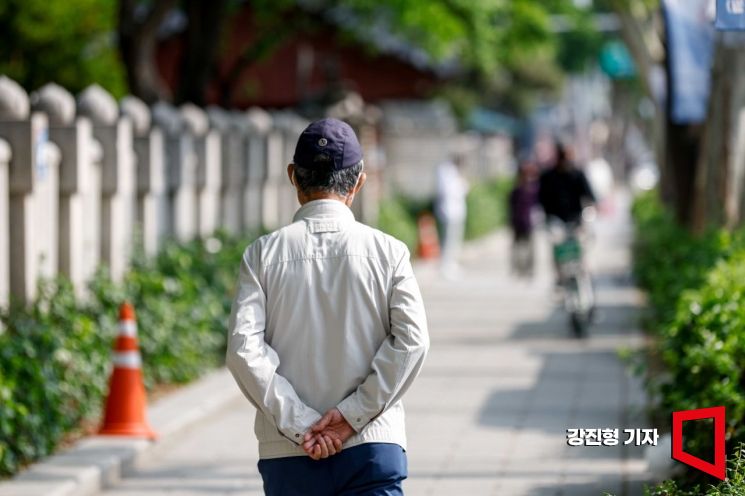
A survey revealed that within the elderly generation, the older the age, the poorer the individuals tend to be. In particular, those born in the 1930s and 1940s, known as the industrialization generation, showed a high level of poverty. To effectively address the real poverty issues, it is advised to reduce support for low-income elderly with high assets and increase support for low-income and low-asset elderly.
The Korea Development Institute (KDI) announced this on the 25th in its KDI Focus report titled "Elderly Poverty Diagnosed by Income and Assets and Policy Directions."
To closely examine elderly poverty, KDI categorized the elderly into those born in the late 1930s, early 1940s, late 1940s, early 1950s, and late 1950s. The elderly poverty rate was highest among those born in the late 1930s at 56.3%. Those born in the early 1940s followed at 51.3%, and those born in the late 1940s had a rate of 44.5%. This generation experienced the Korean War in their youth and was known as the driving force of industrialization in the 1960s and 1970s.
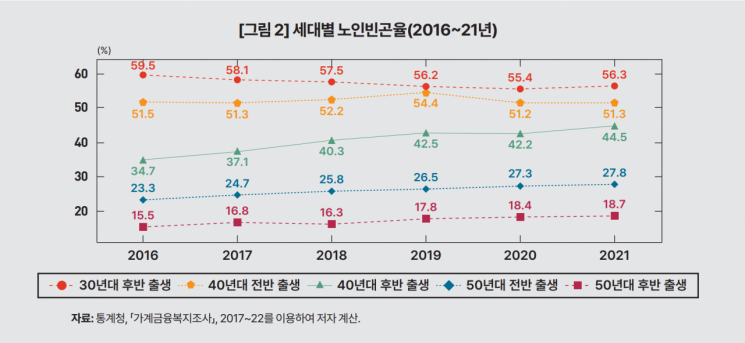
On the other hand, the poverty rate for those born in the early 1950s was only 27.8%. Those born in the late 1950s had an even lower rate of about 18.7%, roughly 10 percentage points less. Researcher Lee Seung-hee from KDI’s Fiscal and Social Policy Research Department explained, “This suggests that elderly poverty issues may develop very differently between generations born before and after 1950.”
The overall elderly poverty rate has also decreased since 2010, largely due to the increasing number of relatively affluent individuals born in the 1950s. Based on disposable income, the elderly poverty rate dropped from 43.6% in 2016 to 37.7% in 2021. During the same period, the proportion of elderly born in the 1950s increased from 18.3% to 47.4%, while those born in the 1940s and earlier decreased from 81.7% to 52.6%.
The poverty rate considering assets was also higher among generations born before the 1940s. The proportion of low-income, low-asset individuals was highest among those born in the late 1930s at 45.9%, followed by those born in the early 1940s at 37.2%. Those born in the late 1940s were at 31.6%. For those born in the early 1950s, it was 19.7%, and for the late 1950s, about 13.2%. This indicates that even among the elderly, the older age groups lack not only income but also assets.
 Research Fellow Seunghee Lee of the KDI Fiscal and Social Policy Research Department is speaking on the topic of "Elderly Poverty Diagnosed by Income and Assets and Policy Directions" at the government complex in Sejong City on the 25th.
This phenomenon is analyzed to be caused by differences in income gaps between generations due to Korea’s rapid economic growth and varying maturity levels of the old-age security system. For example, when those born in 1945 were 30 years old, the gross national income per capita was $613, whereas for those born in 1950 at the same age, it was $1,699?more than three times higher. Moreover, the representative old-age security system, the National Pension, was expanded nationwide only in 1998. Earlier generations had shorter enrollment periods, resulting in lower pension benefits.
KDI advised that since elderly individuals with low income but high assets can escape poverty by utilizing home pensions or farmland pensions, support systems should be reorganized to focus on vulnerable groups. Researcher Lee suggested, “It is desirable to provide the basic pension, which currently supports 70% of the entire elderly population, only to elderly individuals whose recognized income is below a certain level, and to invest the naturally secured resources into elderly welfare systems to improve the quality of life for the elderly.”
© The Asia Business Daily(www.asiae.co.kr). All rights reserved.
![Clutching a Stolen Dior Bag, Saying "I Hate Being Poor but Real"... The Grotesque Con of a "Human Knockoff" [Slate]](https://cwcontent.asiae.co.kr/asiaresize/183/2026021902243444107_1771435474.jpg)


















