Budget phone subscribers are rapidly increasing
while subscribers of the three major carriers continue to decline
Generation Z ranks low in job preference... "Growth stagnation"
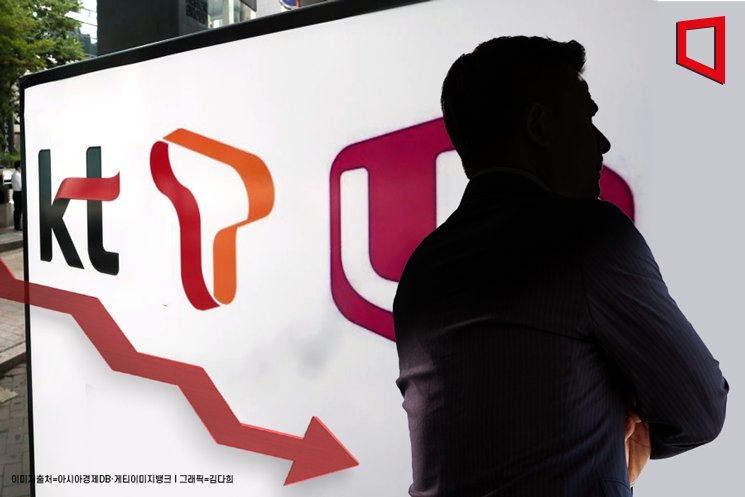
The three mobile carriers have begun to be ignored by young people. SK Telecom, KT, and LG Uplus were once companies with many young customers and young companies where university students wanted to work. However, these days, young customers carry budget phones instead of the three major carriers. Cost-conscious young subscribers have been taken away by budget phone operators. Recently, JobKorea surveyed about 1,200 Generation Z individuals on companies they want to work for. The three mobile carriers did not even make it into the top 20. It is a stark contrast compared to when they once competed for the top ranks. The proportion of employees in their 20s within the companies is also decreasing.
Where did the 20-year-old TTL go... Subscribers taken by budget phones
In 1999, SK Telecom launched the brand TTL targeting the new generation with the advertising copy "20-year-old 011." With the mysterious image represented by TTL girl Lim Eun-kyung and by creating TTL zones around university areas, they provided differentiated services and rapidly rose in the telecommunications service market. They competed with content that captured the hearts of people in their 20s. This firmly supported their position as the number one mobile carrier. However, about 20 years later, the situation has completely reversed. Last month, when Samsung Electronics released the Galaxy Z5 series, SK Telecom lost the most subscribers among the three carriers.
The Korea Telecommunications Operators Association (KTOA) announced that last month SK Telecom lost 28,696 subscribers. KT lost 24,237, and LG Uplus lost 16,746 subscribers. During the same period, budget phones gained 69,679 subscribers.
Budget phone operators are rapidly emerging as competitors to the three major carriers. Budget phone companies rent networks from the three carriers and provide affordable telecommunications services under their own brands. Over the past two to three years, the number of mobile phone subscribers for the three carriers has decreased, while budget phone subscribers have increased. In other words, the three carriers are losing subscribers to budget phones. Among about 70 budget phone operators, five subsidiaries of the three carriers and KB Livem of Kookmin Bank hold more than 50% of the market share, but consumers choose budget phones not because of their brand names but for practical reasons.
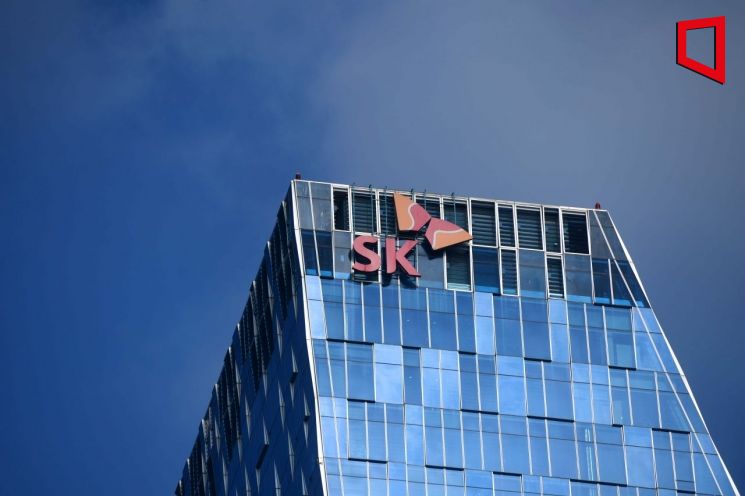 SK Telecom launched a new plan, 'T Plan,' on the 18th, which increases data for the whole family and lowers fees. The photo shows the SK Telecom headquarters in Euljiro, Seoul on the day. Photo by Mun Ho-nam munonam@
According to statistics released by the Ministry of Science and ICT, the number of budget phone subscribers was about 14.7 million at the end of July, approaching 15 million. Notably, about half of budget phone subscribers are in their 20s and 30s. A survey by research firm Consumer Insight showed that the proportion of budget phone subscribers in their 20s and 30s increased from 33% in 2018 to 49% last year.
Most of them are so-called "Godseongbi" (great cost-effectiveness) users who buy unlocked phones and use budget phone plans. They do not open phones through carriers but purchase devices from manufacturers or online platforms and activate them by inserting a SIM card. Since there is no contract burden like 24 or 36 months with carriers, they do not have to pay penalties, making it a rational consumption choice. There is even a saying that Generation MZ budget phone subscribers make their parents switch to budget phones, so the trend of budget phone use among young people cannot be ignored. Given this situation, the Ministry of Science and ICT and the Korea Communications Commission are encouraging the three carriers to launch low-cost 5G plans to reduce household communication expenses.
Generation Z's employment preference response rate at a dismal 1% level
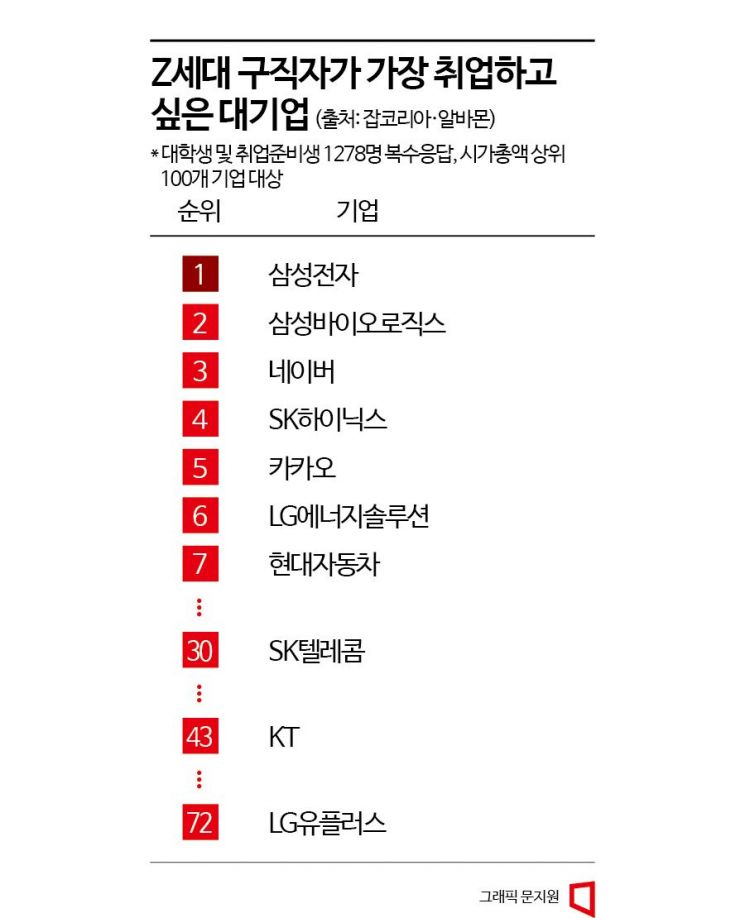
In surveys on companies young people want to work for, the three carriers are drifting away from the hearts of youth. Last month, the employment platforms JobKorea and Albamon conducted a survey on the "top large companies Generation Z wants to work for." They surveyed 1,278 university students and new job seekers preparing for employment at large companies, listing the top 100 companies by market capitalization and allowing multiple selections for the companies they most wanted to work for. Young people focused on expectations of high salaries, welfare systems, working environments, and growth potential when choosing companies.
As a result, Samsung Electronics ranked first with a response rate of 43.9%. Second was Samsung Biologics (29.7%), third Naver (12.4%), fourth SK Hynix (12.3%), and fifth Kakao (10.7%). SK Telecom, KT, and LG Uplus did not make it into the top 20. Among the three, only SK Telecom appeared in the top 30, with a response rate of just over 1%.
Compared to about ten years ago, the difference is clear. In 2010, a survey by the employment portal Incruit of 1,059 students at four-year universities nationwide showed SK Telecom ranked 6th and KT 9th in companies they wanted to work for. Going back to 2003, SK Telecom even ranked as high as 3rd in employment preference (JobKorea survey). It was a time when the information and communications field was highly regarded.
The proportion of young employees within the companies is also decreasing day by day. Last year, SK Telecom's employees in their 20s dropped to the 300s among more than 5,300 total employees. The proportion of employees under 30 at SK Telecom decreased from 8.7% in 2020 to 7.8% in 2021 and 7.4% last year. KT also saw a decrease in employees in their 20s and 30s from 19.2% in 2020 to 18.6% last year among more than 20,000 total employees. During the same period, the proportion of employees aged 40 and above increased from 80.8% to 81.4%.
Regarding this, Professor Shin Min-su of Hanyang University's Business Administration Department analyzed, "From an industrial perspective, the telecommunications industry’s growth has stagnated, and the domestic market is saturated." He added, "There is a lack of awareness about the role of telecommunications companies, and the image of a 'regulated industry' is strong." He continued, "Telecom operators need to instill the perception that they can change so that excellent talents will enter the telecommunications field."
© The Asia Business Daily(www.asiae.co.kr). All rights reserved.



















