Shooting People and Livestock Abroad and Damaging Crops
Ministry of Environment to Designate Invasive Species for Proactive Management
The tropical fire ant (Solenopsis Geminata), which damages crops and has a venomous sting, has been designated as an ecological disturbance species.
On the 24th, the Ministry of Environment announced, "One species of tropical fire ant has been newly designated as an ecological disturbance organism, and 150 species including the Himalayan tahr have been newly designated as species requiring caution upon introduction for management."
Ecological disturbance organisms are those judged to disrupt the balance of the ecosystem or have a high risk of doing so, requiring population control and removal management. Species not yet introduced are designated as species requiring caution upon introduction, while those already introduced are designated as ecological disturbance species.
The tropical fire ant was designated as a species requiring caution upon introduction just one year ago and has now become an ecological disturbance species. As a result, the number of species requiring caution upon introduction increased from 557 to 706, and the number of ecological disturbance species increased from 36 species in one genus (all species of the red-eared slider genus) to 37 species in one genus.
Once designated as an ecological disturbance organism, importation, re-importation, breeding, transfer, acquisition, storage, transportation, and release are prohibited. Violations are punishable by imprisonment of up to two years or a fine of up to 20 million won.
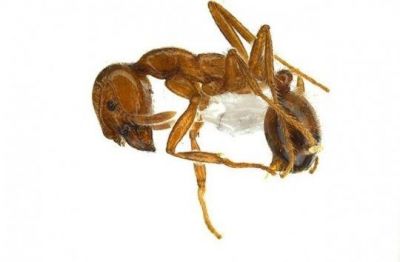 Tropical fire ants designated as ecosystem-disrupting species
 [Image source: Provided by the Ministry of Environment]
The tropical fire ant, introduced from South America, has a reddish-brown body and measures 2 to 5 mm in size. About 100,000 ants form a colony and live in tunnels up to 1.5 meters deep. It has a venomous sting and ecological characteristics similar to the red imported fire ant. It can damage crops by stripping plant bark with its large jaws to drink sap.
In New Zealand, there have been reports of tropical fire ants damaging irrigation canals and electric wires. They also sting humans and livestock with their venomous stings.
Although a colony of tropical fire ants was found in Busan last year, monitoring results did not confirm additional individuals. This year, a queen ant was found in the luggage of a Vietnamese tourist. However, based on expert opinions emphasizing the need for proactive and aggressive management, the Ministry of Environment designated the tropical fire ant as an ecological disturbance organism.
Meanwhile, in addition to the tropical fire ant, the spotted mussel and European green crab were newly listed as species requiring caution upon introduction in this revised notification. Both the spotted mussel and European green crab are included in the International Union for Conservation of Nature (IUCN)'s list of "100 Worst Invasive Alien Species."
Also listed as species requiring caution upon introduction are the spotted snakehead, which closely resembles the native snakehead and has a high likelihood of establishing itself domestically, and the Italian thistle, a temperate plant with strong reproductive ability.
Other species included are those posing health risks, such as the black mamba (black mamba cobra) with strong neurotoxins, the narrow-leaf ragweed that causes allergies, and the South American black-bellied funnel-web spider, which can cause deep vein thrombosis in severe cases of bites.
© The Asia Business Daily(www.asiae.co.kr). All rights reserved.
![Clutching a Stolen Dior Bag, Saying "I Hate Being Poor but Real"... The Grotesque Con of a "Human Knockoff" [Slate]](https://cwcontent.asiae.co.kr/asiaresize/183/2026021902243444107_1771435474.jpg)










