Old residential areas densely packed in Banghak-dong and Ssangmun 1-dong in Dobong-gu, two locations in Euncheon-dong, Gwanak-gu, and Sangdo-dong in Dongjak-gu have been selected as target sites for Seoul City's low-rise residential area redevelopment model, ‘Moatown.’ The area around Dobong-dong 584-2 was not selected.
On the 22nd, Seoul City held the ‘2023 3rd Moatown Target Site Selection Committee’ and announced on the 25th that five out of six applicants (Banghak-dong and Ssangmun-dong in Dobong-gu, two locations in Euncheon-dong, Gwanak-gu, and Sangdo-dong in Dongjak-gu) were selected as target sites. With this, the total number of Moatown target sites in Seoul has increased to 75.
The five newly selected sites are densely populated with old multi-family and multi-household residences, where local residents have long suffered from chronic parking shortages and poor infrastructure. Additionally, many semi-basement houses are distributed in these areas, making residential environment improvement necessary.
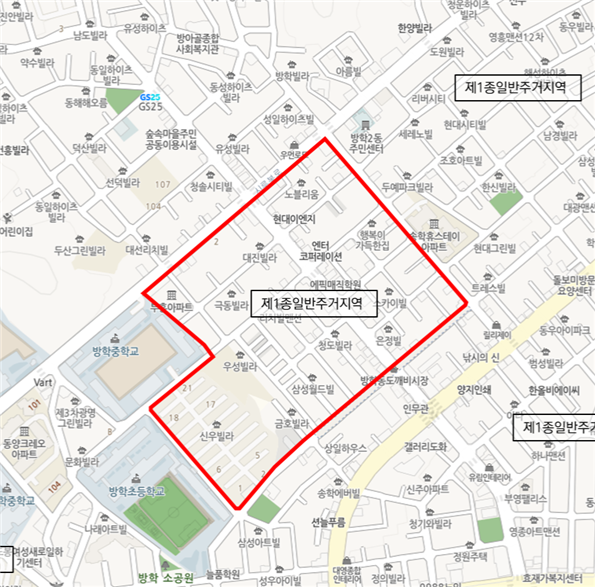
The area around Banghak-dong 618 has an overall aging rate of about 70% and is a typical old low-rise residential area consisting of detached or multi-family houses, struggling with habitual parking difficulties.
The area around Ssangmun 1-dong 460 has a high aging rate of 72%, high household density, a high ratio of semi-basement units, chronic parking shortages, and a height difference of 50 meters, which has limited development in the past.
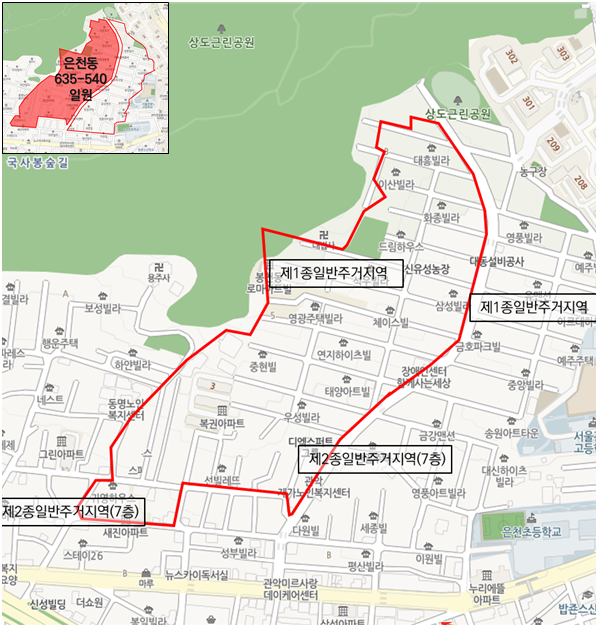
The areas around Euncheon-dong 635-540 and 938-5 each have an aging rate of over 74%, with many detached, multi-household, and multi-family houses. Located on the south side of Guksabong, these areas have a height difference of more than 80 meters, which has made it difficult to improve infrastructure and residential environment.
The area around Sangdo-dong 242 has an aging rate of over 65%, with dense multi-family and multi-household houses, narrow roads, and chronic parking shortages causing inconvenience.
Once selected as Moatown target sites, each autonomous district will establish a ‘Moatown Management Plan,’ conduct public hearings and committee reviews, and proceed through approval and notification as a ‘Small-scale Housing Redevelopment Management Area’ with legal effect as a Moatown, thereby officially launching the Moahousing project.
The city plans to allocate funds for establishing management plans for Moatown designation in the second half of this year (KRW 380 million per site, with 70% supported by city funds and matched by district funds) to the autonomous districts. Once the management plans are established, Moatown designations are expected to be made sequentially from around the second half of next year.
To fundamentally block speculative demand such as share splitting, the city plans to designate and announce the rights assessment reference date as the 27th for the five sites selected by this target site selection committee.
Meanwhile, Seoul City has previously made it clear that areas with resident conflicts or speculation concerns related to Moatown target site selection will be excluded from selection even if they meet the application requirements for the Moatown competition.
A Seoul City official added, "To prevent speculation concerns such as rampant gap investments centered on small villas, from this year, we have strengthened the application requirements for Moatown target site selection and the review criteria of the selection committee to carefully examine resident opposition and speculation concerns."
Furthermore, even in areas selected as Moatown target sites, if there is resident conflict, the project will proceed only in areas desired by the majority of residents through the establishment of management plans.
Moatown differs from redevelopment methods that demolish the entire redevelopment zone and implement the project; it allows partial project implementation only in areas where small-scale redevelopment project consent is obtained (80% of landowners, at least two-thirds of the land area, etc.).
Therefore, even in areas selected as Moatown, during the management plan establishment stage, areas with many opposing landowners can be excluded from the project implementation zone through resident opinion collection.
Han Byung-yong, Director of Seoul City's Housing Policy Office, said, “Moahousing and Moatown are redevelopment methods aimed at systematically revitalizing small-scale redevelopment projects in areas where redevelopment is difficult to expand the supply of quality housing. However, since resident consent is absolutely necessary for project implementation, we will spare no effort to support residents in uniting their intentions and swiftly advancing redevelopment in areas where it is desired.”
© The Asia Business Daily(www.asiae.co.kr). All rights reserved.
![Clutching a Stolen Dior Bag, Saying "I Hate Being Poor but Real"... The Grotesque Con of a "Human Knockoff" [Slate]](https://cwcontent.asiae.co.kr/asiaresize/183/2026021902243444107_1771435474.jpg)












