In Sleep Mode Since the 3rd... No Response to Communication
"Battery May Have Been Damaged by Extreme Cold"
India's lunar lander and exploration rover, which became the first in the world to land on the Moon's south pole, have fallen into eternal sleep. They ultimately could not withstand the harsh cold that comes with the lunar night.
On the 23rd (local time), India Today and others reported that the Indian Space Research Organisation (ISRO) attempted to communicate with the lunar lander Vikram and the exploration rover Pragyan the previous day but received no response.
India's lunar probe Chandrayaan-3's lander Vikram successfully landed on the Moon's south pole on the 23rd of last month. Subsequently, the six-wheeled exploration rover Pragyan, which was onboard Vikram, descended and began exploration.
Pragyan traveled about 100 meters over 13 days and confirmed the presence of sulfur on the south pole's surface, while Vikram sent various scientific data back to Earth, including measurements of the lunar south pole surface soil temperature. Vikram also succeeded in an experiment where it jumped about 40 cm to settle.
During this time, the lunar night arrived, and after 13 days of activity, Vikram and Pragyan entered sleep mode on the 3rd, positioning their solar panels toward the sunrise direction.
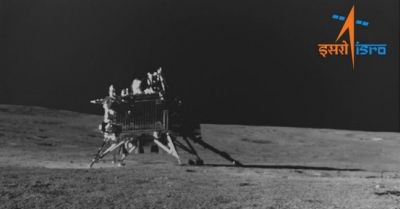 The world's first lunar south pole lander 'Vikram' [Image source: Indian Space Research Organisation (ISRO)]
ISRO stated, "We hope they wake up successfully," adding, "If not, they will remain there forever as India's lunar ambassadors."
However, even after the sun rose over the lunar south pole on the 22nd, they did not wake up. The British BBC analyzed that "there is a possibility that their batteries were damaged due to extreme cold."
On the 10th, the U.S. Space.com reported, "Whether Vikram and Pragyan can be reactivated after the approximately 14-day lunar night depends on luck."
The Moon's day and night cycle changes every 14 days, and during the night, temperatures drop below minus 100 degrees Celsius. For this reason, it had already been predicted multiple times that Vikram and Pragyan, which rely on solar power, would not survive the lunar night. This is because they did not include more durable components or additional insulation devices.
ISRO has not publicly explained why they did not prepare Vikram and Pragyan for this. However, experts speculate that the exploration period on the Moon was expected to be short, and reducing the lander's weight was intended to enable a more stable landing.
ISRO announced via social media that "they plan to attempt communication with Vikram and Pragyan for several more days," but also stated, "The possibility of them resuming exploration is very slim."
© The Asia Business Daily(www.asiae.co.kr). All rights reserved.
![Clutching a Stolen Dior Bag, Saying "I Hate Being Poor but Real"... The Grotesque Con of a "Human Knockoff" [Slate]](https://cwcontent.asiae.co.kr/asiaresize/183/2026021902243444107_1771435474.jpg)
















