Radiation Testing for Seafood Including Fish for Jesuyong Use
Gyeongsangnam-do conducted food hygiene inspections on food manufacturing and sales businesses in the province ahead of Chuseok and caught 8 violations.
Gyeongnam Province announced that from the 4th to the 8th, it inspected 451 food manufacturing and sales businesses in the province to provide safe food to residents.
According to Gyeongnam Province, the violations included ▲2 cases of labeling standard violations ▲1 case of failure to conduct self-quality inspection ▲2 cases of unsanitary management of manufacturing and processing facilities violating hygienic handling standards ▲and 3 other cases.
The province also undertook food safety verification along with hygiene inspections.
They collected 66 seasonal food items for safety testing, including ▲37 processed foods such as rice cakes, Hangwa (traditional Korean sweets), honey, and tofu ▲19 cooked foods such as jeon (Korean pancakes) and fried dishes ▲and 10 seafood items such as yellow corvina and pollock.
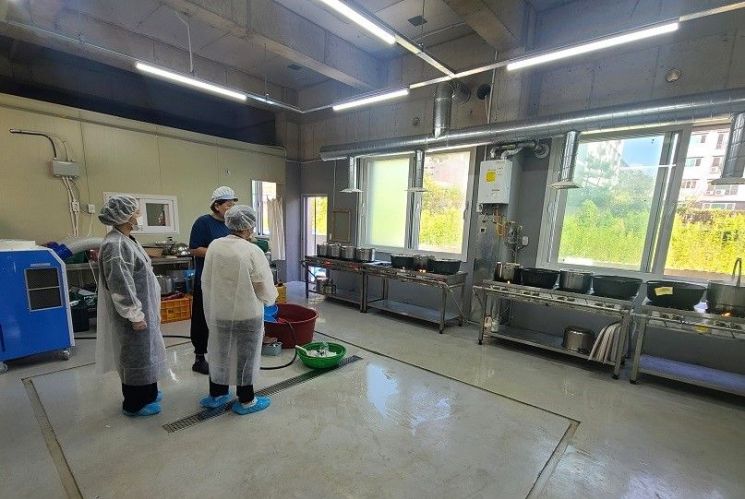 Gyeongnam Province is conducting hygiene inspections of manufacturers and sellers of holiday seasonal foods in preparation for Chuseok.
 [Photo by Gyeongnam Provincial Government]
The Provincial Health and Environment Research Institute tested the collected foods for heavy metals, food poisoning bacteria, preservatives, etc., and judged 49 cases as suitable, with 15 cases still under examination.
Among the collected foods, one case each of pollock jeon and perilla leaf jeon tested positive for Staphylococcus aureus, a food poisoning bacterium, and were immediately recalled and discarded to preempt distribution within the province.
To alleviate residents’ concerns over the marine discharge of contaminated water from the Fukushima nuclear power plant in Japan, the province also completed radiation tests on 53 seafood items used for Chuseok ancestral rites, confirming their safety and suitability for consumption.
No Hyeyeong, Director of the Food and Drug Division, said, “In this Chuseok inspection, over 97% of foods commonly consumed during the holiday were found to have no safety issues. We will continue to prevent food accidents through more thorough hygiene management so that residents can consume ancestral rite foods and others with peace of mind.”
© The Asia Business Daily(www.asiae.co.kr). All rights reserved.

















