Serious Trial Delays... Inside and Outside Courts "Good Trials Lead to Case Backlogs"
Abolition of High Court Chief Judge Promotion System Removes 'Work Motivation'... Law Firm Resignations Continue
Chief Justice Kim Myung-soo stated on the 22nd, "We must reach a just conclusion through thorough deliberation." This is interpreted as a reiteration of the need to allow sufficient time for rulings in pursuit of the ‘good trial’ that Chief Justice Kim has advocated since the beginning of his term, rather than prioritizing speedy trials. Chief Justice Kim will retire on the 24th after completing his six-year term.
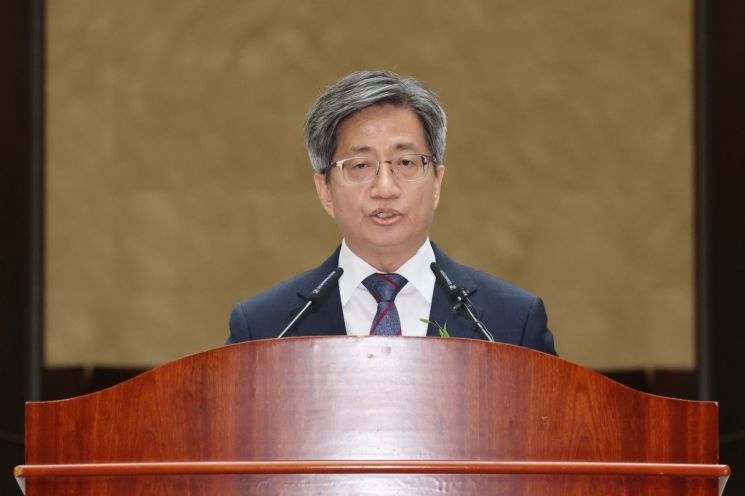 Chief Justice Kim Myung-soo is speaking at the retirement ceremony held at the Supreme Court in Seocho-gu, Seoul, on the morning of the 22nd.
 [Image source=Yonhap News]
At his retirement ceremony held at the Supreme Court in Seocho-gu, Seoul, Chief Justice Kim said, "The path for the judiciary to restore lost trust and fulfill the responsibilities entrusted by the people lies solely in realizing the ‘good trial’ for the people, which is the essential value of justice. With firm belief and urgent sense of mission, I began my journey as Chief Justice to find a new path for the judiciary." He added, "Throughout my tenure, I emphasized that the judiciary must abandon the past vertical and bureaucratic decision-making structure and transition to a transparent and democratic horizontal structure."
He continued, "My belief in the ‘good trial’ has never wavered even for a moment until now, as I retire. The ‘good trial’ is only complete when the people feel and acknowledge it. If the people suffer from delayed justice in trials, the values we have pursued will lose their significance," he stated.
Chief Justice Kim also emphasized judicial independence. He explained, "The independence of judges is like the lifeblood of the judiciary. I have repeatedly stressed that all judicial activities must center on ‘trials’ and that judicial administration should faithfully support ‘trials’ alone. This was also a firm expression of the will to ensure that the mistakes made by judicial administration in the past are never repeated in our judicial history."
He added, "As a result, the phenomenon of judicial administration’s dominance over trials has disappeared throughout the judiciary, and the internal independence of judges has been further strengthened. Independent judges of the judiciary must lead with firm will and indomitable courage to protect their trials and the independence of the judiciary," he said.
Inside and outside the courts, since the launch of the ‘Kim Myung-soo Court,’ issues such as trial delays and judicial trust have become more serious, but there are also positive evaluations that the authority of judicial administration has been decentralized by downsizing the Court Administration Office.
Since his inauguration, Chief Justice Kim has consistently emphasized the ‘good trial.’ However, the result of the good trial has led to a backlog of cases. In particular, the processing time for civil lawsuits has been continuously increasing over the past five years. Civil lawsuits mostly involve disputes closely related to daily life, such as monetary conflicts or ownership disputes.
According to the Supreme Court Judicial Yearbook, it took an average of 14 months for first-instance judgments in civil panel cases nationwide. Civil single-judge cases took an average of 5.5 months. For the second instance, last year, the High Courts took 11.1 months on average, District Courts (Appellate Divisions) took 10.8 months, and the third instance took an average of 11.7 months last year. Based on cases concluded last year, it took an average of 1,095 days from filing a lawsuit in court to receiving a Supreme Court final judgment. This is a significant increase compared to 977 days in 2021.
Analyses suggest that a representative reason for the continued slowdown in trials under Chief Justice Kim’s administration is his personnel policies. It is argued that the internal momentum of the courts greatly declined as Chief Justice Kim abolished the position of High Court Chief Judge and introduced a court president candidate recommendation system. Before his tenure, there was an expectation that judges could be promoted from judge → District Court Chief Judge → High Court Chief Judge → Court President, but with the change in the personnel system, the concept of promotion itself disappeared.
With the abolition of the High Court Chief Judge system, judicial training institute class 25 judges, who were on the threshold of promotion to High Court Chief Judge, have been working as chief judges at frontline district courts, while prosecutors from class 25 are serving as heads of high prosecutors’ offices. This has led to decreased motivation among court members and even mass resignations to large law firms.
At a press conference, Chief Justice Kim addressed trial delays, saying, "I understand that the difficulties in trial delays are due to a mixture of various complex factors. Ultimately, increasing the number of judges will help practically alleviate trial delays."
Additionally, Chief Justice Kim became embroiled in controversy after it was revealed that he rejected a resignation request during a meeting with former Busan High Court Chief Judge Lim Seong-geun, mentioning the possibility of impeachment by the National Assembly. Chief Justice Kim completely denied this, but former Chief Judge Lim released a recording of the conversation, and the People Power Party filed a complaint against Chief Justice Kim in February 2021 for abuse of power, falsification, and use of false official documents. The prosecution is currently investigating.
Considering his status as the sitting Chief Justice, the prosecution has refrained from conducting a full-scale investigation into Chief Justice Kim, but it is expected that the investigation will accelerate after his retirement.
On the other hand, there is also an evaluation that Chief Justice Kim reduced the number of judges working in the Court Administration Office, thereby decentralizing the authority of judicial administration. However, there are criticisms that the non-judge staffing of the Court Administration Office has reduced the efficiency of its operations.
© The Asia Business Daily(www.asiae.co.kr). All rights reserved.
![User Who Sold Erroneously Deposited Bitcoins to Repay Debt and Fund Entertainment... What Did the Supreme Court Decide in 2021? [Legal Issue Check]](https://cwcontent.asiae.co.kr/asiaresize/183/2026020910431234020_1770601391.png)
















