"Hangang, Relatively Safe Due to Low Traffic"
"Countermeasures Against Riververse Also Needed"
As a Han River cruise ship collided with a bridge due to strong winds, interest in the safety of Han River cruises is increasing. Experts generally assess that water navigation on the Han River is relatively safe. However, regarding the currently promoted River Bus, they advise considering the boarding of safety management personnel, given that it carries many passengers.
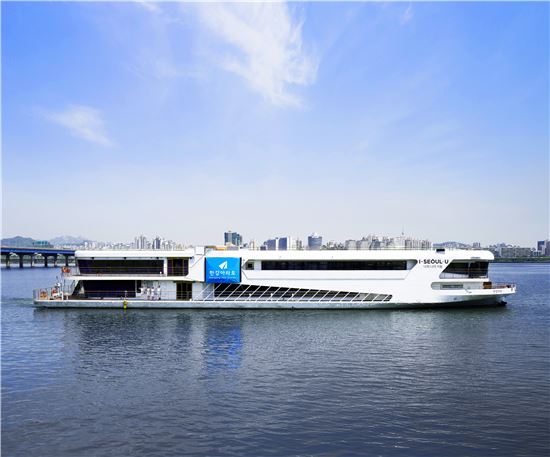 Hangang Araho.
According to the fire authorities on the 22nd, on the 20th, the 'Araho' operated by Bitgang collided with a pier of the Mapo Bridge, resulting in a total of 16 injuries. All of them were able to move, but four were transported to a nearby hospital. The fire authorities estimate that the 'Araho' accident was caused by strong winds and are investigating the detailed cause.
The vessel carrying the most passengers on the Han River currently is the cruise ship. There are currently two places in Seoul and two in Gimpo operating cruise ships on the Han River. Among them, the Han River cruises managed by Seoul City are regularly operated by eCruise, and the 'Araho' involved in the accident is operated irregularly. Although there have been various accidents involving Han River cruises, there have been no casualties. In 2016, a cruise ship operating on the frozen Han River was breached and sank, but all 11 passengers and crew, including five foreign tourists, were rescued. In the same year, a long-abandoned cruise ship also sank, and in 2018, a cruise ship drifted due to strong winds, but there were no casualties in all cases.
The heightened awareness of cruise ship safety stems from the 2019 Danube River disaster in Hungary, which caused significant casualties. A total of 27 people, including 25 Koreans, died in this accident. Experts explain that compared to the Danube River accident, the Han River is relatively wide and has less vessel traffic, making water navigation safer. Professor Park Young-soo of the Department of Navigation Convergence at Korea Maritime University said, "Han River cruises are not fast, and the bridge piers have buffers, so major accidents have not occurred," adding, "The most dangerous thing in ship accidents is collisions between vessels."
In fact, the Danube River accident was attributed to the proliferation of large cruises due to the popularity of night views, with about 70 vessels operating simultaneously in a river width one-third that of the Han River. eCruise, the only company regularly operating cruises on the Han River, currently operates one vessel over 100 tons eight times a day. Therefore, excluding small yachts and leisure boats, there is no more than one vessel continuously afloat on the Han River.
The safety-related situation is also better on the Han River. Wearing life jackets is not legally mandatory for cruise passengers. However, according to the 'Passenger Ship and Ferry Business Act (Cruise Ship Act),' cruise ships must provide life jackets exceeding 120% of the passenger capacity. Safety management is handled by Seoul City. For Han River cruises, the Future Han River Headquarters conducts safety inspections once a month and performs water rescue training. Additionally, weekly spot inspections and biannual inspections by the Ministry of the Interior and Safety are conducted. Passenger ship operations are completely suspended when the discharge rate from Paldang Dam upstream of the Han River exceeds 3,000 tons per second or when visibility is less than 1 km due to fog or heavy rain. A Future Han River Headquarters official said, "It takes more than six hours for water discharged from Paldang Dam to reach the cruise operation area," adding, "There is sufficient time for evacuation."
The River Bus, which Seoul City aims to launch in September next year, is expected to receive similar levels of management. The Future Han River Headquarters and eCruise, selected as the operator, are considering operating between six and ten River Buses. They plan to operate at 15-minute intervals during commuting hours, and considering the River Bus's approximately 30-minute operation time, there will be no more than four vessels afloat on the Han River at any time. A Future Han River Headquarters official said, "The River Bus will also prioritize safety and work with the operator to prepare various measures."
However, experts point out that since the River Bus operates at a higher speed than cruise ships, measures to address this aspect need to be strengthened. The River Bus has a maximum speed of 50 km/h and a typical operating speed of 37 km/h (20 knots). In contrast, Han River cruises operate at about 18.5 km/h (10 knots). Professor Park said, "As the size and speed of vessels increase, the damage from accidents becomes greater," adding, "Considering that it is used for commuting, if there is no significant cost issue, it is worth considering boarding one safety management personnel per vessel."
© The Asia Business Daily(www.asiae.co.kr). All rights reserved.
















