175 Votes in Favor, 116 Against
President Yoon Likely to Exercise Veto Power
For the first time in constitutional history, a motion to dismiss the Prime Minister was passed in the National Assembly.
On the afternoon of the 21st, the National Assembly held a plenary session and passed the 'Motion to Dismiss Prime Minister Han Deok-su' by a secret ballot, with 175 votes in favor, 116 against, and 4 invalid votes out of 295 members present.
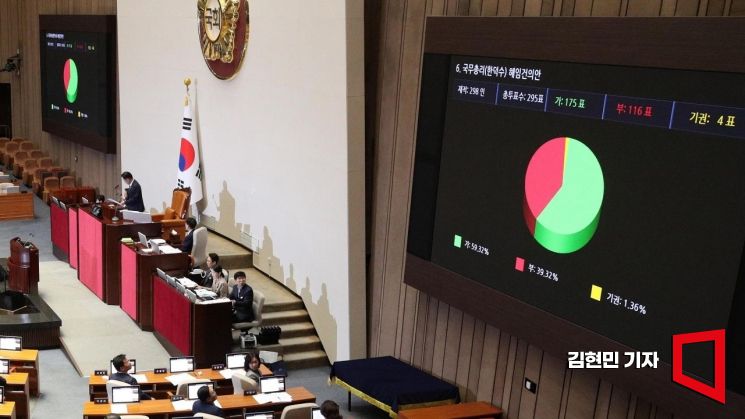 On the 21st, at the 8th plenary session of the 410th National Assembly (regular session) held in the main chamber of the National Assembly, the motion to dismiss Prime Minister Han Deok-su was passed with 175 votes in favor, 116 against, and 4 abstentions out of a total of 295 votes. Photo by Kim Hyun-min kimhyun81@
Before the vote, the ruling party urged rejection of the motion, claiming it was a countermeasure against the arrest warrant request for Representative Lee Jae-myung. Lee Yang-su, the senior deputy floor leader of the People Power Party, said, "If the cabinet resigns en masse, government operations will be paralyzed," adding, "Ordinary and reasonable citizens find this unacceptable."
Lee emphasized, "On the day the prosecution requested an arrest warrant for Representative Lee Jae-myung (the 18th), the motion to dismiss the Prime Minister was submitted, clearly showing it as a countermeasure against the arrest warrant request." He continued, "The public does not sympathize with the serious violations of the constitution and laws regarding this dismissal of the Prime Minister and the impeachment of prosecutors," adding, "If passed, it will be recorded as an indelible shameful chapter in our constitutional history."
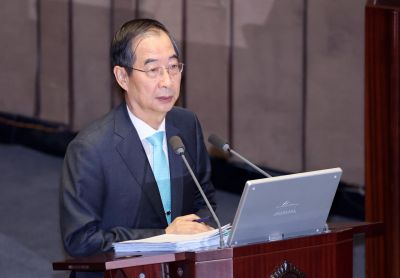 Prime Minister Han Duck-soo is responding to a lawmaker's question during the Education, Social, and Cultural Questions to the Government session held at the National Assembly plenary hall on the 8th. Photo by Kim Hyun-min kimhyun81@
On the other hand, the opposition argued that the Prime Minister should be held accountable for incidents such as the October 29 Itaewon tragedy, the Jamboree fiasco, the tacit approval of Fukushima nuclear wastewater discharge, and the death of a Marine sergeant. Song Ki-heon, the senior deputy floor leader of the Democratic Party, stated, "According to Article 86, Paragraph 2 of the Constitution, the Prime Minister assists the President and oversees administrative affairs under the President's orders," and argued, "Irresponsible cabinet management has brought crises to people's livelihoods, democracy, and peace on the Korean Peninsula."
Song pointed out, "Despite this, instead of reflecting, they hastily blamed the previous administration, the opposition, and the public," adding, "A cabinet that has forgotten balance, communication, fairness, and common sense has degenerated into a total ruinous cabinet." He also said, "The Prime Minister, who, at the President's command to fight, engaged in political strife against the people's representative body, consistently showed a high-handed attitude and sarcasm, mocking and despising the National Assembly and the public, has clearly crossed the line," and added, "The Prime Minister leading the violation of the separation of powers is a serious challenge to democracy that can no longer be tolerated."
The motion to dismiss has no legal binding force. Even if it passes the National Assembly, it will be discarded if the President exercises the veto power. Previously, the National Assembly passed motions to dismiss Foreign Minister Park Jin and Minister of the Interior and Safety Lee Sang-min, but President Yoon Seok-youl vetoed both.
© The Asia Business Daily(www.asiae.co.kr). All rights reserved.
![Clutching a Stolen Dior Bag, Saying "I Hate Being Poor but Real"... The Grotesque Con of a "Human Knockoff" [Slate]](https://cwcontent.asiae.co.kr/asiaresize/183/2026021902243444107_1771435474.jpg)

















