The Dong Seoul Terminal in Gwangjin-gu, Seoul, which was completed 36 years ago, will be reborn as a complex building integrating transportation, culture, and commercial functions. The Seoul Metropolitan Government plans to fully launch Mayor Oh Se-hoon's "Seoul Grand Renovation" project, which significantly strengthens public spaces for citizens, starting with the Dong Seoul Terminal.
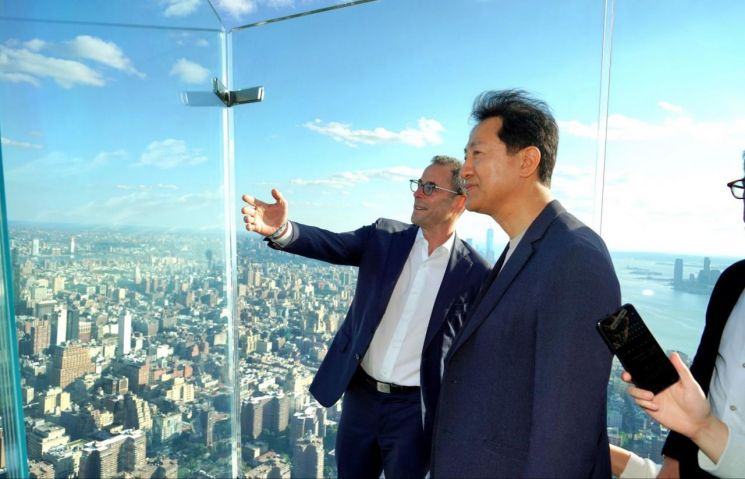 Seoul Mayor Oh Se-hoon, visiting New York, USA, climbed the outdoor observatory "Edge" at Hudson Yards, a waterfront-centered mixed-use development complex, on the 19th (local time) and received an explanation from Jeff Blau, CEO of Related Companies.
 [Image source=Yonhap News]
During his business trip to North America, Seoul Mayor Oh Se-hoon visited Hudson Yards, a waterfront-centered urban complex development area along the Hudson River, on the 19th (local time) and announced the plan for the "Dong Seoul Terminal Modernization" project.
Hudson Yards is a project redeveloping approximately 110,000㎡ of old railroad stations, parking lots, and vacant lots on the west side of Midtown Manhattan along the Hudson River since 2005. It is regarded as a representative example of urban rebirth in New York City. Notably, while maintaining the existing railroad functions on the MTA railroad site, it introduced complex cultural facilities such as "The Shed" and the 100-story outdoor observatory "Edge," becoming a landmark visited year-round by tourists seeking unique architecture and spaces. Mayor Oh also toured "Little Island," a 10,000㎡ artificial island and waterside park designed by world-renowned architect Thomas Heatherwick.
Mayor Oh said, "Here (Hudson Yards), the underground is a railroad maintenance yard, but it became famous for continuously operating trains while building a city in the air above it." He added, "We can benchmark this for utilizing our railroad maintenance yard, and if we create many public spaces like this and provide them to citizens, it will be very meaningful." He continued, "The Dong Seoul Terminal has three underground floors for the bus terminal, with buses continuously coming and going, and above that, commercial facilities like Starfield and offices such as the Emart headquarters will be built, with public spaces on the rooftop offering views of the Han River." He added, "This concept can also be applied to the Yongsan development."
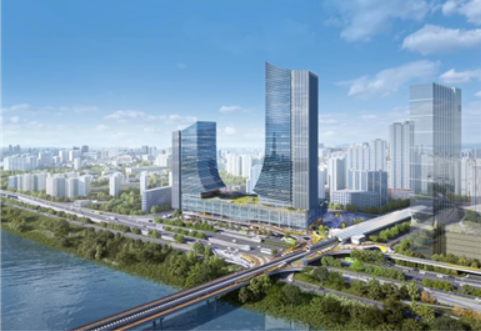
Based on examples of high-density complex development in aging urban areas, Seoul will embark on the "100-Year Seoul Space Grand Renovation" flagship project targeting the Dong Seoul Terminal.
The Dong Seoul Terminal modernization project will organically arrange ▲an underground terminal and transfer center ▲waterfront rest and viewing spaces on the ground level ▲and commercial and office facilities in the air, creating a complex development facility that citizens can visit and enjoy year-round, even if they do not use the terminal.
The Dong Seoul Terminal is planned to be designed with an architectural facade that maximizes the historical significance and symbolism of the Han River by shaping it like a sailboat that once traveled to Gwangnaru Port. Observation-specialized spaces where visitors can enjoy views of the Han River and Seoul will be provided throughout the mid-level floors, including the 40th-floor observatory at the top of the tower. The top-floor observatory will offer a 360-degree panoramic view similar to the "Summit" by One Vanderbilt, allowing visitors to see the Han River and Gangnam downtown to the south, and Namsan Tower and Bukhansan Mountain to the north. Additionally, aerial gardens and waterfront viewing decks will be installed to enable viewing from various angles and locations.
Seoul plans to finalize the preliminary negotiation plan, including specific public contribution plans, with the private developer Shinsegae Dong Seoul PFV (including Shinsegae Property) within this month. In the first half of next year, the district unit plan will be decided, and after obtaining building permits by the end of 2024, construction is scheduled to begin in 2025.
The city is currently in the final stages of preliminary negotiations with the developer regarding ▲a revolutionary traffic system improvement through the creation of three-dimensional bus access roads ▲improvements to the transportation system through a review of the metropolitan transportation transfer system ▲three-dimensional connections between the terminal and the Han River ▲and the establishment of public contribution facilities for the convenience of local residents.
Based on the "preliminary negotiation" system, incentives such as floor area ratio increases are being utilized to create a "pedestrian deck" connecting the Han River, Gangbyeon Station, and the terminal, which had been blocked by Gangbyeonbuk-ro. The project also secured public contributions centered on local residents, including the restructuring of Guui Park and the enhancement of flood control performance at Guui Retention Basin.
The city plans to apply the metropolitan transportation-centered complex development concept, similar to that of the Dong Seoul Terminal, to the "Changdong Station Complex Transfer Center Project," led by SH Corporation. In the future, this development strategy will be expanded to commercial, cultural, and residential facilities, aiming to radically reorganize Seoul's urban space with a vision for the next 100 years.
© The Asia Business Daily(www.asiae.co.kr). All rights reserved.


















