Majority Opinion: "Cannot Be Used as a Comparison Group Identical to Public Officials"
Opposing Opinion: "Should Be Judged Based on Whether They Are Workers Engaged in Similar Tasks"
The Supreme Court has ruled that not providing various allowances paid to public officials to indefinite-term contract national road managers does not constitute "discriminatory treatment" prohibited by the Labor Standards Act.
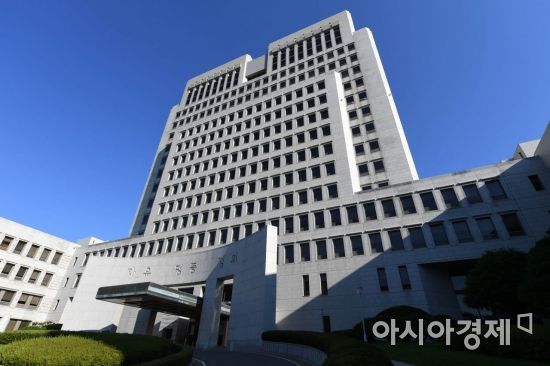
The Supreme Court en banc (Presiding Justice Noh Jeong-hee) on the 21st upheld the lower court's ruling in a wage case appeal filed by national road managers who claimed they were not paid regular attendance allowances and performance bonuses, unlike driving and overweight vehicle enforcement public officials.
'National road managers' are public service workers, not public officials, who enter into indefinite-term employment contracts with heads of local land management offices under the Ministry of Land, Infrastructure and Transport and perform road maintenance and repair work or enforce overweight vehicle regulations.
The government did not pay allowances and travel expenses to national road managers, unlike driving and overweight vehicle enforcement public officials under the Ministry of Land, Infrastructure and Transport, who receive regular attendance allowances, performance bonuses, family allowances, rank supplements, and travel expenses. The national road managers filed a lawsuit arguing that despite performing the same or similar duties as the driving and overweight vehicle enforcement public officials, not receiving the allowances paid to public officials violated the constitutional principle of equality and Article 6 of the Labor Standards Act. Article 6 of the Labor Standards Act stipulates that employers shall not discriminate against workers based on gender, nationality, religion, or social status in terms of working conditions.
The first and second instance courts held that the status of national road managers as indefinite-term contract workers corresponds to the social status specified in the Labor Standards Act. However, they judged that national road managers and driving and overweight vehicle enforcement public officials do not belong to essentially the same comparison group, and there are reasonable grounds for treating public officials and national road managers differently.
The en banc court stated, "The employment status as indefinite-term contract workers does not correspond to the social status defined in Article 6 of the Labor Standards Act in relation to public officials, and public officials cannot be regarded as essentially the same comparison group. Without further judgment on whether there is a reasonable ground for the unfavorable treatment, it cannot be considered that the defendant discriminated against the plaintiffs; therefore, the lower court's conclusion is justified."
Justice Kwon Young-jun issued a separate opinion, stating, "The status of national road managers as indefinite-term contract workers corresponds to the social status under Article 6 of the Labor Standards Act, and public officials performing the same or similar types of work as the plaintiffs can be used as a comparison group to determine discriminatory treatment." However, he concluded, "There is a reasonable basis for not paying the allowances to the plaintiffs, so the defendant is not liable for damages due to unlawful acts."
On the other hand, Justices Min Yoo-sook, Kim Seon-su, Noh Jeong-hee, Lee Heung-gu, and Oh Kyung-mi dissented, stating, "The comparison group of workers should be judged based on whether they perform the same or similar types of work, so public officials can be the comparison group, and the employment status of the plaintiffs as indefinite-term contract workers corresponds to social status. There is no reasonable ground for the defendant not paying family allowances and performance bonuses to the plaintiffs, so the defendant is liable to compensate for damages equivalent to those allowances."
© The Asia Business Daily(www.asiae.co.kr). All rights reserved.

















